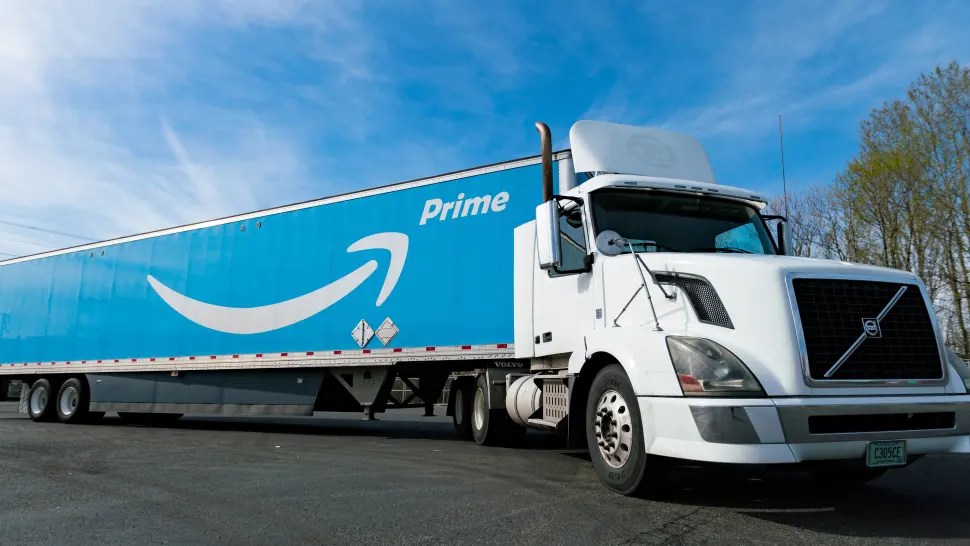
Amazon reported record operating profitability in the third quarter on Thursday after the market closed, as the e-commerce giant continued expanding its delivery network and robotics investments amid higher transportation costs.
CEO Andy Jassy said investments in same-day fulfillment facilities and ultra-fast delivery services are helping the company attract more customers while lowering fulfillment expenditures.
“We’re on track to reduce cost to serve per unit for the fourth consecutive year,” Jassy said during a call with analysts.
The Seattle-based company reported third-quarter revenue of $201.9 billion, up 12% from $180.2 billion a year earlier. Operating income surged 61% to $28.1 billion, compared with $17.4 billion in the same period last year.
Revenue in the quarter came in below Wall Street estimates of $202.3 billion, while earnings per share came in at $1.89, lower than the expectation of $1.96.
Amazon’s (Nasdaq: AMZN) operating margin reached 13.9%, its highest ever, as improvements across its retail and cloud computing businesses helped offset higher expenses.
“In our fulfillment network, the team navigated higher transportation costs from fuel inflation and higher line haul rates,” Chief Financial Officer Brian Olsavsky said.
Despite those pressures, Amazon lowered its overall cost to serve during the quarter through better inventory placement, shorter shipping distances and package consolidation, he said.
Shipping costs increased 11% year over year, compared with 12% growth in units shipped. Excluding fuel and linehaul inflation, shipping costs rose 8%, approximately 4 percentage points slower than unit growth.
Amazon’s North America segment, which includes its U.S. and Canadian retail operations, generated $112.9 billion in third-quarter revenue, up 6% year over year.
Operating income in the segment jumped to $8.7 billion from $4.8 billion a year earlier, an increase of approximately 81%.
North America’s operating margin reached 7.7%.
International revenue increased 5% to $43.1 billion, while operating income climbed to $1.6 billion from $1.2 billion.
Amazon said the timing of Prime Day affected year-over-year comparisons because the shopping event occurred in the second quarter of 2026 for most major markets, compared with the third quarter in 2025.
Excluding that timing change, Amazon estimated third-quarter revenue growth would have been approximately 4 percentage points higher.
Amazon said it achieved its fastest third-quarter delivery speeds ever for Prime members, delivering more than 1.5 billion items on the same day or overnight during the three-month period ending Sept. 30.
Automation remains a major component of Amazon’s strategy to lower fulfillment expenses and increase productivity.
Jassy told analysts the company now operates more than 1 million robots across its fulfillment network.
He said robotics has contributed to improved productivity, reduced operating costs and record-low safety incident levels across its fulfillment operations.
Amazon doubled its fleet of robotic arms, including Cardinal and Sparrow systems, during 2026, according to Olsavsky.
The company is also developing robotics foundation models designed to help machines perform increasingly complex physical tasks.
During the question-and-answer portion of Thursday’s earnings call, Jassy said that transportation cost pressures are expected to continue into the fourth quarter.
Responding to an analyst’s question about fuel and linehaul inflation, Jassy said the impact would be somewhat higher in the fourth quarter than in the third.
Amazon implemented a fuel surcharge earlier this year for sellers using its Fulfillment by Amazon service, allowing the company to recover some of its higher fuel expenses.
However, Jassy said the surcharge does not fully offset the increases, leaving Amazon exposed to higher costs for inbound retail shipments and outbound deliveries.
Amazon expects fourth-quarter net sales between $240 billion and $247 billion, representing year-over-year growth of 12% to 16%.
The company forecast fourth-quarter operating income between $28.5 billion and $33.5 billion, compared with $25 billion in the year-earlier period.
Amazon Q3 2026: Key financial and operating metrics
The table below is suitable for inserting after the article’s opening financial results section.
| Metric | Q3 2025 | Q3 2026 | YoY change |
| Total revenue | $180.17B | $201.94B | +12.1% |
| Operating income | $17.42B | $28.08B | +61.2% |
| Operating margin | 9.7% | 13.9% | +4.2 pts |
| Net income | $21.19B | $20.69B | -2.4% |
| Diluted EPS | $1.95 | $1.89 | -3.1% |
| North America revenue | $106.27B | $112.85B | +6.2% |
| North America operating income | $4.79B | $8.72B | +82.1% |
| International revenue | $40.90B | $43.11B | +5.4% |
| AWS revenue | $33.01B | $45.98B | +39.3% |
| Worldwide shipping costs | $25.38B | $28.30B | +11.5% |
| Fulfillment expenses | $27.68B | $30.00B | +8.4% |
| Third-party seller services revenue | $42.49B | $46.49B | +9.4% |
| Online store revenue | $67.41B | $68.47B | +1.6% |
| Worldwide paid-unit growth | 11% | 12% | +1 pt |
Why it matters: Amazon’s ability to lower per-unit delivery costs despite higher fuel and linehaul expenses illustrates how automation, inventory placement and transportation network optimization could reshape the economics of e-commerce fulfillment and parcel delivery.