




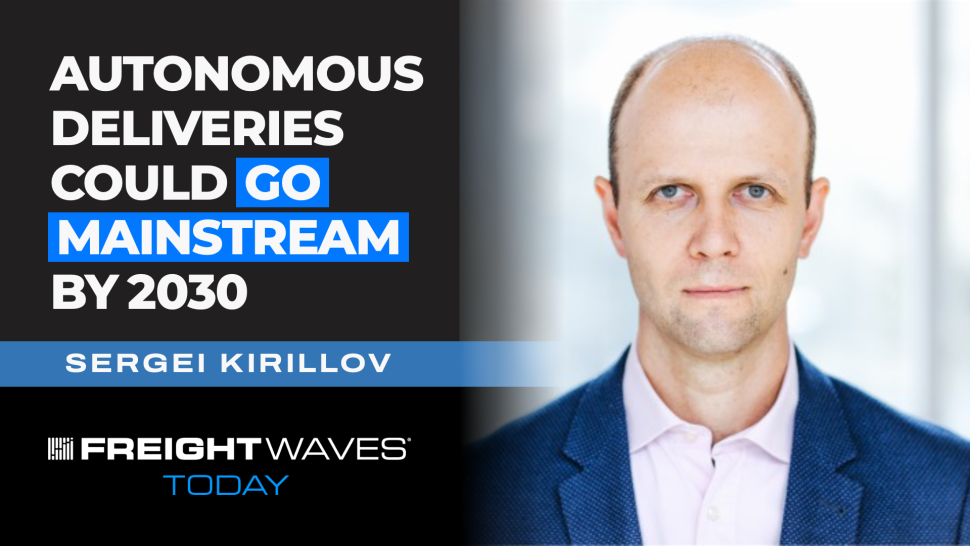
Autonomous delivery robots are already operating at scale — and Avride says it has 60+ driverless Uber vehicles and several hundred delivery bots running today. Sergei Kirillov, chief commercial officer at Avride, breaks down where the company is live, how its sidewalk robots differ from road vehicles, and why college campuses and dense urban deliveries are proving grounds for autonomy. He also gets into public reaction, vandalism concerns and the real logistics use cases behind the tech. #AutonomousDelivery #DeliveryRobots #FreightTech
Avride has surpassed 1,000 autonomous vehicles in active deployment — counting both its suitcase-sized delivery robots and its passenger car fleet — positioning the company among the largest operational autonomous vehicle fleets in the United States, the company’s Chief Commercial Officer said in a recent interview. The milestone matters to logistics operators and last-mile delivery platforms because it represents real-world scale, not just pilot programs.
The company currently runs roughly 150 to 200 vehicles in the Austin area focused on R&D, and more than 60 autonomous passenger cars on the Uber platform in Dallas making daily rides with passengers, the CCO said. On the delivery side, Avride has deployed several hundred small autonomous rovers — described as suitcase-sized robots — operating on the Uber Eats and Grubhub platforms across Jersey City, Philadelphia, Austin, Dallas, and Miami, as well as on more than 25 college campuses.
“Together, robots and cars, we’re way over 1,000 already,” the CCO said. “So that actually sets us to the top of the range in these AV company ratings. And this is a very important experience that we’re getting. Very few other companies have actually reached that level of intelligence and knowledge about the space.”
“I actually think that in the larger cities by 2030, the majority of deliveries done in downtown or dense areas will be already done by different types of automated delivery devices or cars. I think it’s totally possible. I think 2028, 2029 will be the years of the massive scaling of this technology to every sphere of our life.”
Avride’s core technology strategy centers on building a single underlying autonomous driver system that can be adapted across chassis types — from sidewalk robots to passenger cars — rather than engineering purpose-built vehicles for each use case. The CCO noted that the robot compartment was specifically designed to fit a standard 16-inch pizza box with insulation and space for beverages, while the animated face on the exterior was a deliberate design choice that produced a “dramatic decrease of vandalism” by encouraging users to associate the device with a living creature.
On the passenger vehicle side, all rides remain supervised, meaning a human safety operator is present or monitoring remotely. The CCO said transitioning to a fully unsupervised mode requires further development of the core technology as well as broader infrastructure updates, including autonomous-capable car platforms from manufacturers, expanded charging capacity, and depot availability. The company also flagged that merchant-side infrastructure for autonomous delivery — such as loading and unloading protocols — remains underdeveloped and limits the addressable market.
Looking ahead, Avride plans to expand autonomous car operations into at least three additional markets by 2028. The CCO said delivery via autonomous passenger vehicles is a near-term priority, noting that items fitting in a car trunk could be delivered “pretty soon,” while larger-load delivery depends on the availability of purpose-built automotive platforms. The company views its combined robot and car operational data as a compounding advantage over competitors who have deployed at smaller scale.
- Avride has more than 1,000 autonomous robots and cars deployed across U.S. cities and college campuses, operating on Uber and Grubhub platforms.
- The company plans to scale autonomous vehicle operations into at least three new markets by 2028, with the CCO projecting autonomous delivery will dominate dense urban areas by 2030.
- An animated face on delivery robots produced a dramatic decrease in vandalism, while all passenger car rides remain supervised pending further infrastructure and technology development.
This Summary is generated thanks to a transcription of the interview, for the full interview please enjoy the video above.
Brokerage Compliance Symposium
The day before F3. Every compliance issue you face - fraud exposure, carrier liability, FMCSA rules, cargo theft, insurance gaps - navigated by attorneys and operators defining best practices in a changing industry.
F3 Awards Dinner
The night before F3. FreightTech100 companies honored. FreightTech 25 and Shipper of Choice winners revealed live. Cocktail reception into dinner and live music - 300 industry leaders in one purpose-built room.
F3: Future of Freight Festival
Industry-defining keynotes, rapid-fire technology demos, and industry leaders networking in experiences across Chattanooga - plus the inaugural F3 Awards Dinner featuring the FreightTech and Shipper of Choice reveals.
The day before F3. Every compliance issue you face - fraud exposure, carrier liability, FMCSA rules, cargo theft, insurance gaps - navigated by attorneys and operators defining best practices in a changing industry.
The Signal at Chattanooga Choo Choo • Chattanooga, TN Register NowThe night before F3. FreightTech100 companies honored. FreightTech 25 and Shipper of Choice winners revealed live. Cocktail reception into dinner and live music - 300 industry leaders in one purpose-built room.
The Signal at Chattanooga Choo Choo • Chattanooga, TN Register NowIndustry-defining keynotes, rapid-fire technology demos, and industry leaders networking in experiences across Chattanooga - plus the inaugural F3 Awards Dinner featuring the FreightTech and Shipper of Choice reveals.
The Signal at Chattanooga Choo Choo • Chattanooga, TN Register Now