BNSF Railway, CPKC, and CSX plan to seek broad trackage rights over a combined Union Pacific-Norfolk Southern system, if federal regulators approve the transcontinental merger.
Notably, CPKC and CSX are targeting the same corridor: They want access to the Kansas City-St. Louis trackage now controlled by UP or NS, arguing that the merger partners’ existing fix — trackage rights for Canadian National — doesn’t restore meaningful competition.
The railroads outlined their plans in Wednesday regulatory filings with the Surface Transportation Board. The filings tip their hands regarding so-called responsive applications the railroads expect to submit by a Nov. 18 deadline. Numerous short line railroads filed similar requests for trackage rights and, in some cases, access to local customers.
All three Class I railroads urged the STB to reject the UP-NS merger outright, saying it will harm competition, hurt the economy, and is not in the public interest. But if the board does approve the $85 billion deal, the railroads said regulators should impose numerous conditions to mitigate potential competitive harms.
“If the Board decides to go down the path of allowing this merger to fundamentally transform the industry, then it must also fundamentally transform the industry with commensurate conditions to lessen the blow to shippers and the American public,” BNSF told the STB. “To be clear, conditions can only mitigate some of the harm to competition caused by this merger.”
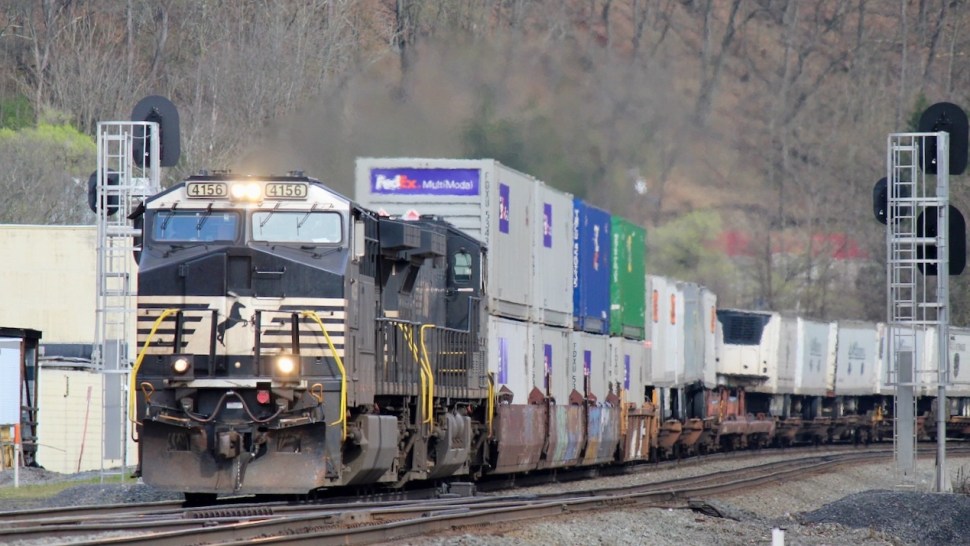
BNSF will seek 824 miles of trackage rights over Norfolk Southern’s Premier Corridor between Chicago and intermodal terminals in Eastern Pennsylvania. The trackage rights would extend from Chicago to Bethlehem, Pa., including the Chicago Line from Chicago to Cleveland; the Cleveland Line from Cleveland to Alliance, Ohio; the Fort Wayne Line from Alliance to West Pitt, Pa.; the Pittsburgh Line from West Pitt to Harrisburg, Pa.; and the Harrisburg Line to Wyomissing Jct., Pa.; plus segments of the Reading Line and the Lehigh Line east of Wyomissing.
The route is a major intermodal lane for BNSF and NS interline service today, particularly for shared customer J.B. Hunt.
“BNSF and NS are currently aligned on working together to provide this intermodal service to customers. If the Board approves the proposed merger, however, UP/NS would have the ability and incentive to ensure that BNSF is not a competitive option from a pricing and service perspective,” BNSF told the board. “Once BNSF is eliminated or limited from that market, UP/NS will be able to extract higher prices from its customers. To mitigate the loss of competition and degradation in service, BNSF anticipates submitting a responsive application seeking overhead trackage rights on certain NS lines between Chicago and eastern Pennsylvania.”
In the Gulf Coast — home to clusters of petrochemical plants and their lucrative carload traffic — BNSF will request that the STB require UP to create a neutral switching or terminal railroad that would directly serve all UP- and BNSF-rail-served facilities.
“Many Gulf Coast shippers are dependent on the UP network without competitive rail alternatives — a dependence that forces captive shippers to pay higher rates than shippers with access to multiple carriers — and the UP/NS merger would exacerbate these harms because Gulf customers ship significant volumes to eastern markets where CSX and NS compete today. Post-merger, UP would leverage its increased market power — and its practice of bundling rail service to customers with multiple facilities across its network — to impose still higher rates on these captive shippers,” BNSF told the board.
Thus BNSF proposes a neutral carrier that would provide BNSF, UP, and potentially other railroads equal access to rail-served customers in the region. If approved, this would have a major impact: UP has the industry’s largest chemical franchise and the railroad serves roughly 900 customers in Houston alone.
“The neutral terminal railroad would haul, switch, or interchange traffic to UP and BNSF at nearby hand-off points. The railroad could be jointly owned and managed by UP and BNSF (although other railroads could participate depending on the geographic territory involved) or be a third-party shortline operator or switching railroad,” BNSF said.
CPKC wants trackage rights improvements
CPKC said it will propose eight conditions that strengthen or protect its current trackage rights over UP in Texas and on NS between Detroit and Chicago. CPKC also intends to seek new operating rights over UP in Louisiana and Texas. And it will ask for trackage rights over NS in the Kansas City-St. Louis corridor and new or adjusted trackage rights over UP in Kansas City and Chicago.
CPKC’s cross-border corridor across Texas relies on trackage rights over UP between Beaumont and Rosenberg, and then again from Victoria to Robstown.
CPKC will ask the STB to remove various restrictions on commodities it can handle over the route, including access to local shippers and connecting short lines. It also will ask the board to impose conditions that would “reduce UP’s ability to impede or delay CPKC’s efforts to add capacity needed to support CPKC growth,” along with setting levels of service UP must provide over trackage-rights routes.
CPKC will seek new rights to operate on UP trackage in the Baton Rouge, La., area to reach local customers. It also will request new rights to operate over UP’s Lufkin Subdivision between Shreveport, La., and Houston. The route, CPKC says, could serve as a relief valve should merger-related traffic increases in the Houston terminal and between Houston and Livonia, La., create congestion on lines that CPKC and UP share east of Houston.
And, faced with the prospect of having NS acquire CPKC’s Dallas-area intermodal terminal in Wylie, Texas, CPKC will ask the STB to prohibit NS or UP from acquiring the terminal. NS has exercised its right, under the CPKC-NS Meridian Speedway agreement, to acquire the Wylie terminal. NS handles the lion’s share of traffic in and out of the terminal, mostly to serve the Atlanta-Dallas market.
“UP’s acquisition of NS would fundamentally alter the competitive consequences of NS’s proposed Wylie acquisition. Unlike NS, UP already operates two intermodal terminals in the Dallas area and UP competes directly against CPKC for traffic between Dallas and the U.S. Midwest. UP’s acquisition of the Wylie Intermodal Terminal would therefore place Wylie under the control of one of CPKC’s principal competitors,” CPKC said.
In the Midwest, CPKC will seek trackage rights on Norfolk Southern’s former Wabash main line from Mexico, Mo., to St. Louis along with related “close the gap” trackage rights on the Terminal Railroad Association between St. Louis and East St. Louis, Ill.
The NS Kansas City-St. Louis route is superior to CPKC’s own circuitous line via Roodhouse, Ill. “CPKC therefore anticipates asking the Board … to require Applicants to grant CPKC trackage rights over a portion of NS’s route in order to improve the competitiveness of CPKC’s Kansas City-St. Louis route both for St. Louis-area traffic moving to/from CPKC’s own network and as a bridge between BNSF and CSX,” CPKC said, noting that it also would like access to local customers on the NS route.
In the Kansas City area, CPKC will seek access to UP trackage in the terminal area to connect CPKC’s Knoche Yard with the Kansas City Terminal Railway. CPKC also will ask the board to protect its rights to use the Polo Line UP-CPKC paired track arrangement between Airline Junction and Polo, Mo.
CPKC relies on Norfolk Southern trackage rights to link Detroit and Chicago. CPKC will ask the STB to strengthen those rights, including stipulations regarding service levels. CPKC will request that the trackage rights for the first time would include traffic interchanged with Conrail in the Detroit area, traffic interchanged with the Ann Arbor in Milan, Mich., and any traffic to or from new facilities CPKC may build in the Detroit area.
In Chicago, CPKC will ask the board to grant access to enter and exit its Chicago-Michigan trackage rights at CP 502 and to operate between CP 502 and points on the Indiana Harbor Belt, including Gibson Yard. CPKC also will ask the STB to preserve its right to operate over UP’s Techy Line, which connects CPKC’s Bensenville Yard with its main line to the Twin Cities via Milwaukee.
CSX aims for intermodal and Midwest access
CSX will request three major concessions: Access to Kansas City via UP’s line between St. Louis and Kansas City; improved access to eastern Pennsylvania via trackage rights over Norfolk Southern; and access to a key dockside terminal at the Port of Virginia via trackage rights over NS and Norfolk & Portsmouth Belt Line.
“CSXT anticipates that it will seek conditions where CSXT is uniquely positioned to preserve part of the competition that a merged UP/NS would otherwise extinguish, and where UP/NS’s dominance would be most aggressively weaponized against competing carriers and the shippers that depend on them,” CSX told the STB.
CSX noted that UP has addressed network overlap with NS in the Kansas City-St. Louis-East St. Louis corridor by reaching an agreement with Canadian National, which would gain access to the UP route if the merger is approved.
“Yet having conceded the need for a structural remedy, Applicants have proposed to address this harm by granting rights to a carrier unlikely to meaningfully challenge the combined UP/NS’s competitive dominance, not the carrier best positioned to restore the competition in the KC-ESL [East St. Louis, Ill.] corridor that would be eliminated by their merger,” CSX told the board. “CSXT is the only railroad that can restore the east/west competition over this corridor that the merger would destroy.”
Today, CSX notes, shippers have “genuine choice” in the K.C.-St. Louis corridor, including UP-CSX and NS-BNSF and NS-CPKC options. “The merger eliminates that choice by placing both lines under common UP/NS control, extinguishing the independent eastern-railroad alternative that currently disciplines pricing and service across the corridor,” CSX said, noting that CN cannot replicate the eastern footprint of either the CSX or NS networks.
CSX said it would seek a 50% divestiture and dispatching control of UP’s line between East St. Louis, Ill., and Kansas City, along with Neff Yard in Kansas City. “With a direct ownership interest in the Kansas City Line, CSXT can build a complete business connecting Kansas City with its entire eastern network via the East St. Louis gateway, restoring precisely the alternative Kansas City service that the merger would eliminate,” CSX said.
In the East, CSX said the granting of trackage rights over Norfolk Southern would help it serve as a counterweight to the NS intermodal dominance in the area that’s within a one-day drive of a third of the U.S. population.
“To ensure that shippers west of the Mississippi continue to benefit from competitive options, CSXT anticipates that it will seek trackage rights on NS from Chambersburg through Harrisburg and Allentown to Manville, [N.J.]. These rights would enable CSXT to access an independent terminal in Bethlehem, Pa., to preserve interline optionality,” CSX told the board.
Specifically, CSX will request trackage rights over the NS Lurgan Branch between Chambersburg, Pa., and Harrisburg; the NS Harrisburg Line between Harrisburg and Wyomissing Junction; the NS Reading Line between Wyomissing Junction and Bethlehem; the NS Lehigh Line between Wyomissing Junction and Allentown Yard and Bethlehem; and the NS Lehigh Line from Bethlehem across New Jersey to Manville Yard.
In Virginia, NS is the only Class I railroad with access to the Port of Virginia’s Norfolk Intermodal Terminal. CSX has for years sought direct rail access to the terminal through federal courts and the STB.
“Today, NS moves traffic for interchange at gateways with UP, BNSF, and CPKC, whose transcontinental traffic moves through NIT. NS currently has no systematic incentive to foreclose any of them from efficient interline access. The merger would eliminate that neutrality entirely.” CSX told the board. “Post-transaction, a combined UP/NS would have both the ability and incentive to exploit NS’s exclusive on-dock rail access to NIT — and its control of the only line available to any competing carrier — to steer transcontinental traffic onto UP’s network and away from BNSF and CPKC.”
CSX said it likely would request trackage rights over NPBL and NS lines in the Norfolk area to reach the terminal.
CN, in its own filing, detailed the agreement with Union Pacific for access to the railroads’ route from the St. Louis area to Kansas City. CN asked the STB to make the deal a condition of its approval of the merger.
CN said it anticipates acquiring connecting trackage rights over the TRRA in a separating filing. And CN said it would seek access to energy customers on UP in Hillsboro and Carlinville, Ill., as well as Des Moines and Avon, Iowa, via haulage or trackage rights.
The related deals, CN said, are in the public interest and preserve competition.
NS defends merger
Trains has asked UP and NS to comment on the rival railroads’ filings.
“We will address the issues raised in the record,” Norfolk Southern said in a statement. “The facts are clear: this merger will deliver substantial, measurable benefits — shifting an estimated 2.1 million truckloads from road to rail annually, saving shippers $3.5 billion that can be passed on to consumers, and creating approximately 1,200 new union jobs. We have reinforced these benefits with unprecedented voluntary commitments that provide robust protections and guarantee significant public benefits.”
UP said that the filings show other railroads are afraid of competition. “Our opponents are afraid to compete; instead, they are exploiting the proceeding to advance their own commercial interests rather than invest their capital to enhance service. Their demands do not strengthen America’s supply chain nor help consumers,” the railroad said.
Filings are consistent with prior mergers
The Class I railroad filings are consistent with prior mergers, as railroads seek to protect themselves from potential competitive impacts from a new larger rival.
In the 1996 Union Pacific-Southern Pacific merger, for example, Conrail sought to acquire SP’s eastern network, including trackage from the Gulf Coast to St. Louis. Regulators rejected Conrail’s bid.
In the Conrail split, CN sought to cobble together a Montreal-New Jersey route by proposing to acquire Conrail’s Montreal Secondary to Syracuse, N.Y., and short line New York, Susquehanna & Western from Syracuse to New Jersey. NS and CSX ultimately reached a haulage rights deal that satisfied CN’s concerns, and CN dropped its request to acquire the trackage.
More recently, as part of the Canadian Pacific-Kansas City Southern merger review, CN sought a forced divestiture of the KCS route linking Springfield, Ill., with Kansas City, which would have given CN access to Kansas City. Regulators rejected that request as part of their 2023 approval of the CP-KCS merger.
Subscribe to FreightWaves’ Rail e-newsletter and get the latest insights on rail freight right in your inbox.
Read more:
Summer wanes but railfreight stays hot
102 Dems to STB: Put labor first in UP-NS rail merger review
Rail freight gains ride steelmaking, energy sectors
DOT unveils plan to turn highways, rail lines into multi‑use utility arteries
Brokerage Compliance Symposium
The day before F3. Every compliance issue you face - fraud exposure, carrier liability, FMCSA rules, cargo theft, insurance gaps - navigated by attorneys and operators defining best practices in a changing industry.
F3 Awards Dinner
The night before F3. FreightTech100 companies honored. FreightTech 25 and Shipper of Choice winners revealed live. Cocktail reception into dinner and live music - 300 industry leaders in one purpose-built room.
F3: Future of Freight Festival
Industry-defining keynotes, rapid-fire technology demos, and industry leaders networking in experiences across Chattanooga - plus the inaugural F3 Awards Dinner featuring the FreightTech and Shipper of Choice reveals.
The day before F3. Every compliance issue you face - fraud exposure, carrier liability, FMCSA rules, cargo theft, insurance gaps - navigated by attorneys and operators defining best practices in a changing industry.
The Signal at Chattanooga Choo Choo • Chattanooga, TN Register NowThe night before F3. FreightTech100 companies honored. FreightTech 25 and Shipper of Choice winners revealed live. Cocktail reception into dinner and live music - 300 industry leaders in one purpose-built room.
The Signal at Chattanooga Choo Choo • Chattanooga, TN Register NowIndustry-defining keynotes, rapid-fire technology demos, and industry leaders networking in experiences across Chattanooga - plus the inaugural F3 Awards Dinner featuring the FreightTech and Shipper of Choice reveals.
The Signal at Chattanooga Choo Choo • Chattanooga, TN Register Now