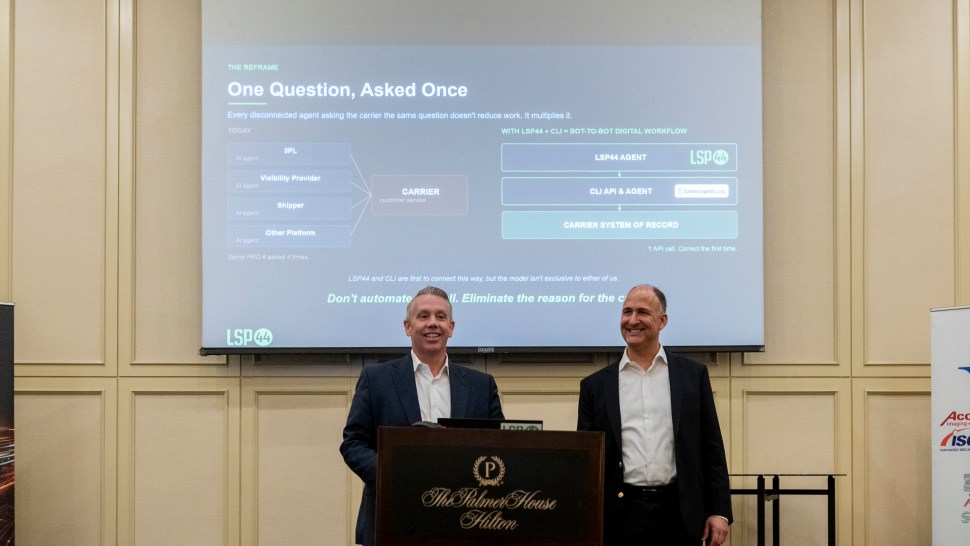
Carrier Logistics and LSP44 have partnered to develop an AI-powered API that can identify less-than-truckload shipments when a shipper or third-party logistics provider does not have the correct tracking number, targeting a source of manual work for carrier customer service teams.
The collaboration combines Carrier Logistics freight management software for LTL carriers with LSP44’s AI agent and API infrastructure for logistics service providers. The jointly developed technology allows shippers and 3PLs to submit other shipment details, including company names, delivery locations, shipment descriptions and approximate dates to search for freight through an automated connection.
“We’ve opened up the API to accept not just a pro number, but description of the shipment, an approximate date, where it’s getting delivered, and the names of the parties,” Carrier Logistics President Ben Wiesen said.
The companies announced the collaboration at Carrier Logistics’ user group conference in Chicago on Friday, Oct. 9. The partnership is now live, according to Carrier Logistics.
Traditional tracking APIs rely on a valid PRO number, the identifier used to track less-than-truckload shipments. When a shipper or broker doesn’t have the correct number, the carrier’s system may be unable to find the shipment, forcing the customer to call or email the carrier so an employee can locate the freight manually.
As more logistics companies automate communications, failed tracking requests can add to the volume of calls carriers must handle. LSP44 cited RXO‘s report that its AI agents automated more than 500,000 phone calls in the first quarter of 2026, illustrating the growing scale of AI-driven communications in logistics. Also, at Carrier Logistics’ user conference on Friday, Oct. 9, Jeremy Estep, head of sales at LSP44 cited estimates that responding to bot communications can cost motor carriers upward of $10 per shipment.
“The industry has treated manual tracking requests as the cost of doing business for decades. Every carrier running LTL has a customer service team absorbing that cost today,” said Nick Ruggiero, LSP44’s head of product.
Wiesen described the problem from a carrier perspective.
“If both parties don’t know what the tracking number is, then that electronic communication fails,” Wiesen said.
The API searches recent shipment records and ranks potential matches using details such as origin and destination, ZIP codes, company names and other shipment characteristics. Shippers and 3PLs can compare the results with their own records to identify the correct shipment and resume electronic tracking.
The API first identifies potential shipment matches using defined search criteria. Carrier Logistics said AI then ranks those candidates by accounting for discrepancies in the available information. For example, it might recognize a shipment number with two incorrectly transcribed digits as a potential match, or rank a shipment higher when its ZIP code matches even if its listed weight differs from the search information.
Wiesen said the system searches around a week’s worth of shipment records. The approach is intended to replicate the work a customer service representative would perform when trying to identify freight from incomplete information.
The API is password-protected and uses account-specific credentials. Carrier Logistics said it considers only shipments associated with validated accounts as potential matches, limiting the records available through a search.
Testing whether the API reduces manual inquiries
The collaboration targets a specific failure point in freight automation: tracking requests that cannot be resolved because the requesting system lacks a valid shipment identifier.
Rather than deploying additional AI agents to respond to calls and emails generated by failed tracking requests, Carrier Logistics and LSP44 are attempting to resolve the identification problem at the API level.
“We could put voice bots on our side to answer voice bots on your side, and email-responding AI to email it. But why? Why can’t we just solve the bottleneck and the fundamental problem?” Wiesen said.
The system’s effectiveness will depend on whether it can identify the correct shipment from incomplete information and whether the requesting company’s software can use the results to resolve the inquiry without additional manual work.
The companies did not disclose how many carriers or customers would participate in the rollout.
“We can’t be sure it’s going to stop all the phone calls until we implement and deploy it,” Wiesen said.
LTL industry works toward standardized visibility
The partnership comes as the LTL industry develops common standards for exchanging shipment information across transportation systems.
The National Motor Freight Traffic Association’s Digital Standards Development Council has published an In-Transit Visibility API standard covering shipment status, delays and delivery estimates. The standard defines common milestones, including pickup, in transit, out for delivery and delivered, so shippers and logistics providers can interpret status updates consistently across carriers.
The council’s framework also provides for authenticated access to detailed shipment information and public access to certain status information. Its stated goal is to reduce reliance on phone calls and inconsistent tracking portals.
Carrier Logistics and LSP44 are addressing a related but distinct problem. Standardized data formats help systems communicate, but the new collaboration is designed to identify the shipment itself when the tracking number supplied in a request is missing or inaccurate.
That distinction matters for companies managing freight across multiple carriers and technology platforms. A system can successfully send an API request yet fail to retrieve the intended shipment if it cannot match the available information.
The API’s impact will depend on how accurately it identifies shipments from incomplete information and whether those matches reduce manual tracking inquiries. The companies have not yet established how many carriers or customers will participate in the rollout or how much manual work the system can eliminate.
Why this matters
As logistics companies automate more communications, missing or incorrect shipment identifiers can prevent tracking systems from finding freight and push inquiries back to carrier customer service teams. Carrier Logistics and LSP44 are trying to address that problem at the API level, rather than adding more automation to handle calls and emails. Whether the technology can reduce manual work will depend on its ability to match shipments accurately and its adoption by carriers and logistics providers.
Brokerage Compliance Symposium
The day before F3. Every compliance issue you face - fraud exposure, carrier liability, FMCSA rules, cargo theft, insurance gaps - navigated by attorneys and operators defining best practices in a changing industry.
F3 Awards Dinner
The night before F3. FreightTech100 companies honored. FreightTech 25 and Shipper of Choice winners revealed live. Cocktail reception into dinner and live music - 300 industry leaders in one purpose-built room.
F3: Future of Freight Festival
Industry-defining keynotes, rapid-fire technology demos, and industry leaders networking in experiences across Chattanooga - plus the inaugural F3 Awards Dinner featuring the FreightTech and Shipper of Choice reveals.
The day before F3. Every compliance issue you face - fraud exposure, carrier liability, FMCSA rules, cargo theft, insurance gaps - navigated by attorneys and operators defining best practices in a changing industry.
The Signal at Chattanooga Choo Choo • Chattanooga, TN Register NowThe night before F3. FreightTech100 companies honored. FreightTech 25 and Shipper of Choice winners revealed live. Cocktail reception into dinner and live music - 300 industry leaders in one purpose-built room.
The Signal at Chattanooga Choo Choo • Chattanooga, TN Register NowIndustry-defining keynotes, rapid-fire technology demos, and industry leaders networking in experiences across Chattanooga - plus the inaugural F3 Awards Dinner featuring the FreightTech and Shipper of Choice reveals.
The Signal at Chattanooga Choo Choo • Chattanooga, TN Register Now