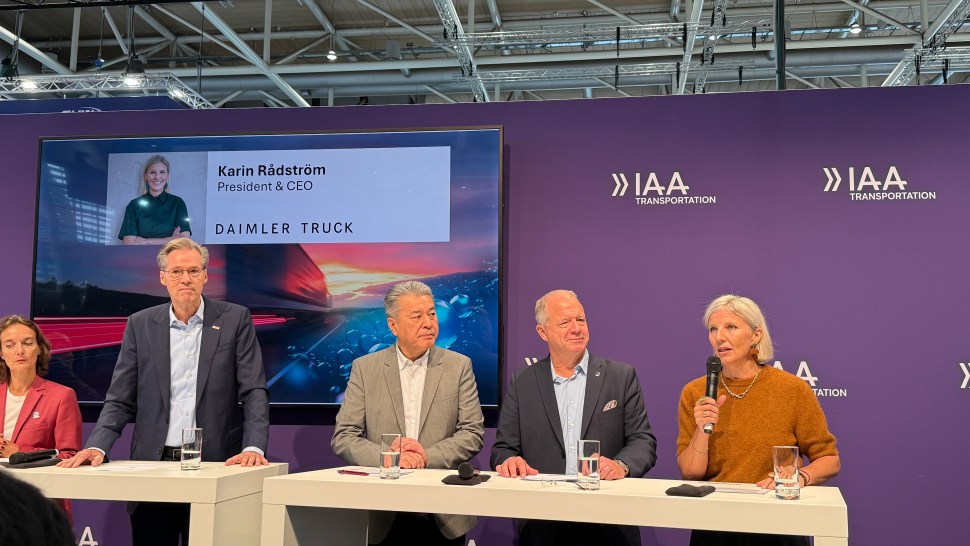
HANOVER, Germany — Two of Europe’s largest truck makers say the battery-electric rollout got ahead of the chargers needed to run it. Eight companies in a press conference at IAA Transportation on Tuesday said hydrogen would not repeat the same mistake, with the fuel, the stations and the trucks arriving together.
Daimler Truck, Volvo Group, Toyota Motor Corp., Bosch, Air Liquide, TotalEnergies, TEAL Mobility and MB Energy announced a joint effort to make hydrogen trucking commercially viable in Europe by 2030, with Germany as the template and a request that the European Commission and other national governments copy it.
Daimler Truck brought its Mercedes-Benz NextGenH2 Truck to the show floor at the same event. The company plans to put a small series of 100 into customer operations from the end of 2026, and the first batch of 50 is already sold, said Karin Rådström, president and CEO of Daimler Truck. Customers have run the previous-generation GenH2 Truck almost 600,000 kilometers.
“This isn’t some small side project for us,” Rådström said. “It’s a very important part of our strategy.”
The company is investing a mid-three-digit million euro amount in hydrogen trucks through the end of the decade, and its first hydrogen combustion engine trucks are being prepared for market launch next year. The NextGenH2 runs more than 1,000 kilometers on a single fill of liquid hydrogen, and it carries 1.3 metric tons more payload than Daimler’s battery-electric eActros 600, because it is not hauling the batteries.
Rådström’s third argument was the grid. Europe has roughly 6 million trucks to convert, she said, burning about 60 million metric tons of diesel a year. The truck count holds up: the European Automobile Manufacturers’ Association counted 6.2 million trucks in use across the EU in Vehicles on European Roads 2026, published in January and drawn from 2024 registrations.
“When you would translate that into electricity, if you would imagine running them all on electricity, that’s around 500 terawatt-hours of energy, which is actually the full annual electrical consumption of the country of Germany,” she said.
Germany’s gross electricity production ran 509.2 terawatt-hours in 2025, according to the Federal Statistical Office’s gross electricity production series, updated this month.
Volvo Group President and CEO Martin Lundstedt framed the alliance itself as the lesson from electrification.
“If we should have anticipated this type of lineup on the electric side five, six years ago, we shouldn’t have been standing yesterday saying that the transformation is moving too slow,” Lundstedt said.
Six euros a kilogram to make the business case
Hydrogen pricing is the pillar the business case rests on, and the panel was barred from discussing it. Master of ceremonies Andy Johnson opened the Q&A by ruling pump prices off limits, because competing station operators shared the stage. Both truck makers named the same target anyway: €6 ($6.92) a kilogram.
“When we can get down — and that is our analysis at Volvo — at a price point of 6 euro per kilogram in Europe, then we have the business case going,” Lundstedt said.
“Also our analysis shows it’s somewhere around 6 euro where it starts to get very, very competitive,” Rådström said. “And my understanding from the supply chain is that’s realistic, not today, but over time. That’s where we get to, maybe 2030 or a little bit after that.”
Europe’s stations dispense at the wrong pressure
Europe has 187 hydrogen stations, Rådström said, and the bulk of them were built for a different job.
“Most of them are 350 bar, so that actually doesn’t give you the added range that you need for it to be really beneficial for trucking,” she said.
Air Liquide is building the supply side out. Armelle Levieux, a member of the company’s executive committee responsible for innovation, technology and hydrogen energy, said the upstream is arriving on schedule: a 20-megawatt electrolyzer running in Oberhausen, Germany, for more than two years, a 200-megawatt unit starting in Normandy, France, before the end of this year, and another 200 megawatts in Rotterdam, Netherlands, the year after.
Heavy-duty trucking has to crack three problems at once, Levieux said: a viable station network, affordable fuel, and synchronization between the truck makers and the infrastructure operators.
“The end game is liquid hydrogen, because this is the only way to really have the volumes and the scale-up we need,” Levieux said. “And obviously this is what is going to drive us to diesel parity.”
TEAL Mobility, the 50/50 joint venture Air Liquide and TotalEnergies formed in 2024, runs 16 hydrogen stations across five countries under the TotalEnergies brand. A TEAL executive said station operators sit at the crossroads of the hydrogen supply chain and truck adoption, which makes them the first to absorb the damage when either one slips. The venture is targeting larger, faster stations that dispense both gaseous and liquid hydrogen until a standard emerges.
Volker Ebeling, senior vice president of new energy, supply and infrastructure at MB Energy, said the Hamburg-based operator already runs hydrogen stations in northern Germany and Sweden. Germany will not supply all the molecules, he said, naming the Nordics as one likely source and describing hydrogen as a global market.
Germany’s funding call drew twice the money available
Germany opened a funding call earlier this year covering hydrogen refueling stations and hydrogen-powered commercial vehicles together, a deliberate attempt to start both at once. The government put €220 million behind it. Applications came to more than €450 million, more than double what was available, said Steffen Bilger, Germany’s federal minister of transport, who opened the press conference in German. The bids sought more than 70 high-capacity stations and 800 heavy-duty trucks, according to the partners’ joint announcement.
In a positive sign, the money ran out well before the applications did.
“Without stations, no hydrogen trucks run. Without vehicles, nobody builds a nationwide station network,” Bilger said. “That shows the companies want to invest, and we want those investments to happen.”
Rådström asked for a second round from the stage, minutes after Bilger left it.
“It would be great to have another program so all these projects can have the first batch,” she said. “The coordinated way of working can make us much more successful in building the hydrogen ecosystem than what we see on the electric side right now.”
A list of industry wants from Brussels
Markus Heyn, a member of Bosch’s board of management and chairman of its mobility division, said hydrogen’s remaining problem is its cost. Vehicles running Bosch fuel cell systems have already covered more than 30 million kilometers.
“The best technology isn’t viable if it’s not economically efficient,” Heyn said. “So we really need to bring the cost down, and we can only bring the cost down if we can scale it up. We need critical mass, and that’s why we need to create demand.”
Heyn’s asks: full implementation of the Alternative Fuels Infrastructure Regulation with targets beyond 2030, targeted funding for electrolysis and infrastructure, an energy tax exemption covering fuel cells and hydrogen combustion engines alike, and removal of the additionality principle he said is slowing production of renewable fuels of non-biological origin.
Toyota is joining as a technology partner, bringing more than 30 years of fuel cell development and supply to the group. Executive Vice President Hiroki Nakajima said the company is separately working with Scania and Iveco on hydrogen-powered heavy-duty transport.
Lundstedt closed on the clock.
“I remain very positive about the discussion that we are starting here today, and not five years from now that we have seen in other experiences, because maybe it’s a little bit one or two years overdue already now,” he said. “But let’s go for it now.”
Brokerage Compliance Symposium
The day before F3. Every compliance issue you face - fraud exposure, carrier liability, FMCSA rules, cargo theft, insurance gaps - navigated by attorneys and operators defining best practices in a changing industry.
F3 Awards Dinner
The night before F3. FreightTech100 companies honored. FreightTech 25 and Shipper of Choice winners revealed live. Cocktail reception into dinner and live music - 300 industry leaders in one purpose-built room.
F3: Future of Freight Festival
Industry-defining keynotes, rapid-fire technology demos, and industry leaders networking in experiences across Chattanooga - plus the inaugural F3 Awards Dinner featuring the FreightTech and Shipper of Choice reveals.
The day before F3. Every compliance issue you face - fraud exposure, carrier liability, FMCSA rules, cargo theft, insurance gaps - navigated by attorneys and operators defining best practices in a changing industry.
The Signal at Chattanooga Choo Choo • Chattanooga, TN Register NowThe night before F3. FreightTech100 companies honored. FreightTech 25 and Shipper of Choice winners revealed live. Cocktail reception into dinner and live music - 300 industry leaders in one purpose-built room.
The Signal at Chattanooga Choo Choo • Chattanooga, TN Register NowIndustry-defining keynotes, rapid-fire technology demos, and industry leaders networking in experiences across Chattanooga - plus the inaugural F3 Awards Dinner featuring the FreightTech and Shipper of Choice reveals.
The Signal at Chattanooga Choo Choo • Chattanooga, TN Register Now