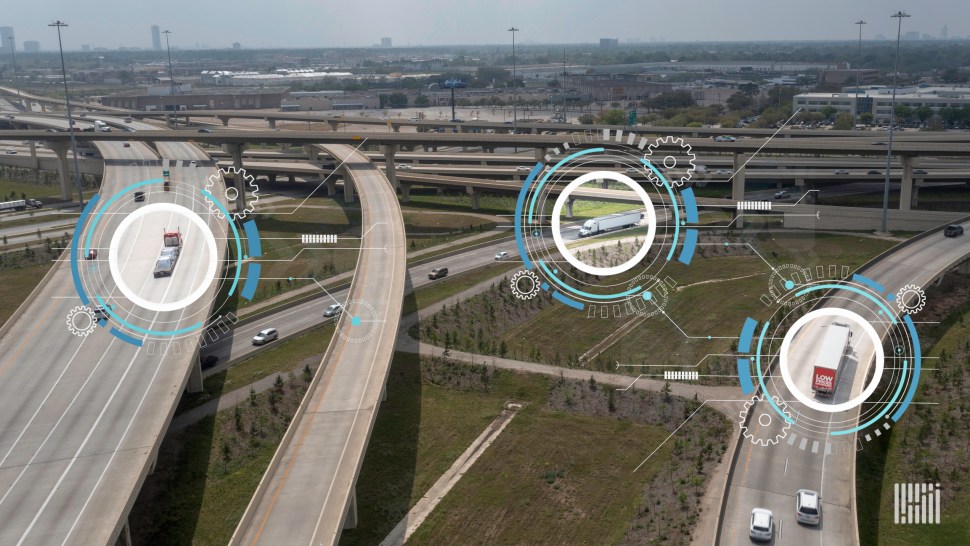
Optimus Technology Inc. on Thursday previewed a digital twin of the U.S. freight network built to model how disruptions and structural changes ripple across corridors, facilities and commodities. The freight digital twin, called the Freight Intelligence Graph, is under development at the Austin, Texas-based company.
The prototype models roughly 350,000 U.S. highway-network nodes and nearly 1 million directed road segments. It runs on top of Optimus’s proprietary freight data foundation. That layer maps more than 450,000 geocoded shipper and receiver roles across nearly 400,000 facility locations. It covers more than 500,000 distinct directional city-to-city corridor combinations.
“Most market intelligence explains what has already happened,” said Ed Stockman, founder and CEO of Optimus. “We are building a model of the physical economy to address a more consequential question: What happens next, and what happens after that? A change in one market can alter capacity, economics and commercial activity several corridors away. Understanding those second- and higher-order effects is essential to planning for the future.”
Access is limited for now to early design partners working on disruption planning, network strategy, infrastructure siting and market exposure. Those use cases sit with strategy and risk teams, upstream of the dispatchers who buy most freight software.
Hyper Predictors and the freight nobody sees
Underneath the graph sit what Optimus calls Hyper Predictors, specialized machine-learning models that combine shipment history, economic activity, geography, commodities, seasonality, weather and network behavior. Their job is to estimate the freight that never shows up in observed data.
“Observed freight data will always leave parts of the network unseen,” said Toby Pasquale, head of engineering at Optimus. “Hyper Predictors close those gaps by combining specialized models, each focused on a different part of the system. Together, they let us infer likely freight flows and identify where demand, loads and capacity pressure may emerge before those patterns become obvious in historical reporting.”
Pasquale previously spent 13 years at Amazon building network routing, optimization and predictive transportation systems.
The company’s worked example is a hurricane hitting Houston. The storm interrupts local freight, then the effects travel: rerouted shipments, repositioned capacity, shifting fuel and route economics, and pressure in markets nowhere near the coast. Analysts inside the prototype can define changes in commodity demand, diesel prices and route conditions. The system then compares a modeled baseline against the scenario to show where flow pressure builds.
What the freight digital twin will not do
Optimus draws the boundary itself. The prototype is a planning and simulation system, not a live fleet map or an ETA product. It does not present a modeled route as an executed shipment, a weather warning as a confirmed road closure, or modeled pressure as actual capacity.
Four principles govern the output: Verified transactions stay distinct from modeled estimates; scenarios are presented as plausible, with no single outcome called inevitable; every output retains its source and limitations; and defensible abstention. Most freight forecasting tools are not built to say they do not know.
Humanoids building humanoids
The most speculative scenario in the preview is the one Optimus cannot ground in any observed data: humanoid robots capable of building more humanoid robots and other goods. If that capability scaled, production capacity would expand faster and sit closer to end markets. Freight would shift from long-haul finished goods toward raw materials, components and localized assembly. Facilities, inventories and transportation networks would reorganize around a different production model.
No such capability exists at that scale, and Optimus is not forecasting one.
“E-commerce transformed distribution, fulfillment and consumer expectations,” Stockman said. “Humanoids building humanoids could represent a substantially greater change to the physical economy. The precise outcome is uncertain, but that is the purpose of scenario modeling: to define the assumptions, explore how first-, second- and higher-order effects could unfold, and identify the signals that would indicate whether a particular future is beginning to emerge.”
Brokerage Compliance Symposium
The day before F3. Every compliance issue you face - fraud exposure, carrier liability, FMCSA rules, cargo theft, insurance gaps - navigated by attorneys and operators defining best practices in a changing industry.
F3 Awards Dinner
The night before F3. FreightTech100 companies honored. FreightTech 25 and Shipper of Choice winners revealed live. Cocktail reception into dinner and live music - 300 industry leaders in one purpose-built room.
F3: Future of Freight Festival
Industry-defining keynotes, rapid-fire technology demos, and industry leaders networking in experiences across Chattanooga - plus the inaugural F3 Awards Dinner featuring the FreightTech and Shipper of Choice reveals.
The day before F3. Every compliance issue you face - fraud exposure, carrier liability, FMCSA rules, cargo theft, insurance gaps - navigated by attorneys and operators defining best practices in a changing industry.
The Signal at Chattanooga Choo Choo • Chattanooga, TN Register NowThe night before F3. FreightTech100 companies honored. FreightTech 25 and Shipper of Choice winners revealed live. Cocktail reception into dinner and live music - 300 industry leaders in one purpose-built room.
The Signal at Chattanooga Choo Choo • Chattanooga, TN Register NowIndustry-defining keynotes, rapid-fire technology demos, and industry leaders networking in experiences across Chattanooga - plus the inaugural F3 Awards Dinner featuring the FreightTech and Shipper of Choice reveals.
The Signal at Chattanooga Choo Choo • Chattanooga, TN Register Now