




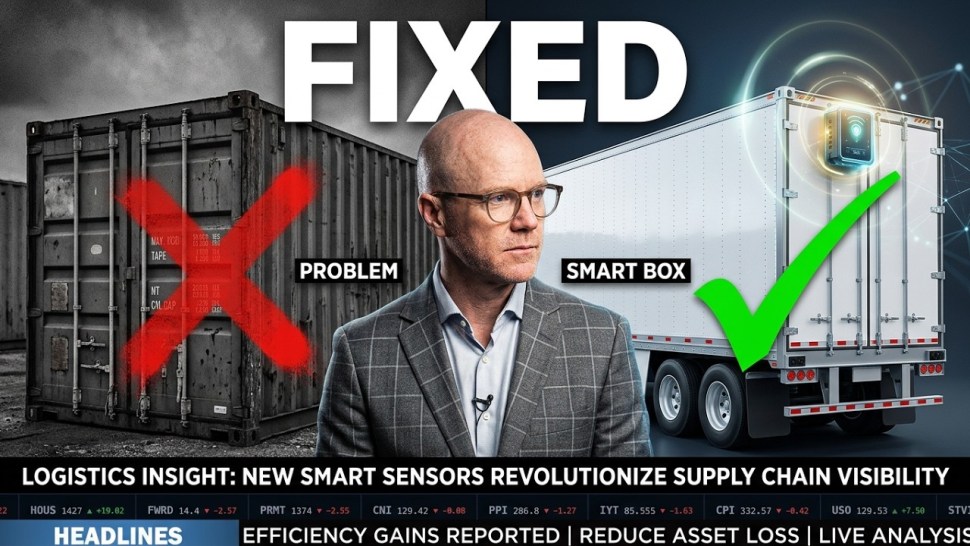
The logistics industry has a dirty little secret: trailers sit idle for 30-40% of their lifespan, costing carriers and shippers millions. Chris Hines, CEO of REPOWR, reveals how their new Trailer Optimization Platform (TOP) is transforming this inefficiency into opportunity. Discover how advanced data feeds and an execution layer can automate repositioning, boost utilization, and reduce operational costs. Learn why optimizing your “dumb boxes” is the next frontier in supply chain efficiency.
Trailers sit empty 30% to 40% of their working lives — and sometimes more — while every other link in the freight chain has been optimized. That is the core problem Repower is targeting with its new Trailer Optimization Platform, known as TOP, which automates the repositioning of trailer assets from surplus markets to deficit ones. CEO Chris Hines, a 44-year industry veteran, joined the Chattanooga-based startup to push it beyond its origins as a trailer marketplace and into an execution layer that carriers have long lacked.
The stakes are significant. A dry van trailer that cost $10,000 at the dawn of drop-and-hook operations now runs $50,000 depending on tariff conditions, Hines noted. Large carriers routinely run trailer-to-truck ratios of 2.5 to 3 to 1, meaning a fleet of 1,000 trucks could be managing 2,500 or more trailers — often tracked across a patchwork of TMS records, spreadsheets, and whiteboards. “Everything else is optimized in our chain,” Hines said. “The gates are optimized, the dock’s optimized, the truck’s optimized, loads, fuel, but the trailers just lag behind.”
“Visibility of the asset is not enough. You need the execution layer and the automation to move the asset to its next location.” — Chris Hines, CEO, Repower
Repower built TOP over roughly 90 days using six proof-of-concept customers, embedding its team directly in carrier trailer operations departments to shape the product. Two of those six POC customers have since converted to paying accounts. The platform ingests data feeds from existing carrier systems, consolidates them into a single view of short and long trailer markets, and then automates moves to balance those positions — including building or breaking down trailer pools tied to new shipper contracts.
The commercial model scales with fleet size and move volume, and Hines framed the ROI calculation around total repositioning spend: loadaway costs, empty miles driven by company drivers, and fuel. The platform is free to sign up for on the Repower website (spelled R-E-P-O-W-R), with carriers walked through an onboarding process after registration. Repower said it has already executed more than 75,000 moves through its marketplace and returned $30 million in shared revenue to beneficial trailer owners.
Hines also addressed a growing fraud problem in the trailer rental space, where carriers are transacting through informal channels such as WhatsApp and Facebook. Over the past year, Repower has built a security and vetting layer into its platform through partnerships with Highway, Genlogs, and Katina. “It’s not enough for the beneficial trailer owner who brings it to the one side of our marketplace to know where that trailer is 80% of the time,” Hines said. “They have to know 100% of the time.” Demand carriers — typically small fleets — must clear the vetting process before accessing any listed asset, with both trailer tracking and ELD data used for continuous monitoring.
Looking further out, Hines said TOP is a first step toward regional pooling of trailer assets, similar to how chassis pools operate in intermodal. Under that model, carriers, brokers, and shippers could share trailer capacity on a utilization basis regardless of which company owns the equipment. The company pointed to Convoy’s collapse — which left an estimated 8,000 trailers unaccounted for — as a cautionary example of what happens when trailer management is treated as an afterthought.
- Trailers sit empty 30% to 40% of their working lives; Repower’s TOP platform automates repositioning to cut those idle-asset costs.
- Repower has executed over 75,000 moves and returned $30 million in shared revenue to beneficial trailer owners since launching transactions in 2022.
- Repower built a fraud-prevention layer with Highway, Genlogs, and Katina after identifying rising trailer rental scams on informal channels like WhatsApp and Facebook.
Speaker 1 [0:00] Welcome back to Freightways. Today we have the trailer whisperer, Chris Hines himself. He is a man that has not made a trailer he does not like. Chris Hines is the CEO of Repower, but he has been around this industry for too long.
Speaker 2 [0:14] 44 years Friday.
Speaker 1 [0:15] I don’t like to date people.
Speaker 3 [0:16] Friday? You have like a date with it?
Speaker 1 [0:19] Wow, congratulations. How did you get in and why aren’t— what kept you in?
Speaker 2 [0:24] Uh, what kept me in was solving the problems of my customers and the carriers. And, you know, I got the— I got the first time to come see Matt, actually. So it’s a pleasure to be with you today.
Speaker 1 [0:36] And you worked with Clyde too, right?
Speaker 2 [0:38] And I actually worked with Clyde as well.
Speaker 1 [0:40] Clyde, my grandfather, one of the patriarchs of long-haul trucking in Chattanooga.
Speaker 2 [0:44] Very early on, out of Atlanta with TIP. But I got in the trailer space and actually didn’t think I’d be sticking around for 40 years.
Speaker 1 [0:54] No one does. You get in, it’s the Hotel California.
Speaker 4 [0:55] You can check in, You can’t check out.
Speaker 2 [0:59] 40 years on Friday. So it’s exciting and really enjoying being in Chattanooga. It took 6 minutes to get over here, the traffic terrible. But it’s a pleasure to be here.
Speaker 1 [1:10] Now, Atri would disagree with you. Atri says that Chattanooga is one of the most congested cities in the country. I was literally stuck in traffic. That is only 2 sections. That’s the I-75/24 split. And that is to my house, the I-24 section. Max, my dad, lives on the opposite side of town, is always complaining about the traffic.
Speaker 3 [1:28] It’s terrible. Yeah, Max and I come from the same side.
Speaker 1 [1:29] You guys both have to come all the way over.
Speaker 3 [1:31] I was literally just talking about that with Zach Strickland this morning, that I’m enjoying my last week before school starts because it’s not so bad in the summer. And then school starts the end of next week and it will get even worse.
Speaker 1 [1:41] All those soccer moms driving their kids to school.
Speaker 3 [1:44] I love those. That’s me. I love those soccer moms driving.
Speaker 1 [1:46] Yeah. So, so, Chris, you joined Repower. Full disclosure, I’m on the board of Repower. Repower started off as a trailer marketplace to really— a trailer board. It was originally the way I sort of think of it, is helping companies sell that have excess trailers, sell capacity, and companies that need excess trailers or need trailer capacity to be able to find a marketplace. You guys have recently rolled out a new software package, a management system, a trailer management system. Tell us about why did you join Repower, and what is it you hope to do with it?
Speaker 2 [2:20] Well, it was a great opportunity for me. It kind of is a crossroads. I was with a publicly traded carrier for about 5 years, obviously at TIP, but when I left TIP in 2002, we had $150,000 net earning assets. So the whole optimization game has always been really important to me. And when the opportunity came up for Repower, our 2 founders found the business right at COVID. in 2020, literally 2020. We started doing transactions in ’22, and I met with them and I’ve been following them throughout. So when the opportunity came up to take this and expand it beyond just— Utilization of, you know, underutilized assets into the execution layer and automation around the shifting sand for a carrier is always having the trailer in the right place where the freight needs to be. Repositioning is a constant and you have to be good at it. And in order to do that, we built the, you know, why we built that platform. Visibility of the asset is not enough. You need the execution layer and the automation to move the asset to its next location.
Speaker 1 [3:27] So Chris, the trucks get a lot of love.
Speaker 2 [3:29] Trucks get a whole lot of love.
Speaker 1 [3:30] They’re sexy, they’re cool, they got big engines, you can ride in ’em. Trailers are the, in many ways historically been the dumb boxes of the industry.
Speaker 2 [3:39] They absolutely have.
Speaker 1 [3:40] That is changing.
Speaker 2 [3:41] And they, you know, historically trailer sits 30 to 40% of its life empty.
Speaker 4 [3:46] Or more.
Speaker 2 [3:47] Or more. Or more in certain cases. So what we brought to the table is that execution layer to get that optimization and utility. Everything else is optimized in our chain. The gates are optimized, the dock’s optimized, the truck’s optimized, loads, fuel, but the trailers just lag behind that much like it does in the, in the setup. It’s behind the truck. But actually what the shipper cares about is in the trailer. It’s the freight. It’s not the truck. Yeah, it’s the freight.
Speaker 1 [4:17] Now, I know this from my experience at US Xpress, that trailers, you know, US Xpress was not great at managing them, but I suspect it’s true of every asset carrier. It was always a problem because the data entry, a driver goes to the dock, the trailer’s not there, the trailer’s been loaded by the shipper to, you know, the bill of lading doesn’t match the trailer. There’s all those data integrity problems. Chris, that existed when, you know, and I suspect that every carrier has the same problem. What is, what is your experience with it?
Speaker 2 [4:45] Well, and I think that’s the why we built the optimization platform to support, because everybody’s clear, visibility isn’t enough. You’ve got to have an execution layer. How we built it, I think, is the most interesting thing. And we did that in the field. We went and sat down with 6 proof of concept customers. We lived with them in their trailer operations departments. And they helped us design the actual execution platform. So thing— products, I think, are much better if they’re built in the field than built in an office. If you’re out with your client, you’re talking to your client, you can build the best products. And we did this relatively quickly, about 90 days of time with the new tools that are out there from a development standpoint. We had the prototype out and we actually have now converted 2 of those POC customers to And I think it feels like it shouldn’t be so hard to manage trailers, right?
Speaker 3 [5:36] You know where your trucks are. But for all the reasons Craig mentioned, driver picks up the first trailer he sees instead of the one that you ask him to.
Speaker 1 [5:42] You also have shippers.
Speaker 3 [5:43] Shippers load the wrong trailer.
Speaker 1 [5:44] Nonsense.
Speaker 3 [5:45] The unit on it that helps you track it, the battery dies, and it’s parked in the shade, so it’s not recharging with solar, whatever. There’s a million reasons. But the other thing that people don’t talk about and think about is a large carrier Has 2.5 or 3 trailers per truck. So it is a massive number of assets to keep track of, right? So tell us what the optimization— TOP is what it’s called, right? Trailer Optimization Platform. What does it actually do?
Speaker 2 [6:10] So TOP takes the data feeds from the carrier around their assets, either via, you know, via the TMA. The amazing thing is, in going back and going and sitting down with these with our large fleets of people that I know, they were still managing this in multiple disparate systems. Some of it’s in the TMS, some of it’s in spreadsheets, you know, some of it’s on the chalkboard still. And we take all of those feeds and then we just build the short and long markets. And then we can automate. Because we do have a trailer marketplace, we’ve moved over, you know, we’ve paid back $30 million in shared revenue back to the owners of the equipment, beneficial trailer owners. So we have that information, um, and we’ve executed, you know, over 75,000 moves in the platform. So we can take that visibility that they have and now put an execution layer to it and move them automated from short markets to long markets is the gist of the product.
Speaker 4 [7:11] So it sounds like you’re really taking one of the most, uh, underutilized assets in a trucking company and helping them Figure out how to utilize it better.
Speaker 2 [7:21] And it goes even further when you think about, we go through this bid process and we get these bids and you get an award. Now I’ve got to get 25 trailers to service that account. And of course it says you’re going to get 5 a day every day, but you’re going to get 1 a day at the beginning.
Speaker 4 [7:35] Getting into—
Speaker 2 [7:37] And then they want you to get 18 on Thursday.
Speaker 4 [7:39] Right.
Speaker 2 [7:39] So building those pools or breaking down those pools has always been cost. I either send my guy and my truck and I’m paying fuel, and then what do I do with him once he’s there? Or I pay a load-away business and I just pay it to build it up. We give you optionality now how to build that pool in the most optimal manner, the most cost-efficient manner.
Speaker 3 [8:00] So, Chris, it’s also massive driver frustration in those exact examples that you gave. And in a market like this, we need to treat drivers well and they need to be retained. And this is one friction this helps take out.
Speaker 2 [8:12] And the one cool thing that we’ve done, we started at the 30,000-foot level, which was just, you know, Short and long markets. We’ve now taken that down to pools, and we’re now going to be using it to actual pools around the customer to be able to manage that pool. And you know, with the AI tools that are out there, we’ll be able to then even take it a step further.
Speaker 1 [8:33] I know I managed a board. I was a driver fleet manager early in my career. Trailers were always a pain, and they they were one of the biggest sources. There was two things that I remember that all 3 things that frustrated drivers. One is just delays at shippers. Payroll, if you messed up the payroll. Trailers were the most— and that was the most frustrating for me, because payroll was usually just getting with payroll department. Shippers, there’s not a whole lot you could do about shipper delays except pay them attention. And sometimes they enjoyed that, because they could get paid. But the ones that really drove me crazy as a fleet manager was driver-trailer— was the driver— was the trailer issues. That just consistently— I mean, how much turnover, Dad, from your perspective, was caused by trailer problems?
Speaker 4 [9:17] Not sure about how much turnover, but one, you know, keep in mind trailers are costly. And the ratio of trailers, when you’ve got 3 to 1, is much more costly than if you’ve got 1.7. I tried to maintain below 2 and then use the rental companies As a way to supplement during those cycles where you need it. Yes, it created problems, but it also reduced costs. You got to manage them. You got to manage them tight. And what Swift is doing is really bringing a new element that really helps managing that inefficient part of the operation.
Speaker 1 [9:53] One of the storylines around Convoy’s bankruptcy was actually the amount of trailers, 5,000 trailers I think was the number. I mean, it’s astounding.
Speaker 2 [10:03] 8,000 trailers.
Speaker 1 [10:05] They weren’t prepared to manage it. But that was one of the— when we did the story about Convoy going under, one of the sort of storylines was the inability to manage the trailer pools. Brokers have gotten into trailer pools. They’re a big piece of it. What has changed in this market? You’ve been doing it for 40 years. You’ve worked in a number of roles. What is it special about this market in terms of trailers specifically that’s really driving things?
Speaker 2 [10:27] Well, I think it’s just the last step of the optimization. You mentioned the 3-to-1 ratio. And fortunately or unfortunately, either way, I’ve been around long enough to Remember when drop and hook was starting? And drop and hook was considered a technology actually at the time, but it was throughput for the carrier. Now you think about it, you go to some of these large facilities, there’s 100 acres of trailers sitting there of all different colors, shapes, and sizes. And there’s no optimization platform yet for us, what we’ve released to manage that mess. And it creates additional units coming in. You could have hundreds of acres, literally, of empty trailers sitting around these facilities. And it’s suboptimal. When you started drop and hook, drop and hook trailers were $10,000. They were less of a, less of a thought. Now you fast forward to today, depending on what tariffs are in place that moment, you know, it’s a $50,000 asset. So it’s a much more, you know, it needs more optimization, obviously.
Speaker 1 [11:30] In a market, I remember where the hours of service rules were changing, the ELD devices. came out, the ELD mandate, there was a conversation about companies expanding trailer pools. Did that— first of all, did that happen?
Speaker 2 [11:41] Not really.
Speaker 1 [11:42] So there’s really, like many things, people get it wrong in terms of these predictions. What does it look like right now? This market is obviously unprecedented in terms of how fast it’s tightened. But what is the trailer situation on the ground? How are fleets dealing with trailers? How are they planning their trailer operations?
Speaker 2 [12:01] Obviously, the, the, if you have the asset, you can get it loaded right now. So that’s not a problem. But the problem is, are you loading it with the right freight? Are you taking the right loads? So there’s a lot of optimization around trucks and routes, but it’s not optimizing the actual trailer. So that trailer has, you know, a daily cost and a daily depreciating cost. It needs to be in the right place and it needs to be there quickly. And taking the costs out of that move, because that’s the one thing large carriers, even, even you know, mid-sized carriers are constantly doing are moving their trailers to where the best freight is. What’s the most optimal way to do it and provide operating, you know, relief to have the assets ready?
Speaker 1 [12:46] And TOPS, Trailer Operating—
Speaker 2 [12:49] Trailer Optimization Platform.
Speaker 1 [12:50] Optimization Platform.
Speaker 2 [12:51] Optimization Platform.
Speaker 1 [12:52] Is all about optimizing the asset.
Speaker 2 [12:54] All about optimizing the asset, automating that process. Because again, there are multiple people. The bigger the fleet, the more trailers they have, the more people they have doing this. in disparate systems. They can now manage that in one and move their assets from their long positions into their future positions. I know I— if I’ve got 90 days that I know I’ve got to pop up a fleet in the middle of nowhere, I now have an option of how to do that.
Speaker 1 [13:20] And Chris, what is the return on investment? So a fleet that wants to use TOP, what’s it cost? And then what do you hope that they can achieve with it?
Speaker 2 [13:29] It’s basically based on fleet size, right? The number of trailers you have and the number of moves you have. So there’s a little bit, you know, every carrier is not the same. You’ve got dedicated fleets, you’ve got, you know, you’ve got one-way fleets. So it’s going to be a little bit different use case-wise depending on how your operation works. But ultimately, if you just take the cost, we ask them to look at their total cost. What have they spent in loadaway? What have they spent in having their drivers drop empty miles and add all of that up? And the execution layer that we provide with the top platform then takes that cost out. So we can reduce the cost immediately.
Speaker 3 [14:08] So my brain is spinning on all the ways that this is valuable and not just for optimizing your asset and for driver frustration, but also I will tell you, when I was over customer service, every day my conversations with our enterprise shippers were, you’re 5 short at this pool, or I was calling them and saying, You’re 20 over at this pool. I’ve got to get them out there. And then, but then you actually have to execute to that to get them out of there.
Speaker 1 [14:31] They were also using the storage. How many times, I mean, how much percent?
Speaker 2 [14:35] Oh, that never happened.
Speaker 1 [14:36] How much percent?
Speaker 3 [14:37] Yes, or they hadn’t unloaded the right ones. It wasn’t first in, first out. There was a million issues with that. So being able to keep that all in one place. But take that one step further is then I have a group of people managing this enterprise customer who’s fighting to get the 5 at their pool. But then I have another group of people managing this enterprise customer where they’re 7 short and they’re fighting to get the 7. And being able to see that all in one place and optimizing it appropriately would be incredibly valuable.
Speaker 2 [15:00] Well, and I think this is the first step in that. Ultimately, if you think about asset classes, chassis, containers, railcars, all trade pools. And ultimately where this will lead will be regional pools of assets because the color of the asset shouldn’t matter. The utilization of the asset should matter. And, you know, we’re really leaning forward into the future to say, let’s manage regional pools. And in those regional pools, you may have BTOs, the beneficial trailer owner, being carriers may be involved in that. Brokers may be involved in that because brokers are now building up assets. Shippers could definitely be involved in that. But sharing of those assets and the utilization of those assets matters.
Speaker 3 [15:46] So more the way that chassis are managed now.
Speaker 2 [15:48] A lot of the way the chassis are managed now, chassis don’t move as far. But if you think about the pooling concept, it was built around, I don’t want to have to own my own chassis, I want to use it by the drink.
Speaker 1 [16:01] So, Chris, Matt Leffler, my co-host for Freight Expectations, a few weeks ago pointed out this new fraud that’s popping up is people are leasing trailers transactionally through these message boards, WhatsApp, Facebook. not marketplaces, but just some rando on the internet, which you should never trust a rando on the internet, but they’re doing it. We talked about fraud every single day. We talk about some form of fraud. I learn a lot. The criminals are working nonstop. What do you guys do in terms of— what are your thoughts on that and how are you helping companies deal with it?
Speaker 2 [16:36] One of the things is building out the top product was a big priority for us, but we had to build it. In the last year, we have spent ad nauseam amounts of the time around the safety and security layer of the business. We’ve developed great partnerships operating in our platform with people like Highway and Genlogs and Katina, because it’s not enough for the beneficial trailer owner who brings it to the one side of our marketplace to know where that trailer is 80% of the time. They have to know 100% of the time. So that connectivity in our platform now is to keep the bad players out And our demand carriers, the small guys that actually rent the assets and utilize them and reposition, 80% of our moves drop in a different market. It provides, you know, the vast majority of these small fleets are safe, are compliant. We’ve got some bad actors obviously, but there’s a couple hundred thousand of these people. A lot of ’em are talented people trying to build a business.
Speaker 1 [17:32] Yeah.
Speaker 2 [17:32] We believe that this gives them, going through our vetting process before they could ever see an asset, This gives the beneficial trailer owner comfort that we’re tracking both with trailer tracking and ELD, and it gives the demand carrier who is small a leg up. It gives them another option to utilize trailers at a lower cost. They didn’t have the option of going to a leasing company like I ran. They didn’t have that option. They really don’t have good finance options, but now they’ve got usability options. So I can go, I can take the best load that, you know, that fits my footprint. And then move that asset and then pick up another asset to utilize. So we really— we are proud to support the demand carriers and give them some operational cost flexibility.
Speaker 1 [18:22] So, Chris, I got to ask, you’ve been around this market for a long time and I’m not trying to date you. Not as long as the two of you guys have. It’s a lot of experience at the table.
Speaker 4 [18:33] How about truck years?
Speaker 1 [18:34] We just came from this. We’re in the middle of earnings. There’s been, you know, we talked about Old Dominion getting a 70 OR. Feels like a railroad.
Speaker 2 [18:42] But you’re—
Speaker 1 [18:43] you were a public CEO. Any reaction to this earnings so far?
Speaker 2 [18:46] Yeah, I think it’s phenomenal because, again, it needs to get broader. But as a carrier, you have to get the return on invested capital to reinvest in your fleet. And that was a conversation I had with shippers years ago. It’s like, guys, I can’t support this and buy more trucks and keep the cycle moving. So I think it’s very positive. It looks like we’ve got a long run. I hope, because you need that long run of earnings to reinvest in the assets. It’s expensive.
Speaker 1 [19:18] Well, if a mere lip to God’s ear, let’s hope this market stays strong. Chris Hines, thank you so much. And folks, you can learn more about Repower. Where should they go?
Speaker 2 [19:25] And they want to—
Speaker 1 [19:26] if they want to become a part of TOP and take advantage of it, where do they go?
Speaker 2 [19:29] All they have to do is go onto our website. It’s free to sign on, and then we’ll take you through the process. Relatively short and easy.
Speaker 1 [19:36] And by the way, you guys can’t spell Repower correctly. It is R-E-P-O-W-R. There’s no E in it.
Speaker 2 [19:43] There’s no E in Repower.
Speaker 1 [19:44] Yeah, so it is— just so that if you’re looking for Repower, it isn’t spelled right, that is a correct website. Chris, thank you so much.
Speaker 2 [19:50] Thank you.
Speaker 1 [19:51] Appreciate you coming in.
Brokerage Compliance Symposium
The day before F3. Every compliance issue you face - fraud exposure, carrier liability, FMCSA rules, cargo theft, insurance gaps - navigated by attorneys and operators defining best practices in a changing industry.
F3 Awards Dinner
The night before F3. FreightTech100 companies honored. FreightTech 25 and Shipper of Choice winners revealed live. Cocktail reception into dinner and live music - 300 industry leaders in one purpose-built room.
F3: Future of Freight Festival
Industry-defining keynotes, rapid-fire technology demos, and industry leaders networking in experiences across Chattanooga - plus the inaugural F3 Awards Dinner featuring the FreightTech and Shipper of Choice reveals.
The day before F3. Every compliance issue you face - fraud exposure, carrier liability, FMCSA rules, cargo theft, insurance gaps - navigated by attorneys and operators defining best practices in a changing industry.
The Signal at Chattanooga Choo Choo • Chattanooga, TN Register NowThe night before F3. FreightTech100 companies honored. FreightTech 25 and Shipper of Choice winners revealed live. Cocktail reception into dinner and live music - 300 industry leaders in one purpose-built room.
The Signal at Chattanooga Choo Choo • Chattanooga, TN Register NowIndustry-defining keynotes, rapid-fire technology demos, and industry leaders networking in experiences across Chattanooga - plus the inaugural F3 Awards Dinner featuring the FreightTech and Shipper of Choice reveals.
The Signal at Chattanooga Choo Choo • Chattanooga, TN Register Now