




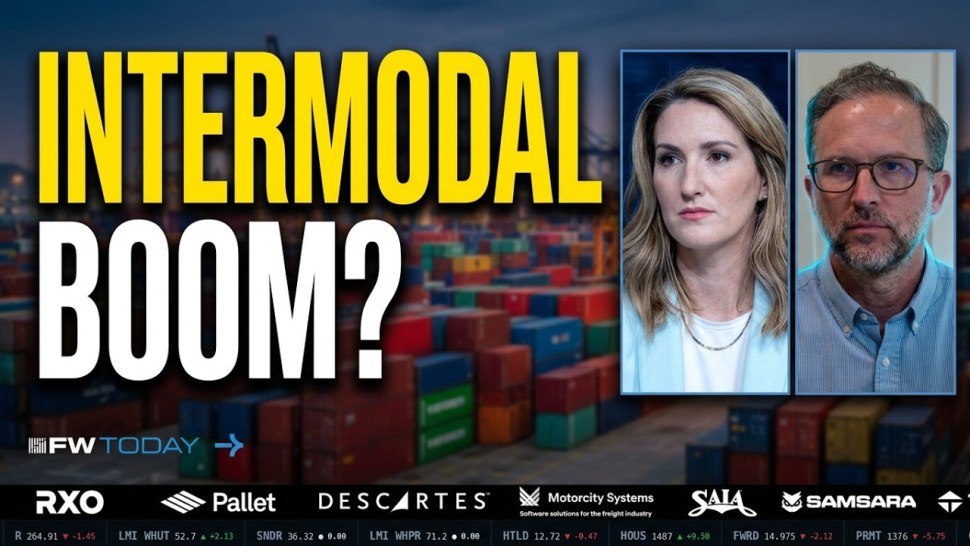
Intermodal demand is surging, but drayage capacity is tight. Geoff Anderman, CEO of STG Logistics, dives into what’s driving this growth and how recent restructuring and new ownership are positioning STG to capitalize on market opportunities. He also shares insights on port activity, tariff volatility, and the competitive landscape for intermodal services.
An intermodal marketing company that wrapped up Chapter 11 proceedings in early July emerged with 90% less debt and new owners — Fortress, Fidelity and Invesco — and its CEO says the restructuring has removed a key constraint on growth just as intermodal demand accelerates. The company operates a fleet of 15,000 containers and provides internal drayage coverage on both ends of its rail moves, a combination the CEO described as an edge over pure-play competitors.
Demand for intermodal service is strong enough that the company left volume on the table in the second quarter, the CEO told FreightWaves. Drayage capacity — the short truck hauls to and from railheads — was the binding constraint, a problem he said persists into the summer. “We could have done even more,” he said. “There was that much sort of demand for the service out there.”
“We could very easily put a significant amount of incremental drivers to work right now, given the demand we’re seeing in the marketplace.”
The drayage crunch mirrors dynamics in the broader trucking market, where regulatory compliance actions have pushed capacity out. The CEO said dray costs are rising in lockstep with over-the-road rates, and the company is managing the squeeze in real time. Driver availability tied to the compliance crackdown is the primary driver, he said, echoing concerns raised by other freight executives.
The CEO identified over-the-road trucking — not rivals such as J.B. Hunt, Hub Group, Schneider or Knight-Swift — as the primary competition for intermodal. He said all intermodal providers share an interest in pulling freight off highways by leveraging railroad partnerships to deliver a cost-efficient, energy-efficient alternative to trucking. He noted J.B. Hunt is the largest player in the space but called the other named carriers “formidable” providers as well.
Modal conversion is emerging as a growth avenue. The CEO said new shippers are trialing intermodal lanes they had not historically used, driven by tightening truck capacity, rising tender rejections and rate pressure. He cautioned that converting shippers takes time — network redesign is required — but said customers who work through the learning curve tend to stay. “To the extent that our rail partners working with us are continuing to provide good service, I think there’s going to be go-forward opportunities to continue to execute on those conversion opportunities,” he said.
On the pending Union Pacific–Norfolk Southern merger, the CEO was measured. He said his company has seen strong rail service from all railroad partners over the past 12 months and wants any merger outcome to preserve competitive, reliable service. He was more direct about tariff volatility, noting that port activity showed strength late in Q2 and into early Q3 but flagged uncertainty about how much of that volume was front-loaded ahead of tariff changes.
With its recapitalized balance sheet, the company plans to invest in logistics capabilities — including transloading, consolidation and deconsolidation inside warehouse walls — alongside its transportation assets, technology and go-to-market strategy. The CEO cited a deal with a large West Coast retailer in which the company consolidated the shipper’s provider network around specific distribution centers, driving what he called “pretty meaningful costs” out of the supply chain while improving service reliability.
- Intermodal IMC exited Chapter 11 in July with 90% less debt and new owners Fortress, Fidelity and Invesco
- Drayage capacity tightness capped Q2 volume growth and persists into Q3, with dray costs rising alongside over-the-road rates
- Modal conversion from truckload is an emerging growth driver as tender rejections rise and truck capacity tightens
Speaker 1 [0:00] Welcome to FreightWaves Today, Jeff. Intermodal having a good year. What are you seeing?
Speaker 2 [0:05] Hey, thanks for, thanks for having me back. Yeah, it’s, it’s busy, right? So the demand for intermodal volume or intermodal services is growing, which we’re obviously excited about and really looking forward to kind of seeing how that plays out for the rest of the year.
Speaker 1 [0:25] So you guys have restructured, you know, a company that’s been through, you know, I call it a period of history where Chapter 11, you’re out of that process. You now have new ownership. Fortress Fidelity and Invesco are new owners. By the way, Invesco is an investor in FreightWaves. So a little bit of hometown Atlanta pride there. Tell us a little bit about the new ownership group.
Speaker 2 [0:52] Yeah, look, the ownership group is very supportive. I think very excited about the future of the business. And so we’re sort of excited to have them involved. Expect that they’re going to support us as we continue to grow our business, continue to sort of ride the wave of enhanced interest in intermodal service, and expect a lot of good things sort of coming out of this process that we just wrapped up earlier in July.
Speaker 1 [1:20] What is the state of intermodal right now? We’re seeing the data. J.B. Hunt, you know, being a public company gives us an enormous preview into the state of freight. Intermodal blew it out of the water for J.B. Hunt. What are you guys experiencing right now?
Speaker 2 [1:34] Yeah, I mean, demand is strong, and I think it’s like, like J.B. Hunt and others have said, I think, you know, sort of our ability to To kind of meet that demand was almost hindered a little bit, I would say, in the second quarter as a result of some tightness in drag capacity in the marketplace, whether that’s with our own drivers or third parties. We could have we could have done more in the second quarter, and we actually had a good strong second quarter from a volume perspective. But we could have done even more. There was that much sort of demand for for the service out there.
Speaker 1 [2:08] Jeff, do you do you guys view JB Hunt as a competitor, or is it? Are you after the same? Is really the truck the competitor here and you guys have the same mission?
Speaker 2 [2:17] Yeah, no, look, I think broadly speaking, we view the trucks as our biggest competition, right? I mean, trucking, over-the-road trucking is obviously the most clear and largest substitute for intermodal service. Obviously, you know, folks like JB Hunt, Hub Group, Schneider, Knight-Swift, you know, they’re all, sort of active in the, uh, in the intermodal space, uh, JB Hunt obviously being the largest, but those other companies that I described, uh, obviously being formidable, uh, sort of providers and carriers as well. Um, so we, we do view them as competition, but obviously have tremendous respect for them. I think all of us are very much interested though in taking freight off the road and, and using intermodal capacity and leveraging our partnerships with the railroads to provide an efficient, reliable, and obviously energy-efficient sort of solution as well, or substitute for over-the-road trucking.
Speaker 3 [3:17] Jeff, you mentioned a tightness in dry capacity in Q2 sort of limiting growth ability and ability to accept freight. What are you seeing so far this summer as we are, I guess, well into August, so a month, almost a half?
Speaker 2 [3:33] Yeah, yeah, I think we’re still— Yeah, yeah, sorry. We’re still seeing some of that tightness, right? So, you know, not unlike what’s happened in the over-the-road market, many of the things that have happened there to kind of drive capacity out of that market, they’ve certainly impacted the drayage market as well. And remember, for intermodal, you have a truck move, a dray, on each end of a rail line haul. And that obviously requires, you know, a driver with equipment. to be able to pull that container, you know, to or from the railhead. And so we’re still seeing some of that tightness. I think the cost of dray capacity is going up just like it is in the sort of over-the-road trucking market. And so we’re actively sort of managing that in real time here to make sure that we’re able to provide the capacity that our customers expect.
Speaker 1 [4:24] We’ve heard that dray capacity due to the compliance crackdown is a big issue, is just driver availability. Are you hearing the same thing?
Speaker 2 [4:33] Yeah, absolutely. I mean, that’s what we’re feeling in real time, I would say. You know, we could very easily put, you know, a significant amount of incremental drivers to work right now, given the demand we’re seeing in the marketplace.
Speaker 3 [4:50] I want to go back a little bit to restructuring and being at a you know, more positive financial states. So what do you guys focus on next? Where do you find the next efficiency? What’s the next big thing?
Speaker 2 [5:05] Yeah, so we’re a little bit unique relative to some of those other sort of providers I referenced earlier in that we have the ability to combine, you know, an asset-based intermodal offering, you know, 15,000 containers, internal dray coverage on each end of the rail, with, I would say, pretty sophisticated expertise and capabilities around logistics. So actually transloading, loading containers, unloading containers, consolidating and deconsolidating freight inside the 4 walls of a warehouse. And those are capabilities that honestly allow us to do more for our customers and provide sort of better outcomes and efficiency for them. So as an example, You know, we do business with a large, very large, you know, kind of retailer in multiple locations on the West Coast. We were able to sort of support them in consolidating the number of providers they had in their network around specific distribution centers and facilities that they use and drive, you know, pretty meaningful costs out of their supply chain, as well as provide, you know, sort of more efficient, reliable service as kind of that sort of one throat to choke provider for them.
Speaker 3 [6:21] And we wanna do more of that, right?
Speaker 2 [6:21] Yeah. So, you know, talking to our customers about how we save them money, how we provide them a better service, and how we drive better outcomes in their supply chain, leveraging both our intermodal and our drayage capabilities, but also our logistics capabilities to make their lives easier and obviously, you know, sort of make their supply chains more efficient.
Speaker 1 [6:44] Jeff, we’ve had our Future of Rail Symposium last week. We had UP and NFCC CEOs in studio, much like yourself last time you were here talking to our team, talking to us, frankly. The 2 CEOs were talking to Bill Stevens. They’re very bullish, obviously, on what the merger means. As a user, as a customer of the railroads, how do you feel about it?
Speaker 2 [7:11] Yeah, look, I understand why they’re excited. Obviously, the idea of Connecting two railroads so that you can connect the full continent or the full U.S., I should say, so that you take you know kind of handoffs out of the equation potentially drive more efficiency some of those things like that I get the excitement ultimately for us you know we have long-term relationships with all all the railroads that are operating in the U.S. today. For us, we want to just be able to provide competitive, you know, kind of cost-efficient and reliable services to our customers. So ultimately, to the extent that the merger allows us to continue to do that, you know, we obviously get it.
Speaker 1 [7:58] Do you think it benefits intermodal more so? I mean, there’s been, you know, it seems like the intermodal case is a strong case to make because you should get faster service competing against truck. There’s this sort of ceiling on how much intermodal Frankly, you guys could charge because you ultimately have a truck that’s always there. It puts a ceiling where I don’t think you’re going to see, at least my perspective, is that you’ll see— there’s just a ceiling on, frankly, what you could charge intermodal. It feels like the bulk shippers are the ones that have the most concern about this. Any perspectives on how you’re thinking about it?
Speaker 2 [8:33] Yeah, I mean, look, we’re sort of listening to understand sort of how they plan to sort of bring the networks together. Again, to enable incremental growth. So to the extent that it allows folks like us, other IMCs, you know, sort of other users of intermodal service and the railroad in general, to the extent that it allows those things to happen or enables sort of that advantage, we’re certainly, you know, open to kind of learning more about that and understanding how it can support growth in our business and kind of help us support our customers.
Speaker 1 [9:11] Jeff, appreciate you pointing that out. I think everyone’s afraid to sort of say what they really— we got to get you at dinner one night with some drinks in you to get the real truth of how you feel about it. Everyone’s afraid to sort of step out in front of it because, look, these are, you know, that’s the challenge. These are major powerful partners of yours. And if you, you know, as you work with different providers, they have a different opinion. We’ve heard the case of NS and UP. We’ve also heard BN, B. Very on FreightWaves today. Chief of Staff was very out front about how they feel against this merger. All of this makes sense. I think it’s ultimately the bulk shippers are the ones that I think are going to end up having the most to say in terms of opposition. They’re the ones that are— if there is a sway against it, it’s going to be the bulk shippers that really, I think, tilt it, in my opinion.
Speaker 2 [10:01] Yeah, look, I think that’s a fair perspective. I think the thing I’ll say is whether you attribute this to what UP and NS are trying to do or not. I think we’ve seen excellent rail service over the course of the past 12 months from all of our partners. And so, you know, again, you can attribute that to what is going on in the marketplace. You can attribute that to just the focus that the railroads have put on enhancing service and making sure that, you know, they’re truly a viable and reliable mode versus truck coming out of, you know, sort of the COVID boom times. But ultimately, you know, again, we need that rail service to be there, and it has been.
Speaker 1 [10:43] So, Jeff, you’ve got a new balance sheet, 90% less debt. It’s got to feel great. That’s not holding you guys back. You’ve got the ability to go build the business, invest in the business. What are you going to do with it?
Speaker 2 [10:53] Yeah, like I said, we’re going to continue to invest in our logistics capabilities aligned with our transportation capabilities, so asset-based intermodal, dredge. We’re going to continue to invest in our people. We’re going to continue to invest in building the growth engine here. And that could be through obviously our go-to-market strategy. That could be through technology. All those good things that help us be a better partner to our customers and a better partner to our key partners at the railroads and anybody else that we’re relying on heavily to execute on behalf of our customers.
Speaker 3 [11:29] So, Jeff, based on your service offerings, you really have a full port-to-door view of the freight market. We talked a little bit about demand for intermodal being strong and capacity being tight there on the drayage side. But talk to us a little bit about what you’re seeing at the ports. What is happening there regarding tariff volatility? How exposed are you guys to that and what are you seeing as far as what we can expect in the market?
Speaker 2 [11:53] Yeah, I mean, look, I think there continues to be volatility, right? I mean, obviously what’s going on geopolitically, whether that’s you know, what’s happening in the Middle East and how that’s impacting fuel prices, or, you know, sort of what’s going on with tariff policy, that obviously creates volatility. And then, you know, obviously, you know, we’re a heavily sort of imbalanced economy from an import-export perspective, regardless of kind of what the tariff policy has done over the course of the past couple of years. And so, you know, the consumer obviously has a heavy impact on kind of what we see from a demand perspective and in terms of what you see flowing through the ports. So there’s still, there’s still some volatility out there. I would say Q2 and coming into, you know, kind of early or late summer here, early Q3, we, we have seen some strength in terms of activity flowing through the ports. But ultimately, we’ll see sort of what the back half of the year brings in terms of, you know, kind of how much of that was front-loaded sort of activity ahead of you know, incremental changes in tariffs, how much of that was trying to get ahead of fuel, you know, sort of some of those things that can make things a little bit more sort of unpredictable and kind of get back to that volatility word that you mentioned earlier. I’ve said a couple of times here.
Speaker 3 [13:13] Yeah. What are your thoughts on that consumer sentiment? We sort of get mixed views from some of our guests. I think we think it’s relatively strong. Right. And certainly the industrial economy is strong in that we’ve heard from quite a few of our guests that the consumer sentiment is relatively strong.
Speaker 1 [13:25] Some people Geotis, the CEO of Geotis yesterday pointed out that in certain sectors apparel is really strong. I think it’s because people are slimming down, but housing’s kind of weak. So it just depends on a sector-by-sector specific— what are you guys seeing?
Speaker 2 [13:42] Yeah, it seems to be holding up relatively well from a consumer perspective. I agree with you, Craig, that, you know, housing continues to be relatively soft. And obviously that’s been historically a big driver of freight demand. So sort of the way we think about it here and when we talk to customers is, you know, obviously the capacity is tight, particularly from a trucking perspective. And that’s with demand that I’d say is just okay. Right. So to the extent that there is any meaningful inflection in demand, I expect that to be a pretty significant catalyst for upward pressure on freight rates from carriers to customers or shippers as a result, given how, you know, again, the capacity seems to be relatively tight because of all the regulatory things that have been done and the compliance things that have been done over the course of the past 12 months or so.
Speaker 1 [14:44] Jeff, are you seeing shippers for the first time try intermodal? Are we seeing a modal shift for shippers now saying, hey, I haven’t tried intermodal before, I should try it, or are we seeing the growth come from existing shippers that already had intermodal operations that are ramping volumes?
Speaker 2 [14:59] Yeah, I’d say it’s both, though we are seeing opportunities for modal conversion. And I think, you know, some of my publicly traded competitors have obviously mentioned that that’s something that they’re seeing as well and a focus. So I think you’re starting to see, particularly with truck capacity tightening, tender rejections and all that, that you guys cover in detail, And then the rate pressure that’s creating, I think you’re starting to see some people come around and say, hey, you know, might make sense for us to try intermodal, maybe in lanes or regions that we had not historically. And to the extent that, you know, our rail partners working with us are continuing to provide good service, I think there’s going to be go-forward opportunities to continue to execute on those conversion opportunities.
Speaker 1 [15:43] Yeah, I think once they discover it, Julie, we’ve talked about this, is like once they discover it takes them a couple of months to This stuff isn’t immediate. You got to build your infrastructure. You got to redesign your network around it. It takes some time. But once you discover it, and you realize that the service is good, maybe not as good as truck, but it’s far cheaper. And when truck capacity is tight, this is a good opportunity.
Speaker 3 [16:04] Yeah, I think when they get through the learning curve, they understand how it works. They understand, you know, they either have someone taking care of it for them from, you know, door to door and getting it where they need it to. And then they don’t have to understand how it works. They just have to be comfortable with the transit time.
Speaker 1 [16:16] That’s true.
Speaker 3 [16:17] Or they have to start, you know, understand how the railheads work, and then once they get there, they’ve learned it and, and I would imagine stay.
Speaker 1 [16:23] All right, Jeff, this most important question of the day. Okay, if you had to pick a livery of a train, which one would you pick? Who’s got the best liveries out there?
Speaker 2 [16:32] Oh man, that’s a tough one. I’m gonna have to go with, with UP.
Speaker 1 [16:37] Yeah, you like UP’s best. Is this because you guys do a lot of business with UP and you gotta like talk the book, or is you really believe it?
Speaker 2 [16:44] No, I believe it. I believe it. I mean, look, there’s probably, uh, there’s probably some truth in what you said as well, but, uh, but I believe it as well.
Speaker 1 [16:51] You don’t want to get bumped off the train for picking, uh, another one. I, look, I’m a big fan of the CP. I think they’re beautiful red trains that are going through, you know, British Columbia. Something about the backdrop of that. Bill Stevens points out Alaska’s got a library too. What’s that?
Speaker 2 [17:09] No, it’s a good choice. I can’t argue with you there, Craig.
Speaker 1 [17:11] I think that big giant red train is just absolutely gorgeous. So my son and I, we’ve got an O scale Lionel set layout. We got a couple of different ones. We got the John Deere. But the one that I really liked is Lionel rolled out last year, this new CPKC branded train, this livery. And that’s the one that he seems to like the best. My daughter—
Speaker 2 [17:34] It does pop. The red trains pop for sure.
Speaker 1 [17:37] Yeah, for sure. Beautiful against the backdrop. My daughter’s 5. One of my daughters is 5 because I have twins.
Speaker 3 [17:43] They’re both 5.
Speaker 1 [17:43] They’re both 5. Yes. And she is obsessed with Rudolph. And I’ve kind of converted her, you know, from Tennessee, we’re a little redneck down here, to like, she thinks the John Deere stuff is like Rudolph. So she runs around, uh, like a little, you know, Tennessee hillbilly with some John Deere merch on. I love it. You know, it’s great. So Jeff, appreciate you coming back on to Freightways today. We’ll have to have you back as we get into peak season. We’re going to be watching the intermodals to see how they’re performing. Best of luck in your restructuring. If you need a place to park a little bit of that money, that new balance sheet, Freightways Today would love to have you as a sponsor.
Speaker 2 [18:28] Sounds good, Craig. Hey, I appreciate you guys having me back on.
Brokerage Compliance Symposium
The day before F3. Every compliance issue you face - fraud exposure, carrier liability, FMCSA rules, cargo theft, insurance gaps - navigated by attorneys and operators defining best practices in a changing industry.
F3 Awards Dinner
The night before F3. FreightTech100 companies honored. FreightTech 25 and Shipper of Choice winners revealed live. Cocktail reception into dinner and live music - 300 industry leaders in one purpose-built room.
F3: Future of Freight Festival
Industry-defining keynotes, rapid-fire technology demos, and industry leaders networking in experiences across Chattanooga - plus the inaugural F3 Awards Dinner featuring the FreightTech and Shipper of Choice reveals.
The day before F3. Every compliance issue you face - fraud exposure, carrier liability, FMCSA rules, cargo theft, insurance gaps - navigated by attorneys and operators defining best practices in a changing industry.
The Signal at Chattanooga Choo Choo • Chattanooga, TN Register NowThe night before F3. FreightTech100 companies honored. FreightTech 25 and Shipper of Choice winners revealed live. Cocktail reception into dinner and live music - 300 industry leaders in one purpose-built room.
The Signal at Chattanooga Choo Choo • Chattanooga, TN Register NowIndustry-defining keynotes, rapid-fire technology demos, and industry leaders networking in experiences across Chattanooga - plus the inaugural F3 Awards Dinner featuring the FreightTech and Shipper of Choice reveals.
The Signal at Chattanooga Choo Choo • Chattanooga, TN Register Now