AI dispatch agents have gotten good at finding freight. They’ll pull from load boards, filter by equipment and radius, and return a ranked list in seconds. What they still struggle to do is tell an operator whether that top-ranked load actually pays.
MapUp aims to close that gap with the launch of FuelGuru MCP. The company calls it the first production Model Context Protocol server built for fleet fuel purchasing, tolls and commercial truck routing. It lets any AI agent, load board, dispatch tool or TMS copilot ask MapUp’s engine what a trip will really cost for a specific truck on a specific day under a fleet’s own rules.
“While these AI agents are already helping to pick a good load, the next level of intelligence is defining what is a good load,” MapUp CEO Katie Mahlawat told FreightWaves. “Right now the good definition is time and cost and how that trade-off plays out.”
The load that looks fine but really isn’t
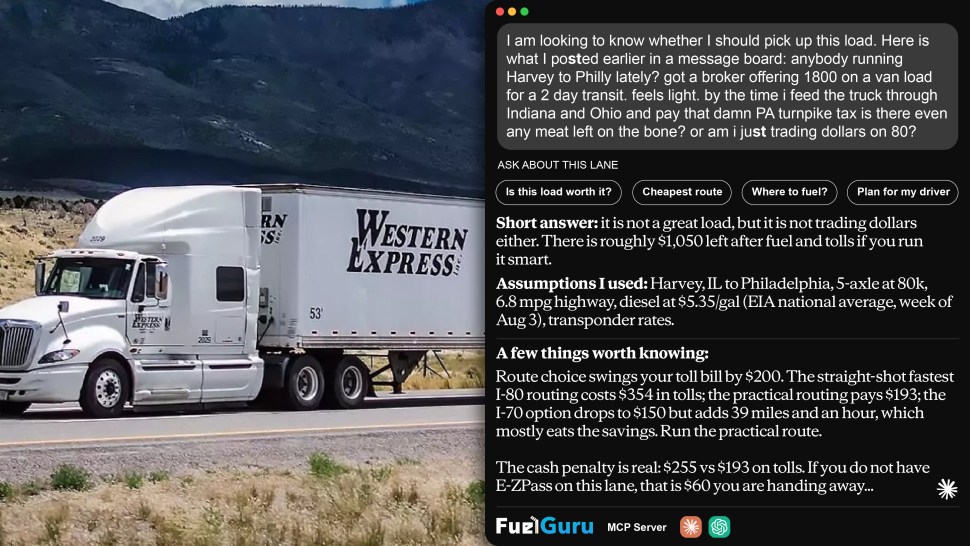
Mahlawat used a concrete example. A broker posts $1,800 all-in for a five-axle dry van from Harvey, Illinois, to Philadelphia. On the 773-mile practical route, that works out to about $2.33 a mile. The posted rate alone says nothing about what remains after route-specific fuel, tolls and time.
In an August 2026 FuelGuru analysis, MapUp priced three commercial routes for the same trip. The practical I-80 route covers 773 miles in 11 hours and 49 minutes of driving, more than a solo driver can legally run without a 10-hour break, with $192.97 in tolls and $554.58 in fuel, leaving $1,052.45 of the rate before driver pay, equipment and fixed costs. The fastest option, which combines I-80 with the Pennsylvania Turnpike, arrives 23 minutes sooner but leaves only $908.91.
That is $144 in extra fuel and tolls to buy back 23 minutes — a marginal tractor hour priced at $374. Very few fleets in North America treat a marginal hour of driver time at that rate. Many simply price all-in or chase a target rate per mile. The truck then takes the faster route because nobody priced the alternative before it rolled.
The cheapest line on the table punishes the opposite instinct. An I-70 routing carries the lowest tolls at $150.36 but adds 39 miles and 62 minutes. At a $54-an-hour loaded driver cost, that extra hour costs about $56 to save $22.77 in combined fuel and tolls — a net loss before it threatens the delivery window.
“This is why ‘avoid tolls’ is bad policy and ‘always take the toll road’ is worse,” wrote MapUp co-founder and Chief Technology Officer Maneesh Mahlawat in the company’s launch note. “Neither is a decision. Both are habits.”
Nick Brooks, vice president of technology and marketing at Western Express, said the timing of the calculation is what carries the operating value.
“Being able to come back with the real fuel cost and the real toll cost at the time you are going to incur it is infinitely valuable,” Brooks said. “As toll routing gets more complicated, it is going to make profitability happen quicker.”
A universal power adapter for freight math
FuelGuru first launched last year at FreightWaves’ F3: Future of Freight Festival, where FirstFleet Chief Information Officer Austin Henderson demonstrated it alongside NavGuru, MapUp’s commercial navigation product. It originally shipped as an API, so every platform that wanted the engine had to build a custom integration.
“MCP is like a universal power adapter,” Katie Mahlawat said. “You could say you want to connect your own phone to anyone else’s speaker. How do you like them to talk to each other? That’s it.”
Now the integration is largely a credential. “Get an API key from us, plug it in your Claude configuration, it gets added as a skill,” she said. “Now you have an agent which is a FuelGuru brain.”
An agent hands over the load, truck position, equipment, appointment windows, tank level, fuel economy, card pricing and fleet rules. FuelGuru returns practical, fastest, cheapest and alternate routes with drive time, vehicle-specific tolls, fleet-net fuel cost and prescribed stops.
The pricing is fleet-specific, not a national average. FuelGuru costs the negotiated rate the fleet’s card will actually capture at that station, against the state tax spread, the out-of-route miles to reach it, and the arrival time the hours-of-service plan predicts.
Lane profitability used to take a month and five teams
At a large carrier, pricing a lane often feels like navigating a committee. A sales team quoting next quarter’s rates collects cost history from the fuel desk, the toll team and finance. Those groups rarely hold the same version of the truth because of different incentives and data silos.
“That process takes somewhere between two, three weeks to a month, as well as coordination between four or five different teams, for their sales team to have that at their fingertips,” Mahlawat said.
For fleets already running MapUp, including FirstFleet and Western Express, the MCP server can read the carrier’s own history instead of relying on averaged or lagged data.
The same math reaches into fuel-surcharge negotiation. A carrier that can see route cost by customer can identify which accounts may carry a less favorable fuel-surcharge program. Mahlawat said the mismatch between static lane pricing and moving costs is what first pulled her into the problem.
“That means the same pricing is going on for a while, while things like fuel prices are fluctuating … every day toll hikes are happening.” One example was how Pennsylvania Turnpike tolls have increased every year since 2009. The five increases from 2022 through 2026 compound to about 25.
Without access to fleet-specific tools, a general-purpose chatbot falls back on public or historical estimates. It does not know a carrier’s negotiated fuel prices, card network, tank level, remaining driver hours or operating rules. “If you tell me $1,400 to $1,500 on a Wednesday evening or on a Sunday morning, it could be somewhere between $1,000 to actual $2,000,” Mahlawat said. “So this is what we are eliminating.”
Lane profitability for the 90%
Owner-operators and small fleets account for the vast majority of U.S. trucking carriers. Enterprise fuel-optimization tools were rarely built for them.
“So far 90% of trucking never had access to something like Expert Fuel or Manhattan Fuel and Route … because those are enterprise solutions and built that way,” Mahlawat said.
Bubba, the AI AutoPilot from Hey Bubba, is an early example. Through FuelGuru MCP it can evaluate available loads using the truck’s actual deadhead, commercial route, fuel plan, toll exposure and remaining hours.
“MapUp gives our AI the live fuel pricing, routing and toll intelligence to determine whether a load is cost-effective, whether to bid higher, which driver should run it and where that driver should fuel,” said Tapan Chaudhari, founder and CEO of Hey Bubba.
A prescription that never reaches the cab
Fuel optimization is not new. Compliance is where the value often leaks. Fleets that already own an optimizer commonly see driver adherence in the mid-70s percent range, in part because the plan lives in a back-office report while the driver lives in the truck.
“A perfect plan followed 74% of the time leaks a quarter of its value before anyone books a savings number,” Maneesh Mahlawat wrote.
MapUp splits the work. FuelGuru decides and NavGuru executes, placing the prescribed route and fuel stops into the driver’s turn-by-turn navigation. At one dedicated carrier running more than 2,500 trucks, fuel-prescription compliance moved from 74% to above 98% within four months of putting the plan where the driver already was.
The plan does not freeze at dispatch. Miss a stop, run off route or show less fuel in the tank than expected, and FuelGuru recalculates on current position, prices, time and fleet rules, then hands the revision to NavGuru.
“AI agents can automate a lot of work, but they still need the brain behind the decision,” Katie Mahlawat said. “FuelGuru MCP gives them the math to calculate the real cost of a route, including fuel, tolls and time. That is how they can understand what is actually a good load.”
Brokerage Compliance Symposium
The day before F3. Every compliance issue you face - fraud exposure, carrier liability, FMCSA rules, cargo theft, insurance gaps - navigated by attorneys and operators defining best practices in a changing industry.
F3 Awards Dinner
The night before F3. FreightTech100 companies honored. FreightTech 25 and Shipper of Choice winners revealed live. Cocktail reception into dinner and live music - 300 industry leaders in one purpose-built room.
F3: Future of Freight Festival
Industry-defining keynotes, rapid-fire technology demos, and industry leaders networking in experiences across Chattanooga - plus the inaugural F3 Awards Dinner featuring the FreightTech and Shipper of Choice reveals.
The day before F3. Every compliance issue you face - fraud exposure, carrier liability, FMCSA rules, cargo theft, insurance gaps - navigated by attorneys and operators defining best practices in a changing industry.
The Signal at Chattanooga Choo Choo • Chattanooga, TN Register NowThe night before F3. FreightTech100 companies honored. FreightTech 25 and Shipper of Choice winners revealed live. Cocktail reception into dinner and live music - 300 industry leaders in one purpose-built room.
The Signal at Chattanooga Choo Choo • Chattanooga, TN Register NowIndustry-defining keynotes, rapid-fire technology demos, and industry leaders networking in experiences across Chattanooga - plus the inaugural F3 Awards Dinner featuring the FreightTech and Shipper of Choice reveals.
The Signal at Chattanooga Choo Choo • Chattanooga, TN Register Now