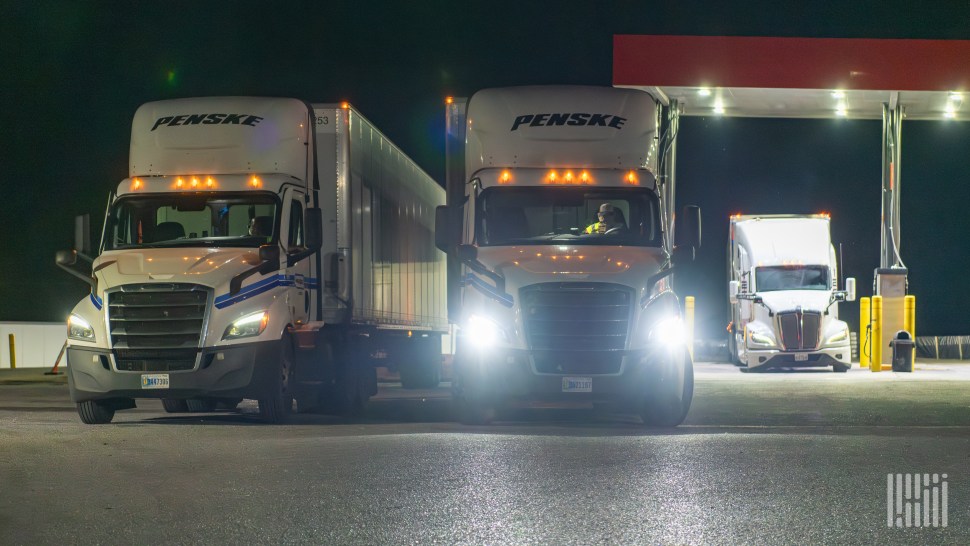
The Fifth Circuit Court of Appeals has reversed two earlier lower court decisions that were initially victories for companies in the sprawling Penske empire, with one of the reversals tied directly to the Supreme Court decision in Montgomery vs. Caribe Transport II.
In a decision handed down earlier this week, the Court of Appeals for the Fifth Circuit found that an earlier dismissal of broker Penske Transportation Management (PTM) from the case of Morales et. al vs. OK Trans et. al, an action based on a lower court’s interpretation of the Federal Aviation Administration Authorization Act (F4A), needed to be reversed because of the precedent set in Montgomery.
The decisions that went against Penske companies are now under the case of Crane vs. Liberty Lane, an outgrowth of the original lawsuit. The Morales lawsuit was filed in the Southern District of Texas after the fatal accident in December 2018 that killed Lydon Dean Meyer. He was driving a pickup truck struck by an OK Trans truck that had jackknifed and slid across the road.
Montgomery makes quick work in the appeal
The section in the six-page appellate court decision dealing with the PTM reversal is brief. It notes that the district court in May 2024 had granted PTM’s request for summary judgment to be dismissed from the case.
The district court’s argument was that the F4A’s provision that a state could not undertake action under the law that would affect a “price, route or service” included protecting a broker who had hired a carrier involved in an accident.
The plaintiffs’ argument in the appeal to the Fifth Circuit was that such an action could be pursued against a 3PL under the “safety exception” of F4A which permits a legal case if it involves safety issues.
Over several years, disputes and conflicts in several circuit courts that led to Montgomery centered on whether the safety exception could pull a broker into a state lawsuit. The Supreme Court ended that conflict in May when it unanimously said that yes, the safety exception’s language applying it “with respect to motor vehicles” meant brokers as well.
Montgomery was cited by the Fifth Circuit without much comment in its reversal of the earlier district court decision to dismiss PTM as a defendant in the case.
Several stops in the road to the crash
The driver and the carrier were on the road only after a series of transactions where the assignment of the freight went through several different hands, including two Penske-owned firms,including PTM.
The appellate court’s decision impacting Penske Logistics is more complex.
Penske Logistics is part of Penske Transportation Solutions. That company in turn is owned by a combination of Penske Corp., which is privately held, Mitsui & Co., and publicly-traded Penske Automotive Group (NYSE: PAG). Mitsui and Penske Corp have made an offer to buy that portion of Penske Automotive they do not already own.
A spokesman for Penske declined comment on the circuit court decision.
As a supply chain solutions company, Penske Logistics provides service as a carrier.
According to a recap of what happened leading up to the death of Meyer, automotive seating manufacturer Adient hired Penske Logistics to move its products.
But Penske, using the services of PTM which the court described as its “affiliate broker,” subcontracted out the work to another carrier, Liberty Lane.
Liberty Lane then subcontracted out the Adient shipment to a company called OK Trans. That carrier in turn hired Satnam Singh Lehal to drive the load, and he was behind the wheel when his truck jackknifed and Meyer was killed.
The plaintiffs’ argument, according to the appellate court’s recap, is that “Penske Logistics is vicariously liable for Lehal’s negligence as his statutory employer.”
Penske as an employer
That argument was rejected by the same district court that granted summary judgment to broker PTM under the provisions of F4A. The district court said Penske Logistics “was not Lehal’s statutory employer because its shipping arrangement was with Liberty Lane, not OK Trans or Lehal.” It also granted summary judgment to Penske Logistics and removed it as a defendant.
But in defeat number two in Crane vs. Liberty for a company named Penske, the Fifth Circuit reversed that finding in the same decision that brought PTM back into the ongoing litigation.
The foundation of the circuit court’s decision is that it assumes Penske Logistics is a motor carrier. That is significant to distinguish itself from one of the more controversial findings in the $600 million-plus nuclear verdict of Lipe vs. Lupus Superior, where C.H. Robinson (NASDAQ: CHRW) was found to be the employer of the Lupus Superior. That driver was an employee of Lupus Superior, a “W-2 employee” in human resources parlance.
Even though there was no formal arrangement between Penske Logistics and Lehal and his employer OK Trans, the court cited other precedents and statutes “which required Penske Logistics to take ‘control and responsibility for the operation of the equipment.’”
“Under our precedent, Penske’s assumption of control and responsibility of the vehicle made Penske Lehal’s statutory employer, regardless of whether Penske and Liberty Lane complied with the former regulatory requirements,” the court wrote. “Plainiffs can therefore hold Penske Logistics vicariously liable if they can establish the other elements of liability.”
Precedent existed
Marc Blubaugh, co-lead of the transportation practice at the Benesch law firm, said the decision involving Penske Logistics was not surprising.
“The proposition that a motor carrier (Penske Logistics) could be deemed the statutory employer of another motor carrier whose driver caused a collision isn’t groundbreaking,” Blubaugh said in an email to FreightWaves. “Various courts have addressed the issue in a variety of ways over the years, as the opinion itself recognizes.”
In reversing the district court on that issue as well, Penske Logistics was put back into the case. It was remanded back to the district court along with the question of liability for PTM, which presumably will be one of the most closely-watched cases of how a court deals with the new landscape of broker liability.
More articles by John Kingston
C.H. Robinson earnings call shifts to nuclear verdict as key topic
Shipper liability takes another Texas setback; CHRW plays offense
RXO, post-Montgomery, sees benefit in its insurance, vetting
Brokerage Compliance Symposium
The day before F3. Every compliance issue you face - fraud exposure, carrier liability, FMCSA rules, cargo theft, insurance gaps - navigated by attorneys and operators defining best practices in a changing industry.
F3 Awards Dinner
The night before F3. FreightTech100 companies honored. FreightTech 25 and Shipper of Choice winners revealed live. Cocktail reception into dinner and live music - 300 industry leaders in one purpose-built room.
F3: Future of Freight Festival
Industry-defining keynotes, rapid-fire technology demos, and industry leaders networking in experiences across Chattanooga - plus the inaugural F3 Awards Dinner featuring the FreightTech and Shipper of Choice reveals.
The day before F3. Every compliance issue you face - fraud exposure, carrier liability, FMCSA rules, cargo theft, insurance gaps - navigated by attorneys and operators defining best practices in a changing industry.
The Signal at Chattanooga Choo Choo • Chattanooga, TN Register NowThe night before F3. FreightTech100 companies honored. FreightTech 25 and Shipper of Choice winners revealed live. Cocktail reception into dinner and live music - 300 industry leaders in one purpose-built room.
The Signal at Chattanooga Choo Choo • Chattanooga, TN Register NowIndustry-defining keynotes, rapid-fire technology demos, and industry leaders networking in experiences across Chattanooga - plus the inaugural F3 Awards Dinner featuring the FreightTech and Shipper of Choice reveals.
The Signal at Chattanooga Choo Choo • Chattanooga, TN Register Now