




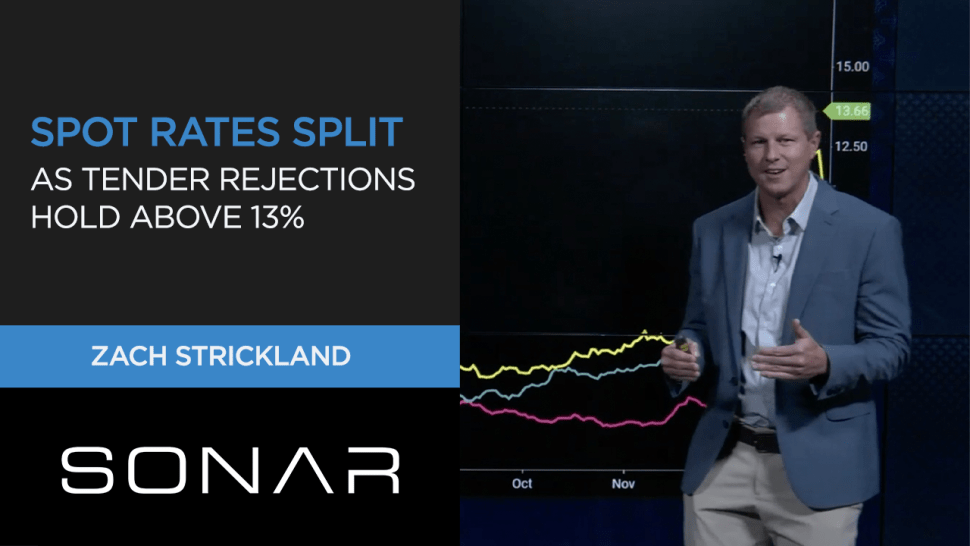
Tender rejections are stuck near 13.5%, still far above a balanced freight market — but spot rates and volumes are starting to tell a more complicated story. In this SONAR update, we break down why truckload demand softened faster than expected, how intermodal is taking share from long-haul truckload, why short-haul freight still looks firm, and where reefer spot rates are flashing regional pressure in the Midwest. If you run freight, buy capacity or price loads, this is the setup to watch now.
Truckload tender rejection rates have stalled at 13.5%, more than double the 5% to 7% range considered a balanced market, but a faster-than-expected demand pullback and a measurable shift toward intermodal are beginning to pressure dry van spot rates, according to Zach Strickland’s latest SONAR update.
Strickland noted that rejection rates sat near 5.5% one year ago, and that anything above the 10% threshold makes it “extremely challenging for most shippers to find capacity.” The current stall around 13.5% signals a still-tight market, but a trendline that formed in June had been pointing toward an eventual return to equilibrium in the 5% to 7% range — and demand has been eroding faster than seasonal norms suggest it should.
“One of the reasons for that, because we’re in a supply-side-led cycle, demand has really fallen down faster than we expected, especially from a seasonality standpoint,” Strickland said. The tender volume index, which measures shipper-to-carrier load tenders, has fallen below April levels — a notable drop given that April is itself a slow month and July typically only moderates modestly from June.
“We’re seeing almost a mirror image of replacement” — Zach Strickland, describing the divergence between long-haul truckload and domestic intermodal container volumes.
Long-haul truckload tender volumes are up just 2% year over year, while domestic intermodal container volumes have risen 8% year over year, and Strickland said the widening gap is a key driver of the modal shift narrative. Short-haul tender volumes — loads under 100 miles — are up 4% year over year, outpacing long-haul, and Strickland pointed to that resilience as evidence the truckload cycle is not nearing an early end. Short-haul freight is also the segment least susceptible to intermodal substitution.
On the spot rate side, a spread is opening among the three modes. Flatbed remains the strongest, supported by AI data center construction activity, though rates have begun to edge lower. Refrigerated spot rates, which had been moving nearly in lockstep with dry van, are now separating to the upside. Dry van, the mode most exposed to intermodal competition, is pulling back and would show a largely red — declining — national rate map, Strickland said.
A regional signal is drawing particular attention. Midwestern rejection rates spiked earlier this week, and the same pattern is now appearing in refrigerated spot rates, with increases concentrated in protein and grain corridors. Strickland flagged it as early for a harvest-driven rate move and called the region one to watch for carriers and shippers active in temperature-controlled freight.
- Tender rejection rates are holding at 13.5%, more than double the 5–7% balanced-market benchmark, but demand is falling faster than seasonal trends expected
- Domestic intermodal container volumes are up 8% year over year vs. 2% for long-haul truckload, pointing to modal shift as a key driver of dry van rate softness
- Midwest refrigerated spot rates and rejection rates are spiking early, with protein and grain corridors flagged as a region to watch ahead of harvest season
This Summary is generated thanks to a transcription of the interview, for the full interview please enjoy the video above.
Brokerage Compliance Symposium
The day before F3. Every compliance issue you face - fraud exposure, carrier liability, FMCSA rules, cargo theft, insurance gaps - navigated by attorneys and operators defining best practices in a changing industry.
F3 Awards Dinner
The night before F3. FreightTech100 companies honored. FreightTech 25 and Shipper of Choice winners revealed live. Cocktail reception into dinner and live music - 300 industry leaders in one purpose-built room.
F3: Future of Freight Festival
Industry-defining keynotes, rapid-fire technology demos, and industry leaders networking in experiences across Chattanooga - plus the inaugural F3 Awards Dinner featuring the FreightTech and Shipper of Choice reveals.
The day before F3. Every compliance issue you face - fraud exposure, carrier liability, FMCSA rules, cargo theft, insurance gaps - navigated by attorneys and operators defining best practices in a changing industry.
The Signal at Chattanooga Choo Choo • Chattanooga, TN Register NowThe night before F3. FreightTech100 companies honored. FreightTech 25 and Shipper of Choice winners revealed live. Cocktail reception into dinner and live music - 300 industry leaders in one purpose-built room.
The Signal at Chattanooga Choo Choo • Chattanooga, TN Register NowIndustry-defining keynotes, rapid-fire technology demos, and industry leaders networking in experiences across Chattanooga - plus the inaugural F3 Awards Dinner featuring the FreightTech and Shipper of Choice reveals.
The Signal at Chattanooga Choo Choo • Chattanooga, TN Register Now