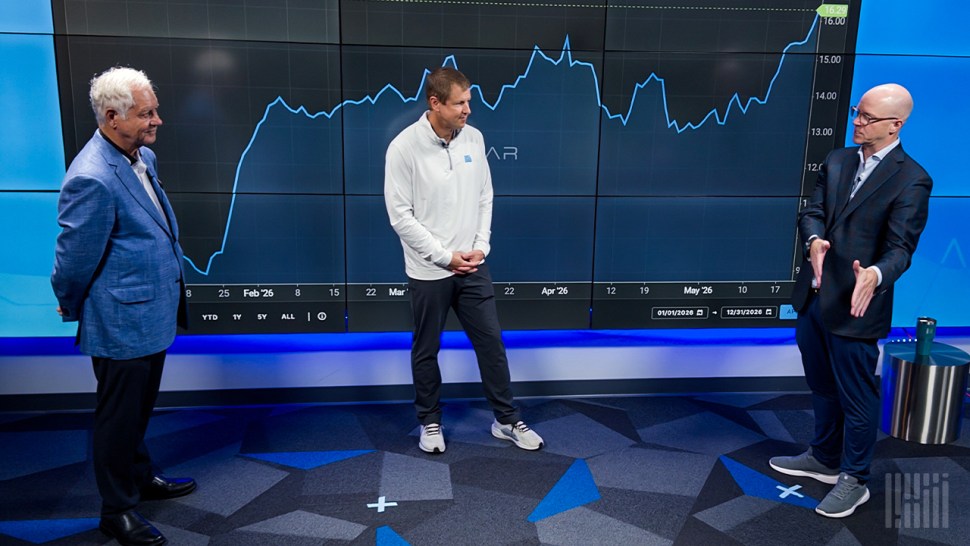
Max Fuller is the founder and former CEO of U.S Xpress. Dave Bozeman is the CEO of 3PL giant C.H. Robinson.
They didn’t plan it, but on Thursday they both expressed a view of the future of the freight market in public forums that has also been heard in conversations since the Supreme Court handed down its decision on broker liability last week in Montgomery vs. Caribe Transport II.
What Max Fuller and Bozeman said out loud is that the impact of the unanimous decision might not stop with brokers. Additionally, shippers might be as affected as 3PLs by the Montgomery decision.
That was one of several topics heard in this month’s FreightWaves State of Freight webinar, with the strengthening market never far from the discussion. Here are five takeaways:
Two industry leaders see peril for shippers
FreightWaves CEO Craig Fuller brought a guest on to the State of Freight: his father Max. The company Max Fuller founded, U.S. Xpress is now part of Knight Swift (NYSE: KNX).
Max Fuller turned out to be one of two trucking executives Thursday who publicly raised the prospect that the impact from Montgomery might not be limited to just brokers. It could extend to shippers as well.
The other was Bozeman (NASDAQ: CHRW). Bozeman, appearing Thursday before the Wolfe Research transportation conference in New York, said what many people have been considering since the Supreme Court handed down its decision last week.
The argument that shippers might now find themselves liable is that the Supreme Court found that the phrase “with respect to motor vehicles” in the so-called safety exception of the Federal Aviation Administration Authorization Act (F4A) applies to brokers. The safety exception allows state action on safety issues even as F4A bars it in many other areas.
Mixed decisions from federal courts protected 3PLs in some regions of the country but not in others. With the Montgomery decision, it’s now settled that the safety exception means brokers are “with respect to motor vehicles” and state actions like lawsuits can proceed against them.
But the Supreme Court didn’t say anything about shippers. Could they be sucked into that “with respect to motor vehicles” definition under the safety exception?
“Shippers are now going to have to start looking because this particular ruling now changes the dynamic and the space of where shippers can be liable on some things.” Bozeman said according to a transcript of his remarks. “So their vetting process of brokers is going to go up.”
Max Fuller, with his background as a carrier rather than a broker, said much the same thing in the State of Freight webinar. “From what I see, they’re progressing to the point where the shipper is going to have liability, kind of like brokers,” he said. Shippers at times will use a “cheaper carrier to get a cheaper rate,” Fuller said. “They support people that aren’t being as safe as they should.”
Craig Fuller said the current strengthening market, now aided by potential fallout from Montgomery, is the “the time when the shippers say ‘we’re partners.’” But he added that a legitimate response might be “where were you two years ago when I needed to move my truck?”
“They always come up with being partners when it gets into a tough market,” Max Fuller said.
Bozeman also expressed the view that C.H. Robinson–even though it was effectively the losing party in the decision–may benefit from Montgomery’s consequences.
Shippers “(are) going to want a broker that has the strong economics and the strong service schedule to be able to have trust in where they move their goods.” Bozeman said. “And that means a lot of those kinds of smaller, less-scaled brokers will probably be hampered and come out of the system. That could be 20%, 30% of that. “
Strength into Memorial Day likely to continue
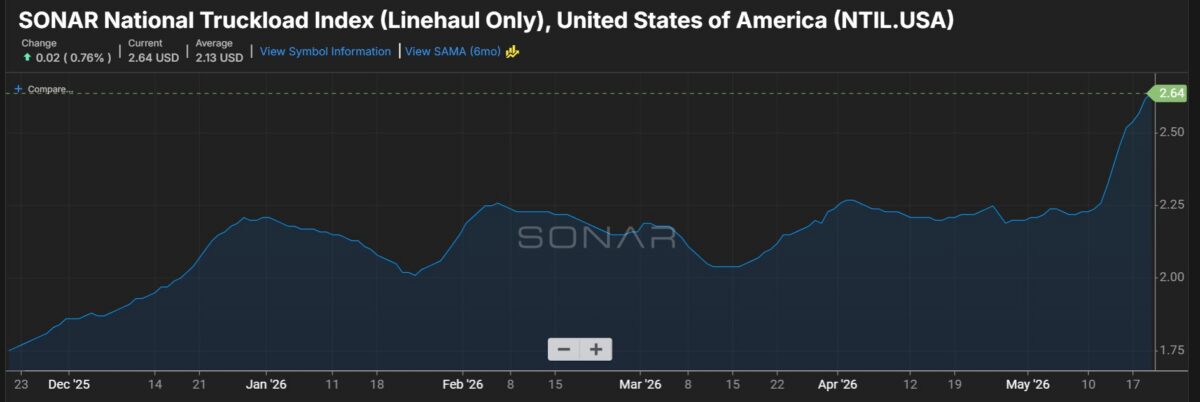
Craig Fuller and Zach Strickland, SONAR’s head of market intelligence, posted what has become a regular feature of the State of Freight webinars since late last year: a chart showing rising freight rates.
SONAR’s National Truckload Index (Linehaul only) is up to $2.64 per mile. On May 1, it was just under $2.20 per mile.
“I think this is the lowest number for what we’ll see all weekend,” Fuller said. “I think this is going to continue to rally through the weekend. I don’t see any softness coming into Memorial Day.”
Strickland noted that June tends to be the busiest month of the year in freight markets. Fuller said that was a contrast to other holidays, where there is often a “pretty significant slump” in freight demand after the celebration has passed.
“Let’s remember what happens in June,” Fuller said. “You’ve got a combination of beverages shipping, you’ve got the big construction season, you’ve got gardening, you have a lot of the summer goods and summer activities that take place.” And back-to-school shipping starts to emerge then as well, Fuller added.
“There’s no reason to think we won’t have a real bullish June,” he said.
Reason for overcapacity is becoming clear
Fuller conceded that he did not realize how much capacity was being impacted by immigrant drivers until they started to disappear from the market under the Trump administration crackdown on such issues as English language proficiency and non-domiciled CDLs.
“We didn’t realize that immigration was so pervasive and how much expansion was being caused through a lot of new entrants in the market,” Fuller said. “We now know that this was a largely oversupplied situation caused by immigrants.”
Fuller noted that he and Strickland, during the depths of the freight recession, would ask “what is keeping these trucks alive?”
“It’s very clear now that this was a labor availability and immigration-related availability that really kept a lot of new entrants in the market that was oversupplied,” Fuller said.
The market has legs…so hire some drivers
As the three presenters agreed that the strong market looks like it is here to say, Craig Fuller asked his father how he would react if was running a company now.
“I’d be trying to hire every driver I could going into this environment,” Max Fuller said. “We’ve gone through four years of a down cycle, you’re probably going to go through at least four years of an up cycle with probably premium rates that we’ve never seen before.”
With that projection, Max Fuller said, companies are probably going to start buying more trucks, “and that’s when they start hiring drivers.”
Data centers boosts demand
While Fuller and Strickland may have talked about beverages and summer equipment, Fuller said much of the increase driving demand has been from the U.S. industrial sector.
Fuller and Strickland showed the chart of the Outbound Tender Volume Index (OTVI), which measures demand. Even as some parts of the economy have been softening, like consumer packaged goods (CPGs), the OTVI continues to climb.
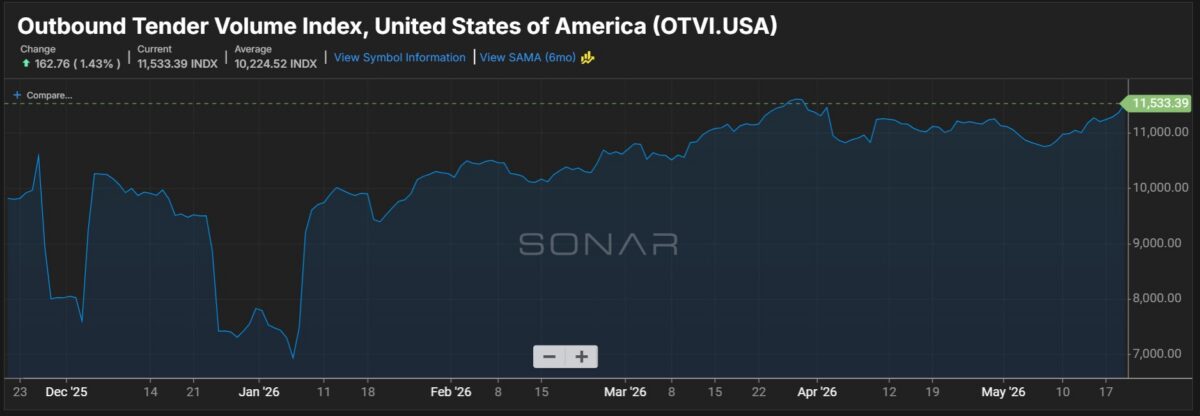
“What we have now is $800 million of capital spending coming into the economy through AI data center construction,” Fuller said. He added by way of comparison that construction of the interstate highway system was a $700 billion project.
The impact on demand from the data center construction “is a lot bigger factor than I think a lot of people may understand,” Fuller said.
Industrial demand “has not been participating in the market for many years,” he added. But now, “it’s going to drive us to the best year on the demand side.”
More articles by John Kingston
Crucial changes in latest NJ independent contractor rule impacting truckers
New pot of money available to buy ZEV trucks in California
BMO’s transportation group, huge lender to trucking, is being sold
Brokerage Compliance Symposium
The day before F3. Every compliance issue you face - fraud exposure, carrier liability, FMCSA rules, cargo theft, insurance gaps - navigated by attorneys and operators defining best practices in a changing industry.
F3 Awards Dinner
The night before F3. FreightTech100 companies honored. FreightTech 25 and Shipper of Choice winners revealed live. Cocktail reception into dinner and live music - 300 industry leaders in one purpose-built room.
F3: Future of Freight Festival
Industry-defining keynotes, rapid-fire technology demos, and industry leaders networking in experiences across Chattanooga - plus the inaugural F3 Awards Dinner featuring the FreightTech and Shipper of Choice reveals.
The day before F3. Every compliance issue you face - fraud exposure, carrier liability, FMCSA rules, cargo theft, insurance gaps - navigated by attorneys and operators defining best practices in a changing industry.
The Signal at Chattanooga Choo Choo • Chattanooga, TN Register NowThe night before F3. FreightTech100 companies honored. FreightTech 25 and Shipper of Choice winners revealed live. Cocktail reception into dinner and live music - 300 industry leaders in one purpose-built room.
The Signal at Chattanooga Choo Choo • Chattanooga, TN Register NowIndustry-defining keynotes, rapid-fire technology demos, and industry leaders networking in experiences across Chattanooga - plus the inaugural F3 Awards Dinner featuring the FreightTech and Shipper of Choice reveals.
The Signal at Chattanooga Choo Choo • Chattanooga, TN Register Now