






A toll transaction records a time, a location, a lane, a vehicle, and a plate. It reaches most fleets as a single line on a monthly bill.
Everything except the dollar figure gets set aside. It is the least useful part of the record.
Consider two fleets running similar lanes in one region under identical published rates. One posts a predictable toll bill every month. The other watches toll spend climb and cannot say why. Both pay the same rates, so the gap comes from how each fleet runs, and the evidence is in toll data that neither of them reads.
Rates get the attention because they are easy to see. They are also the part nobody controls.
What fleet toll management can control
Toll rates went up again in 2026. The Pennsylvania Turnpike raised rates 4% in January. The MTA went up 7.5% across all its facilities. The network keeps growing too, with new capacity opening this year in Kansas, Washington, Virginia, and Texas.
All of it is announced in advance. Fleets can budget for it and move on. That is the part of fleet toll management you control.
What you cannot budget for is narrower and more specific. It is the one charge that looks wrong and takes half a day to run down, multiplied across a month of charges. On the invoice, it appears as nothing but a number.
What your toll data records that the invoice leaves out
Charges like that are operational facts. They reach you as an amount, and when toll spend climbs faster than rates do, the cause is usually in that detail. Across the toll activity PrePass® processes for fleets, a few patterns come up again and again.
- Express lane usage. Drivers taking premium lanes when the schedule did not require it. One charge is easy to justify. The same truck doing it every week is a policy question.
- Out-of-route activity. Detours, late route changes, and driver preference putting trucks on toll roads they did not need.
- Transponder mismatch and plate mismatch. A device moved between trucks, or a plate assigned to the wrong vehicle, so charges land on the wrong asset and cost allocation quietly stops being accurate.
- Max toll charges. An agency applying its highest rate when entry or exit information is missing.
- Unmatched location. A charge recorded at a plaza where vehicle GPS does not show the truck.
- Duplicate charges and classification errors.
Read as accounting, each charge is a small variance not worth chasing. Read as operations, together they describe how the fleet actually ran last month. Which lanes drivers preferred. Which trucks left the route. Where equipment records drifted out of date. Which agencies billed for something nobody can verify.
That information already exists. A fleet pays to generate it every time a truck crosses a plaza. Almost none of it gets used.
Why toll analytics is harder than it sounds
The volume is real. A large operation can generate tens of thousands of toll transactions a month across a dozen or more agencies, each with its own file format and billing cycle. Someone reviews the biggest charges, the violations, and whatever a customer calls about. That process is good at finding isolated problems and poor at finding patterns. The larger costs are in the patterns.
Volume is only part of it. The bigger problem is that no single system holds the answer.
Toll records sit with the agencies. GPS data sits with your telematics provider. Vehicle and plate assignments sit in your fleet records. Rental and lease information sits somewhere else again, often with a partner. Ask whether one specific charge was correct and answering it means pulling from at least three of those. With a thousand charges, nobody asks at all.
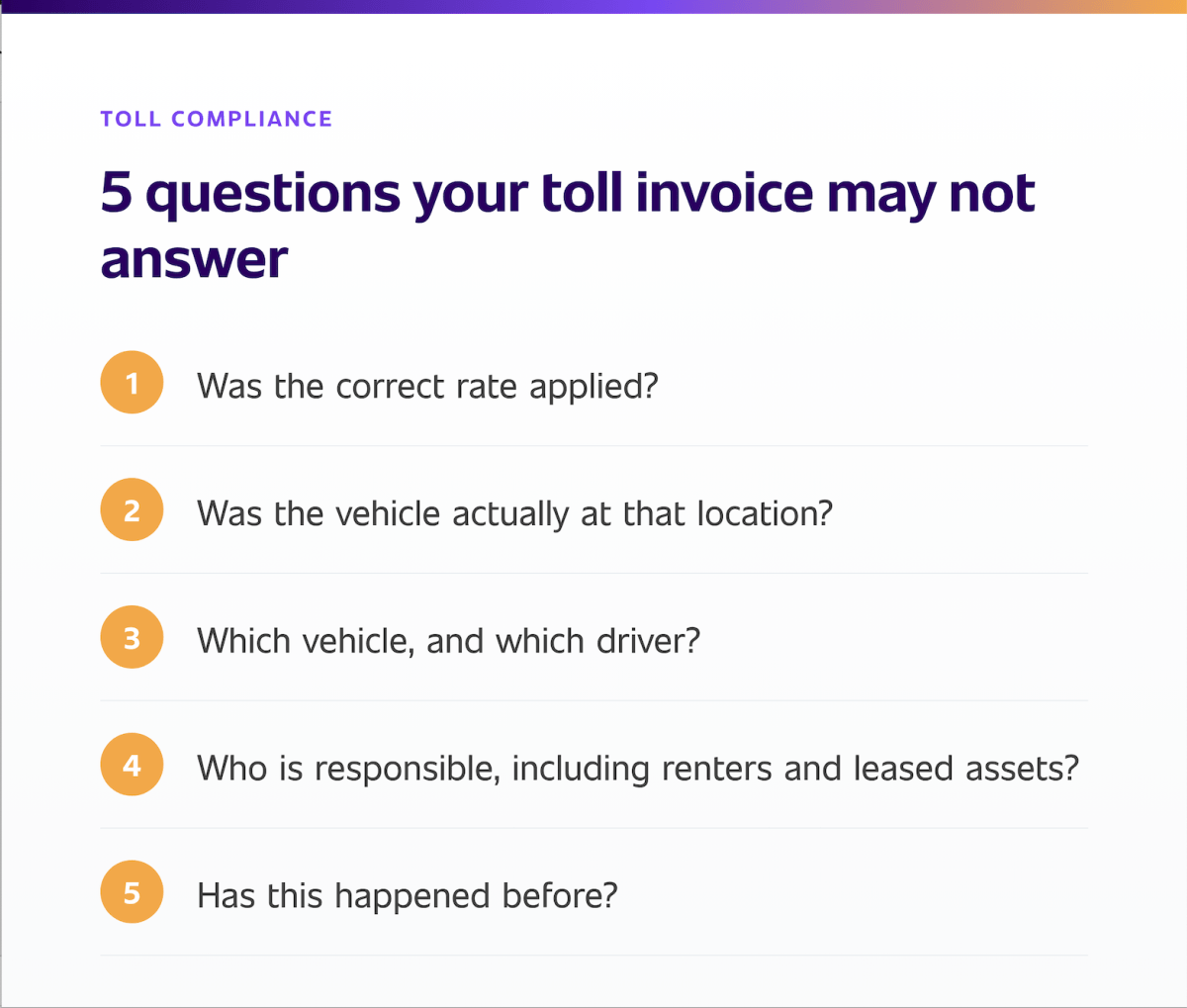
Which is why the useful information only appears when the sources are read together. Take a charge recorded at a plaza your truck never passed through. In the toll record it looks ordinary. In the GPS record there is nothing, because nothing happened. The problem shows up only when you put the two side by side.
That is the bar for toll analytics: checking charges against what the operation actually did.
That comparison is easy to describe and tedious to run. Checking one charge against GPS takes a few minutes. Checking tens of thousands is arithmetic at a scale no one has time for. This is what AI is good at. It reads every transaction, compares it against vehicle, plate, and location records, and flags the few that do not reconcile. The software decides nothing. It narrows a month of charges to the ones worth a person’s attention.
What toll management software changes
When those records are read together continuously, the question changes. Instead of asking what the fleet spent last month, an operations leader can ask why the same issue keeps appearing on the same lane, the same truck, or the same driver.
Charges get confirmed before payment rather than investigated after it. Costs land on the right vehicle, renter, or customer. Recurring issues appear as trends instead of one-offs.
Fleet operations has done this before. Fuel, maintenance, and routing all moved from monthly reporting to daily operating data. Toll is the last major area of fleet cost still handled mostly as an accounting task.
Where to start
Fleets working on this have a few options. PrePass Toll Management approaches it by bringing toll activity from multiple agencies into one place through INFORMTM Tolling, so separate agency bills arrive as a single monthly invoice.
From there, GPS Toll Verification checks when and where charges occurred against route and GPS data, and AI Toll Insights connects toll, GPS, and vehicle data to surface transponder mismatch, plate mismatch, express lane usage, max toll charges, unmatched location events, and out-of-route activity. The intent is to point a team at what needs review rather than ask them to read every transaction. The Violation Prevention Service helps maintain continuous plate coverage, and the Violations Settlement Service works with participating agencies on outstanding violations.
Toll rates will keep rising, and that part is out of your hands. What your toll data says about your operation is not.
PrePass Toll Management, including GPS Toll Verification and AI Toll Insights, is at prepass.com/tollmanagement.
Sources
- 1. Pennsylvania Turnpike Commission, 2026 toll rates: https://www.paturnpike.com/news/pa-turnpike-blog/details/blog/2025/07/01/understanding-the-pa-turnpike-s-2026-toll-rates
- 2. Metropolitan Transportation Authority, 2025 fare and toll changes: https://www.mta.info/fares-tolls/2025-changes
New network capacity referenced generally by state, supported in these links:
- 3. Kansas Turnpike Authority, 69 Express: https://69express.ksdot.gov/
- 4. Washington State DOT, Puget Sound Gateway Program (SR 167):
https://wsdot.wa.gov/construction-planning/major-projects/puget-sound-gateway-program
- 5. Virginia DOT, 495 Express Lanes Northern Extension: https://495next.vdot.virginia.gov/
- 6. TEXpress Lanes, I-635 East and I-30 projects: https://www.texpresslanes.com/projects/lbj/
Brokerage Compliance Symposium
The day before F3. Every compliance issue you face - fraud exposure, carrier liability, FMCSA rules, cargo theft, insurance gaps - navigated by attorneys and operators defining best practices in a changing industry.
F3 Awards Dinner
The night before F3. FreightTech100 companies honored. FreightTech 25 and Shipper of Choice winners revealed live. Cocktail reception into dinner and live music - 300 industry leaders in one purpose-built room.
F3: Future of Freight Festival
Industry-defining keynotes, rapid-fire technology demos, and industry leaders networking in experiences across Chattanooga - plus the inaugural F3 Awards Dinner featuring the FreightTech and Shipper of Choice reveals.
The day before F3. Every compliance issue you face - fraud exposure, carrier liability, FMCSA rules, cargo theft, insurance gaps - navigated by attorneys and operators defining best practices in a changing industry.
The Signal at Chattanooga Choo Choo • Chattanooga, TN Register NowThe night before F3. FreightTech100 companies honored. FreightTech 25 and Shipper of Choice winners revealed live. Cocktail reception into dinner and live music - 300 industry leaders in one purpose-built room.
The Signal at Chattanooga Choo Choo • Chattanooga, TN Register NowIndustry-defining keynotes, rapid-fire technology demos, and industry leaders networking in experiences across Chattanooga - plus the inaugural F3 Awards Dinner featuring the FreightTech and Shipper of Choice reveals.
The Signal at Chattanooga Choo Choo • Chattanooga, TN Register Now