




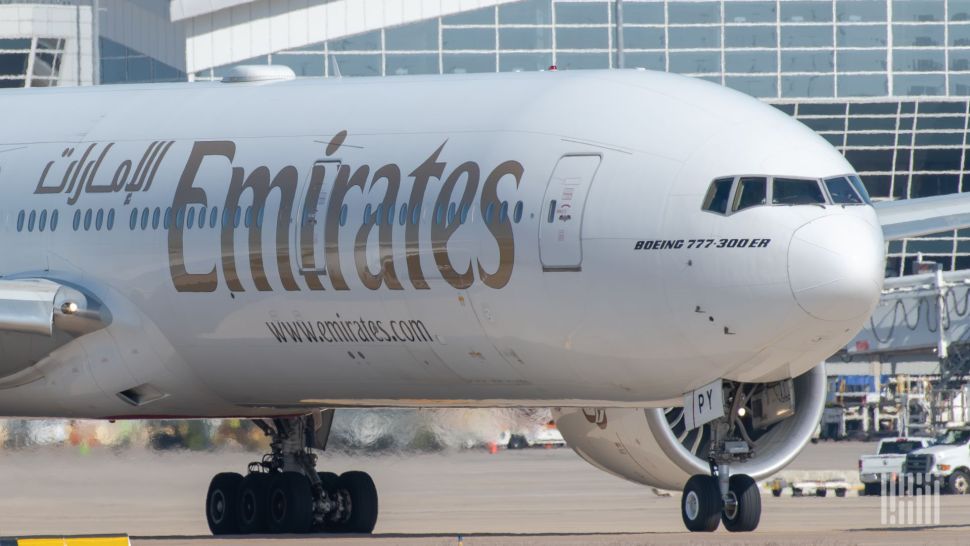
The Federal Aviation Administration’s decision last week to waive an upcoming production ban for the Boeing 777 freighter is welcome news for airlines and freight forwarders because the air cargo industry is experiencing a shortage of widebody capacity.
The FAA granted Boeing (NYSE: BA) an exemption to produce 35 777 freighter aircraft beyond the Jan. 1, 2028 international deadline mandating the use of cleaner engines, saying an extension is in the public interest so Boeing can continue to meet customer demand until its next-generation 777-8 cargo jet becomes commercially available.
The supply of air cargo capacity continues to be constrained due to retirements of aging freighter aircraft amid strong demand associated with the AI data center boom and ocean shipping disruptions created by the Iran war.
Compounding the space crunch is the fact that Airbus and Boeing are producing fewer widebody passenger planes, which normally carry about 50% of global air cargo shipments in their lower holds, than they did before Covid. In 2019, the two manufacturers delivered 345 large passenger aircraft. Last year, they combined for 179 deliveries and are on pace for only a few more deliveries in 2026 because of ongoing engine quality and supply chain issues, said air freight consultant Tom Crabtree. The result is that freighters are currently handling about 60% of total volume.
Air cargo volume is up more than 4.7% year over year through August, well above a slight increase in capacity. The market dynamic has helped push spot rates up by more than 25% from the prior year, according to market researchers.
Boeing estimates that without the exemption it would lose more than $15 billion in export sales.
International Civil Aviation Organization agreements ban commercial aircraft manufacturers from selling large aircraft that don’t meet 2028 fuel efficiency and carbon emissions standards. Without the exemption, Boeing would not be eligible to receive FAA airworthiness certificates for the 777F after 2027.
Under the Biden administration, the FAA in early 2024 issued a rule to reduce carbon pollution emitted by large aircraft flying in U.S. airspace, essentially adopting the ICAO standard in U.S. law. The rule only applied to new aircraft, not aircraft produced prior to Dec. 31, 2027 and already in service.
In December, Boeing petitioned the FAA for an exemption by April 2026 so it could maintain uninterrupted production while it finalizes development of a successor freighter that complies with new standards. At the time, e-commerce was still considered a major driver of air cargo growth, but new restrictions on parcel-level imports in the United States and Europe have since slowed B2C shipments volumes moving by air. It also argued that without the exemption, airlines might hold on longer to older, more polluting aircraft rather than investing in the legacy 777, which is more fuel efficient than previous types, such as the Boeing 747-400.
The 777 is a large widebody freighter primarily used by cargo airlines such as FedEx, DHL and Lufthansa Cargo on long-haul, intercontinental routes.
Why It Matters: Having more access to capacity for fleet expansion or modernization is good news for cargo airlines, especially since next-generation Boeing and Airbus freighters have faced development delays and production rates are likely to be slow at the outset, although no trade associations or airlines wanted to publicly comment on the FAA’s decision. Some customers of the 777-9 passenger variant also want Boeing to delay freighter deliveries so it can focus on delivering more passenger models, according to Leeham News.
Korean Air last week finalized an order for eight 777-8 freighters after signing a tentative purchase agreement in August 2025. Boeing has booked more than 80 orders for the next-gen freighter. After years of development delays, Boeing is not expected to make first deliveries of the 777-8 until late 2028 or 2029.
The FAA decision gives Boeing a three-year window, until Jan. 1, 2031, to sell the 35 units. It also extends flying privileges for 777F users beyond the United States to foreign countries that have bilateral aviation agreements with the U.S. The number of exemptions falls below the threshold allowed in the ICAO guidance for the airplane type.
The agency said the additional fuel burn from the 35 additional aircraft — a fraction of a percent — was so negligible that the environmental impact of producing them compared to overall emissions from the commercial fleet was minimal.
“The FAA has determined the exemption is in the public interest due to the limited number of potentially exempted airplanes, the unavailability of the more fuel-efficient B777-8F, the production timelines associated with the 777F and its replacement 777-8F, the limited operational and environmental impacts, continued economic benefits, consistency with international guidance, and the potential acceptance by foreign authorities,” the exemption order stated.
Engine-maker GE Aerospace, the Aerospace Industries Association, the California Manufacturers and Technology Association, the National Association of Manufacturers and the U.S. Chamber of Commerce supported the exemption in government filings.
The European Aviation Safety Agency, which is the primary regulator for Europe-based Airbus, did not object to the exemption. Still, the possibility remains that a foreign government could prohibit airlines from operating post-2027 classic 777s in their airspace.
Airbus is developing an all-new A350 freighter, which is tentatively scheduled to make its commercial debut in late 2027.
Boeing originally stated that it didn’t plan to produce 777 freighters beyond what were on the order book at the end of 2024, but changed its mind as customers continued to ask for planes. Taiwan-based China Airlines and China Southern Airlines this summer each ordered two classic 777 freighters, while Saudia ordered four of the cargo jets. China Airlines also ordered four classic 777s last November.
Boeing also has six unfilled orders from Russia-based Volga-Dnepr airlines on its books that likely will never be produced because of export restrictions triggered by Russia’s attack on Ukraine. Those production slots eventually could be reallocated to another airline.
“I believe that by the end of 2030, Boeing will probably have delivered between 390 and 400 units, based on my estimates, making it the most popular widebody freighter ever,” said Crabtree.
In 2024, Congress passed legislation giving Boeing an additional five years to produce the 767 medium-widebody freighter for FedEx and UPS. But management later that year said it would sunset 767 production at the end of 2027.
Click here for more FreightWaves/American Shipper stories by Eric Kulisch.
RELATED STORIES:
China Southern Airlines to lease Boeing 777-300 converted freighters
Ocean shipping giant MSC orders next-gen 777-8 cargo jets from Boeing
Brokerage Compliance Symposium
The day before F3. Every compliance issue you face - fraud exposure, carrier liability, FMCSA rules, cargo theft, insurance gaps - navigated by attorneys and operators defining best practices in a changing industry.
F3 Awards Dinner
The night before F3. FreightTech100 companies honored. FreightTech 25 and Shipper of Choice winners revealed live. Cocktail reception into dinner and live music - 300 industry leaders in one purpose-built room.
F3: Future of Freight Festival
Industry-defining keynotes, rapid-fire technology demos, and industry leaders networking in experiences across Chattanooga - plus the inaugural F3 Awards Dinner featuring the FreightTech and Shipper of Choice reveals.
The day before F3. Every compliance issue you face - fraud exposure, carrier liability, FMCSA rules, cargo theft, insurance gaps - navigated by attorneys and operators defining best practices in a changing industry.
The Signal at Chattanooga Choo Choo • Chattanooga, TN Register NowThe night before F3. FreightTech100 companies honored. FreightTech 25 and Shipper of Choice winners revealed live. Cocktail reception into dinner and live music - 300 industry leaders in one purpose-built room.
The Signal at Chattanooga Choo Choo • Chattanooga, TN Register NowIndustry-defining keynotes, rapid-fire technology demos, and industry leaders networking in experiences across Chattanooga - plus the inaugural F3 Awards Dinner featuring the FreightTech and Shipper of Choice reveals.
The Signal at Chattanooga Choo Choo • Chattanooga, TN Register Now