The Real Impact of FMCSA’s English Proficiency Enforcement

Let’s get one thing straight up front—this isn’t about politics, and it’s not about opinion. This is about operational reality. The FMCSA’s renewed enforcement of English proficiency rules isn’t new, but it is hitting harder now, and if you’re not paying attention, it can cost you.

Small fleets and owner-operators need to stop treating this as some side-note regulation. Because it’s not. It’s showing up in audits, roadside inspections, and now—more than ever—it’s being used as a gatekeeping tool for who gets to play and who gets sidelined.

So let’s break this down the right way: what’s happening, why it matters, how it impacts your operation, and what you need to do now before it bites you in the back office or out on the road.

What the Regulation Actually Says

The FMCSA requires that any commercial motor vehicle operator must be able to:

  • Read and speak the English language sufficiently to converse with the general public,
  • Understand highway traffic signs and signals in the English language,
  • Respond to official inquiries, and
  • Make entries on reports and records.

It’s written right into 49 CFR § 391.11(b)(2). And again—this isn’t new. But in 2024 and beyond, enforcement is tightening up in ways small carriers cannot afford to ignore.

What’s Actually Happening on the Ground

Here’s what enforcement looks like in real life:

  • Drivers getting flagged during roadside inspections not for speeding, not for hours of service—but because they “couldn’t effectively communicate” with the officer.
  • Auditors documenting violations when a safety manager or driver couldn’t explain required logs or paperwork clearly enough during a compliance review.
  • Shippers and brokers quietly blacklisted carriers because their communication was difficult, unclear, or broke down at critical moments.

This is becoming an operational risk factor. Not a personal one. If your driver can’t confirm directions, clarify pickup numbers, or speak effectively to DOT during a stop—you don’t just have a language barrier. You have a business liability.
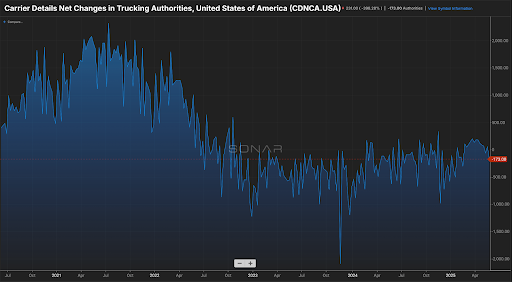
(Source: SONAR Carrier Details Net Change in Trucking Authorities (CDNCA.USA). Overall carrier counts continue to fall with new fraud prevention features in the FMCSA carrier registration process along with ELP enforcement mandates being communicated)

Who This Hits the Hardest

Let’s be honest: this hits immigrant-owned and non-native English-speaking carriers the hardest. And while we can debate fairness all day long, the reality is this: FMCSA doesn’t grade on a curve.

If you or your drivers are operating in this system, you’re expected to meet the standard. Doesn’t matter where you’re from or how good your operation runs otherwise.

And that’s where a lot of small fleets get caught off guard. They assume that as long as they’re safe, compliant, and professional, that’s enough. It’s not.

The Business Risks You’re Not Seeing

This isn’t just about avoiding a ticket or a violation. The real risks go deeper than that:

1. Insurance Premiums and Underwriting

Insurance companies monitor inspection reports and safety data. Too many language-related issues in the books? That’s a risk marker. Your premium’s going up—or worse, you won’t get renewed.

2. Broker Relationships

Brokers are constantly evaluating carrier performance. If your driver can’t clearly confirm appointments, answer phone calls, or communicate updates—it creates friction. That friction turns into lost freight.

3. DOT Audits

Language-related deficiencies can trigger audit findings in:

  • Driver qualification files
  • Training logs
  • Safety communication documentation

And once you’re flagged for noncompliance, it’s a short walk to conditional ratings, intervention letters, and even involuntary out-of-service orders.

Real-World Scenario

Let’s say you’ve got a great driver—hardworking, dependable, safe on the road. But he struggles with English, especially on the phone. One day he gets pulled over for a routine inspection. The officer asks a few questions—Where are you coming from? Where are you headed? What’s your load?

The driver can’t clearly answer.

Now that officer checks the English proficiency box as “Unable to communicate effectively.” That report gets logged. It’s now part of your safety profile. And if that happens more than once, it starts raising flags that your hiring process doesn’t meet FMCSA standards.

Now imagine an insurance renewal or a DOT audit happens while that’s sitting in your file. Think they’re going to overlook it?

What FMCSA Is Really Enforcing

FMCSA isn’t out here acting like English teachers. They’re not looking for perfect grammar or native fluency.

What they are looking for is functional communication.

Can the driver:

  • Understand and follow verbal instructions?
  • Respond to law enforcement or shipper personnel?
  • Complete their logs, inspections, and required forms without assistance?

If the answer is no, then enforcement can—and likely will—follow. And in 2025, that means compliance reviews aren’t just about logs and maintenance anymore. They’re about communication too.

So What Do You Do About It?

Here’s what you don’t do: bury your head in the sand and hope nobody checks. That’s not leadership. That’s negligence.

If you’re running a small fleet, here’s how to address this head-on:

1. Assess Your Current Roster

Start with an honest internal review. Can every driver on your team:

  • Speak clearly enough to hold a phone conversation with a shipper or officer?
  • Fill out DVIRs, logbooks, and inspection reports without assistance?
  • Ask for help or give updates when something goes wrong?

If not, it’s time for a conversation.

2. Invest in Communication Training

Don’t overthink this. You don’t need a language lab. You need a structure:

  • Set up a weekly 15-minute communication call for non-native speakers
  • Role-play common broker and DOT questions
  • Use apps like Duolingo or Babbel as part of onboarding
  • Partner with a local ESL program to offer basic English improvement tools

Small steps go a long way. This is about getting drivers functional, not fluent.

3. Document Everything

If you’re taking steps to train or improve English proficiency, log it.
Create a folder in your DQ files labeled “Communication Training” and add:

  • Sign-in sheets from calls or sessions
  • Certificates from language apps
  • Notes from coaching sessions

If FMCSA comes knocking, you want to show you’ve addressed the regulation, not ignored it.

4. Revise Your Hiring Standards

Make English proficiency part of your hiring checklist. Ask questions that test for it—not just “Can you speak English?” but actual situational examples:

  • “How would you handle a shipper that says your load isn’t ready?”
  • “What do you say if DOT pulls you over and asks for your last log entry?”

If they can’t get through those basics, they’re not ready to run under your authority yet.

Let’s Talk About Culture

Some folks hear “language enforcement” and immediately go defensive. They see it as an attack on who they are, how they speak, or where they’re from. That’s not what this is.

This is about safety, communication, and compliance. The truth is, some of the best drivers in the country didn’t grow up speaking English. But they worked at it. They adapted. They built businesses and reputations because they understood that in this industry, communication is currency.

If you want to protect your authority, keep your safety rating intact, and get taken seriously by brokers and shippers—you have to lead from the front.

Final Word

The FMCSA’s enforcement on English proficiency isn’t about discrimination—it’s about operational standards. And like it or not, it’s here, and it’s not going away.

If you run a small fleet, you can’t afford to have your reputation—or your revenue—tied up in communication breakdowns. Every inspection, every load, every broker call is a chance to either build trust or lose it.

Start training. Start testing. Start documenting. Because in this business, communication isn’t a soft skill. It’s a safety requirement.

And if you don’t manage it, FMCSA will.
Overhaul’s FraudWatch: a new paradigm in freight fraud prevention

Freight fraud has emerged as one of the most rapidly growing and financially devastating risks in today’s global supply chain landscape. With global cargo theft losses exceeding $80 billion in 2023 and the average cost of a successful fictitious pickup surging to $365,000 per incident in Q1 2024, the industry has been desperately seeking more effective solutions. Enter Overhaul’s FraudWatch, a winner of the 2025 FreightWaves Fraud Fighter Awards, which has revolutionized the approach to freight security.

Unlike traditional tools that focus on recovery after theft has occurred, FraudWatch breaks new ground by proactively identifying and stopping fraud attempts before they can impact the bottom line. This shift from reactive to preventive risk management marks a breakthrough in how the industry combats increasingly sophisticated cargo theft schemes.

“It is a team sport; you need everyone involved in your supply chain to be actively involved in combating fraud for your efforts to be successful,” Overhaul wrote in its application materials. “Knowing who is working to keep your supply chain secure is only possible with granular visibility. You can’t make assumptions or hope for the best: it’s about using real data and real visibility to stop fraud in its tracks.”

At its core, FraudWatch offers real-time, pre-shipment risk detection powered by Overhaul’s AI-driven Intelligence platform. The solution verifies carrier and driver identities, flags suspicious behavior, and prevents loads from being assigned to bad actors before theft can occur.

FraudWatch analyzes data across Overhaul’s global shipment footprint and employs advanced machine learning and natural language processing to detect red flags—whether it’s mismatched booking data, suspicious communications, or a newly registered MC number with no verifiable history. It then delivers real-time risk scores and fraud alerts directly into existing transportation workflows, making prevention both scalable and actionable.

What truly sets FraudWatch apart is its two-step verification process. It is “the only carrier verification and fraud detection solution that delivers two-step verification to eliminate threat of double brokering – carrier/driver verification at point of carrier assignment and again at point of shipment pick up.” This comprehensive approach provides an unprecedented level of security in an increasingly high-risk environment.

The impact of FraudWatch has been significant. The solution is market-tested on thousands of shipments, saving customers over $100 million in potential losses during its early adoption phase in 2024 alone. In fact, 14% of all U.S. motor carriers that FraudWatch screens at pickup are flagged as high-risk—7% identified as potential bad actors and 12% found to be operating without proper FMCSA authority.

These findings illustrate how widespread fraud risks remain, even among seemingly vetted carriers. FraudWatch’s secondary screening at pickup—a key differentiator—adds an extra layer of protection, preventing significant losses that would otherwise go undetected. In early deployment, 8% of FraudWatch-enabled shipments encountered a high-risk carrier, driver, or double-brokering attempt—risks that were proactively stopped before the load was compromised.

The solution integrates with Overhaul’s broader security infrastructure, enabling escalation to internal intelligence and recovery experts for further investigation and coordinated law enforcement engagement when a fraud pattern is detected. This full-spectrum approach—monitor, detect, verify, and escalate—gives logistics providers a level of control and confidence previously unattainable in the freight industry.

“The only way fraud will stop/decrease is if the criminals start getting caught in the act,” Overhaul emphasized, highlighting the importance of their coordinated approach to fraud prevention.

Overhaul’s commitment to freight security extends beyond technology. In a notable case, their watch officers noticed suspicious markings on a tractor that had arrived to pick up a customer’s freight. Upon investigation, they discovered that “the carrier whose name was on the side of the tractor was not the actual carrier, and that the carrier listed on the side of the tractor did not operate in the same state as the origin location.”

As a result, they turned the driver away and cancelled several loads that were scheduled to be picked up by the same fraudulent carrier. “Had they left the origin, our client would never have seen those 6 truckloads again,” Overhaul explained.

In another significant collaboration, Overhaul supported the California Highway Patrol and the San Bernardino Police Department in an investigation that led to major arrests in auto theft and drug trafficking. The team worked closely with BNSF security leads and law enforcement agencies to recover products for multiple customers, demonstrating their capability to not only prevent fraud but also assist in the recovery of stolen goods when necessary.

Looking ahead, Overhaul cautions that “the future of fraud will be technology enabled.” They have observed technology driving fraud into new methods including document forgery, and as technology, including AI, advances, they anticipate it being used more extensively in fraudulent activities. “One likely development on the near horizon is the use of AI bots to cast a wider net when phishing or AI avatars to be used in video verification calls,” they warn.

For companies looking to protect themselves against these evolving threats, Overhaul recommends getting “plugged in to the industry, attend events, work with organizations like Overhaul that can seamlessly connect you with Law Enforcement and teach you how to protect yourself.” They also emphasize the importance of industry collaboration: “Work together, share intelligence and best practices, be transparent.”

FraudWatch’s launch represents not just a technological milestone but a strategic response to an urgent industry challenge. By combining AI, real-time data, and deep industry expertise, FraudWatch has set a new standard for proactive, intelligent risk management in the supply chain. In an era where digital impersonation, phishing scams, and fictitious pickups are becoming more common—and more costly—Overhaul’s innovative solution provides the industry with a powerful weapon in the fight against freight fraud.

HTL buys its fifth 3PL since 2021, expands into reefer business

HTL Freight, the acquisitive 3PL based in North Carolina that has purchased several brokerages in recent years, has bought TS3 Logistics, a California-based specialist in refrigerated truckload and refrigerated LTL transportation.

Of the five acquisitions that HTL has made since its 2021 change in ownership, this is the second-largest purchase. The specific price paid for TS3 was not disclosed.

Left Lane Associates was the advisor to HTL on the acquisition. Peter Stefanovich, the president of Left Lane, said in an email to FreightWaves that HTL did not have extensive experience in the refrigerated and temperature-controlled freight sector previously, and the acquisition of TS3 extends the company’s reach.

HTL was purchased from original management by Onu Okebie and Brian Boland, Stefanovich said. All the acquisitions have come since then, he added, noting that the prior owners had not expanded the company through purchases.

HTL’s purchase of TS3 was its first since it acquired 3PL CTS Logistics in 2024. That was the company’s largest acquisition.

“In just four years, we’ve executed five targeted acquisitions, each one adding strength in key service modalities, geographic presence, and operational depth,” Okebie said in a prepared statement. “This move expands us into the critical temperature-controlled freight sector while establishing a stronghold on the West Coast to complement our reach across the Southeast, Northeast, Midwest, and Southwest.”

TS3 will be integrated under the HTL banner. There are 10 employees at TS3, and the acquisition will bring total employment up to 70, Stefanovich said.

Boland, the co-owner who is also CFO of HTL, said TS3 “brings a strong service reputation, deep market knowledge, and an entrepreneurial team.”

More articles by John Kingston

DAT and OTR, embroiled in dispute over factoring, reach settlement and end battle

Onstage in Chicago, CHRW talks tech and staffing; RXO sees language order hitting capacity

Logistics GDP share rose in ’24, not likely to drop: CSCMP report

Flooding and rockslide shuts down I-40 on North Carolina-Tennessee border

Flooding and a rockslide shut down a stretch of Interstate 40 between the Tennessee and North Carolina border according to the Tennessee Department of Transportation. 

The impacted area is near mile marker 450 along a route that was previously washed away when Hurricane Helene made landfall last September. Emergency repairs reopened parts of the interstate in February 2025, with one lane of travel each way. 

By Wednesday afternoon, TDOT crews were on site removing rail barriers to allow struck vehicles to turn around. Mark Nagi, regional communications officer for TDOT’s Region 1, noted in a post on the X platform that motorists who want to access North Carolina should reroute via I-81 North to I-26 east. 

For commercial vehicles, the I-40 route is one of the few designated truck routes for drivers crossing the Appalachians to reach parts of western North Carolina. TDOT advises fleets to not attempt to use TN Highway 441/ Newfound Gap Road, which runs through Gatlinburg and the Great Smokey Mountain National Park. 

Nagi added in a post, “Newfound Gap Road is a two-lane road with steep continuous grades and tight curves. There are no truck lanes, runaway truck ramps or places for a large commercial vehicle to slow down and pull over. US 441/Newfound Gap Road is not safe for large commercial vehicles.”

By Thursday morning, I-40 remained closed with TDOT crews on site assessing the interstate and adjacent slope. The designated detour to reach North Carolina remains I-81 North to I-26 East.

DHL Express prepares to open $140M cargo facility at Lyons airport

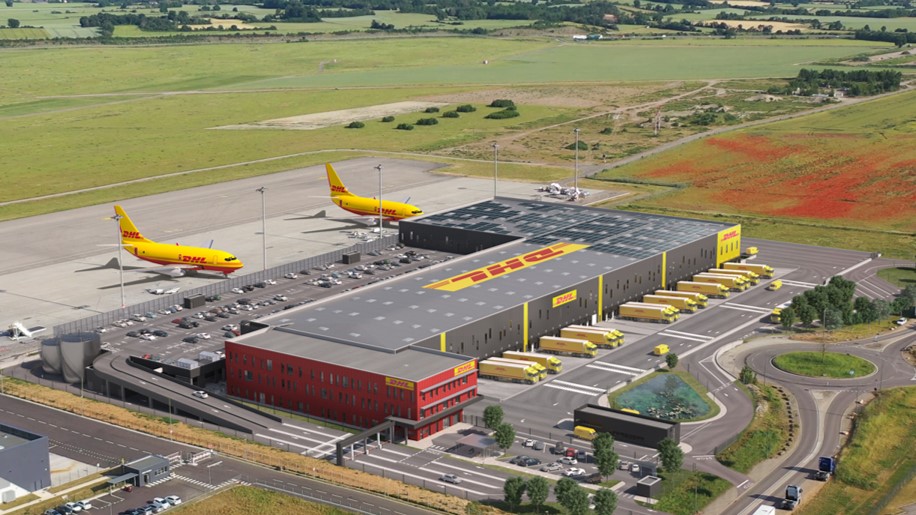
Aerial view of a DHL air cargo terminal with mustard-colored planes parked next to it.

DHL Express is moving this summer into a $140 million facility at Lyon-Saint Exupéry Airport with five times the parcel processing capacity of the current building and the designation as the first in France to handle both time definite and day definite international shipments.

The 261,500-square foot gateway has triple the amount of operating space than the current terminal and will be able to sort up to 17,500 pieces per hour compared to 3,500 pieces, DHL announced this week. High-tech equipment to facilitate processing and reduce operator handling will save an hour in parcel processing time. There are 48 loading docks, up from 15 in the current location, and 79 van parking spots. The expanded gateway is DHL Express’s second largest investment in France, only topped by the $200 million to expand the air hub at Paris-Charles de Gaulle airport in 2021. 

The transition to the new facility will be completed in mid-August, spokesman Dirk Heinrichs said in an email message. 

In a first for a DHL parcel center in France, the gateway will handle less-urgent day definite cross-border shipments to nine countries in Europe via air and road connections alongside express deliveries.

In addition to accommodating expected shipping growth, the new location will host the company’s regional commercial and support functions. A total of 400 employees will work there, up from 360 in the existing terminal. 

The current facility in Lyons handles 38,000 parcels per day, and up to 60,000 during the peak holiday season. 

Lyon-Saint Exupery Airport is located in the Auvergne-Rhône-Alpes region, representing more than 20% of DHL Express traffic in France. The region is a convenient transshipment point for key trade routes across Europe. DHL Express has seen parcel activity in France grow by 15% over the past five years. It handled more than 45 million parcels last year, up 1% from 2023. In the Auvergne-Rhône-Alpes region, volumes have increased more than 20%, according to the company.

“This site uniquely covers our entire service offering, from international to local, urgent to less urgent. It will enable us to continue providing excellent service to our customers in the years to come, with the possibility of expanding in future to support the increase in global flows,” Philippe Prétat, CEO of DHL Express France, said in a news release.

The site will be 55% more energy efficient than the old one. It is equipped with 78 charging stations for electric vehicles, energy-efficient lighting, fast-opening and closing dock doors to minimize heat loss in winter and cool air loss in the summer, a reflective white roof and rainwater harvesting systems, according to DHL.

Another Lyon cargo facility

In related news, ground handling agent Worldwide Flight Services announced Thursday it has signed a 20-year lease to operate a large air cargo terminal in the CargoPort area of Lyon-Saint Exupéry Airport, due to open in summer 2026. The new DHL facility is located in the same dedicated freight zone.

Nearly a quarter of the 206,000-square foot transfer facility will be devoted to refrigerated storage for pharmaceutical shipments and perishable goods. WFS said the facility’s modern design will promote efficient cargo processing, especially for pharma shipments in one of the top vaccine-producing regions of the world. The building includes 36 dock doors, including five specially configured for aircraft pallets. 

The project is being developed by U.S.-based warehouse landlord Prologis, the Lyon Airport authority and French real estate agency Groupe em2c. WFS and Singapore-based parent company SATS operate 

Click here for more FreightWaves/American Shipper stories by Eric Kulisch.

New DHL Express hub at Paris airport cuts delivery times

DHL steps up Middle East expansion with $570M in planned investments

Solar to power half of Port Newark box terminal’s energy needs

Port Newark Container Terminal, the Port Authority of New York and New Jersey, and the city of Newark marked the completion of a solar energy project designed to provide half of the terminal’s yearly electrical power needs.

The collaborative project covering 7.8 acres with solar panel canopies aims to meet 50% of the terminal’s annual energy needs, the bi-state agency said in a release.

Including the solar project, PNCT is spending a total $500 million on expansion.  

Five elevated canopy-mounted solar arrays spanning multiple truck lanes produces 3.8 megawatts, while additional canopies and rooftop arrays generate another 3.4 megawatts. The installation takes up just 0.04 acres of ground space in the port’s urban location, and will also contribute surplus electricity back to the regional power grid.

The project was dubbed a “win for Newark residents, a win for the environment, and a win for our seaport,” by Port Authority Chairman Kevin O’Toole. Executive Director Rick Cotton highlighted the development as a reflection of the agency’s commitment to sustainable practices amidst rising cargo volumes.

Newark Mayor Ras J. Baraka praised the project for advancing both environmental health and economic prosperity, underscoring the city’s collaboration with PNCT as vital for addressing urban challenges. 

Jim Pelliccio, president and chief executive of Port Newark Container Terminal, said the investment is foundational to the port’s sustainable transformation.

Aimed at achieving net-zero emissions by 2050, the authority’s plans encompass a range of programs, such as the Truck Replacement Program and the Clean Vessel Incentive. These programs incentivize truck companies and ocean carriers to adopt cleaner engines and operate with reduced emissions. The authority is also focusing on transitioning cargo handling equipment to zero-emission models as they become commercially available.

The buildout of the seaport’s on-dock ExpressRail system reduces emissions by enabling goods to reach the Midwest, New England, and eastern Canada more sustainably than via truck

PNCT has further strengthened these efforts by converting terminal lighting to LED fixtures and employing energy-efficient cranes and hybrid straddle carriers.

Find more articles by Stuart Chirls here.

Related coverage:

New Freightos index: Israel-Iran conflict yet to hit shipping

Tariff damage looms without new trade deal, says economist

WATCH: ‘Dark fleet’ tanker collision sparks fire near Strait of Hormuz

Los Angeles box volume hits lowest level in two years

Intermodal weaker as US rail traffic declines

U.S. rail traffic for the week ending June 14 included 485,810 carloads and intermodal units, down 1.5% from the same week a year ago, according to the Association of American Railroads, including 224,851 carloads, a 1% gain over the corresponding week in 2024, and 260,959 containers and trailers, down 3.5%.

Coal led five category gainers, up 5.3% for the week. 

Last week, traffic was down 1.3%, the first week below 2024 levels since February.

“The latest intermodal numbers…show things have stabilized for the moment at about 4% below prior year,” said rail consultant Lawrence Gross, in a LinkedIn post. “Not great but not a catastrophe by any means. All railroads [are] running in the red versus prior year except CPKC, which has easy prior-year [comparisons].”

Through 24 weeks of 2025, overall volume is 11,710,144 carloads and intermodal units, up 4.2% from the same period a year ago. That includes 5,250,685 carloads, up 2.5%, and 6,459,459 intermodal units, up 5.7%.

North American traffic for the week, from nine reporting U.S., Canadian, and Mexican railroads, included 678,590 carloads and intermodal units, a 1% decline from the same week a year ago. That includes 332,361 carloads, up 0.9%, and 346,229 intermodal units, down 2.8%.

Year-to-date traffic in North America was at 16,180,193 carloads and intermodal units, up 2.9% over the first 24 weeks of 2024. That includes 3,906,603 carloads and intermodal units in Canada, up 1.0%, and 563,446 carloads and intermodal units in Mexico, down 9.1%.

Subscribe to FreightWaves’ Rail e-newsletter and get the latest insights on rail freight right in your inbox.

Related coverage:

Watco rail gets $600M in new private equity

WATCH: CSX delivers for Army’s 250th birthday bash

How technology Is helping Union Pacific help truckers…and rail shippers

Sharp slowdown in intermodal rail a warning for H2: AAR

Trump Administration Tariff Updates – June 19, 2025

a container ship docked at Port Houston

With the July 9 deadline for finalizing trade deals approaching, the Trump administration is advancing its global tariff strategy. This report outlines the latest developments in tariff implementations and ongoing negotiations with key trading partners.

Details of U.S.-China Trade Deal

High-level negotiations in London, concluded on June 10, 2025, have produced a framework agreement with China, pending final approval from Presidents Trump and Xi. The deal stabilizes trade relations, with minor issues remaining, particularly around China’s rare earth export controls. The U.S. seeks guaranteed semiconductor supply access to counter China’s leverage. The agreement builds on the May 2025 Geneva consensus and includes the following tariff structure on Chinese imports:

  • A baseline reciprocal tariff of 10%, applied to all Chinese goods under the International Emergency Economic Powers Act (IEEPA), effective April 5, 2025.
  • An additional 20% tariff on specific Chinese imports, tied to China’s efforts to curb fentanyl precursor shipments to the United States, implemented in February 2025.
  • A 25% tariff on certain goods under existing Section 301 provisions, targeting unfair trade practices such as intellectual property theft.

Tariff Composition Clarification: The tariffs are not a flat 10% rate. All Chinese imports face the 10% baseline tariff; specific goods linked to fentanyl precursors incur an additional 20% (totaling 30%); and certain goods under Section 301 face the 25% tariff, which stacks with the 10% baseline (totaling 35%). For example, electronics under Section 301 face 35%, while non-fentanyl, non-Section 301 goods (e.g., apparel) face only 10%. This structure addresses trade imbalances, fentanyl flows, and past trade abuses while incentivizing compliance.

Global Trade Negotiations

As the July 9 deadline nears, the administration has categorized trading partners into two groups:

  • Good Faith Negotiators: Countries actively pursuing trade agreements, such as Canada and Japan, are likely to receive deadline extensions.
  • Non-Cooperative Nations: Countries deemed uncooperative, such as India, face punitive high tariffs, potentially up to 50%.

The G7 summit in Canada earlier this week served as a platform for bilateral trade discussions. President Trump held meetings with several nations, including the European Union. However, initial EU negotiations stalled over reciprocal trade terms, and subsequent meetings were canceled when the president departed the summit early, threatening a 50% tariff on EU imports if no deal is reached by July 9. China and the EU are preparing retaliatory tariffs, with China eyeing 25% tariffs on U.S. soybeans and the EU planning 25% tariffs on U.S. whiskey and soybeans if the 50% tariff materializes. For now, the only country that has signed a trade deal since Liberation Day is the U.K.

Economic, Legal, and Political Impacts

Economic Impacts: The Federal Reserve announced on June 18, 2025, that it will maintain current interest rates, reflecting several economic factors:

  • A surge in U.S. imports, contributing to a $200 billion Q2 trade deficit, is straining economic growth.
  • The administration’s tariff policies, generating $10 billion in customs revenue from the 10% baseline tariff, are projected to increase consumer prices by 3-5% and drive inflation.
  • The Federal Reserve faces challenges in forecasting the tariff plan’s broader economic impact, with potential GDP reductions of 0.5-1% by 2026.

Legal and Political Developments:

  • Lawsuit Updates: Learning Resources, a family-owned toy company, alongside retail coalitions, has petitioned the Supreme Court directly, seeking to bypass the Appeals Court to challenge whether the President exceeded his authority in implementing the global tariff plan. The Learning Resources v. Trump case continues to draw attention, with the Appeals Court’s May 29, 2025, stay allowing tariffs to remain in effect. The Department of Justice is preparing a robust defense, arguing that IEEPA grants broad presidential authority. Growing business coalitions, including toy and retail associations, may join the suit, potentially increasing pressure on the Supreme Court to consider an expedited review despite its term ending soon.
  • Congressional Pushback: Bipartisan senators introduced a bill on June 17, 2025, to limit presidential tariff authority under IEEPA, citing economic disruption. While unlikely to pass before July 9, it signals rising political friction, with moderate Republicans joining Democrats in criticizing the tariff plan’s scope.

Emerging Trends:

  • Supply Chain Shifts: Companies are accelerating nearshoring to Mexico to mitigate tariff costs. The Mexican Government reported a 165% surge of new foreign direct investment into the country in Q1 2025, driven by tariff fears, with sectors like automotive and electronics leading the trend.
  • Global Retaliation Risks: China, the EU, and Canada are preparing retaliatory tariffs targeting U.S. agriculture and energy exports. A June 19, 2025, Reuters report cites EU plans for 25% tariffs on U.S. whiskey and soybeans if the 50% tariff threat materializes, which could escalate trade conflicts post-July 9.

Blue Yonder acquisition aims to streamline its returns process

Scottsdale, Arizona-based supply chain management company Blue Yonder announced Wednesday that it has acquired full ownership of Inmar Post-Purchase Solutions (IPPS) and will continue to support FedEx Easy Returns.

In a news release emailed to FreightWaves, Blue Yonder stated that its subsidiary Doddle helped acquire the post-purchase solutions company and will offer FedEx customers access to its low-cost, package-and label-free returns solution.

Blue Yonder said its purchase of the remaining 51% of IPPS adds to Doddle’s previously owned 49% of the company since March 2022.

According to the release, FedEx Easy Returns is currently available at around 3,000 drop-off locations in FedEx offices and Kohl’s stores across the U.S. – with plans for rapid growth.

The company and its subsidiary, under the new name Blue Yonder Reverse Retail Operations LLC, will continue to help streamline the returns process for retailers with its Returns Management solution. This returns management system allows consumers to return items without needing to print labels or have packaging, all while streamlining the returns process for retailers.

“According to our consumer retail returns survey, consumers are more likely to use third-party returns services if they have convenient drop-off locations (60%) and offer faster refund processing (47%), so efficient returns are absolutely critical for improving consumer experiences while optimizing costs for retailers,” said Duncan Angove, CEO of Blue Yonder, in the release. “The volume of consumer returns is growing exponentially, but the disparate elements of the reverse logistics process make it hard to keep up. Through the acquisition, we will continue making returns convenient and hassle-free for retailers and consumers.”

“The physical movement of returned items is a major supply chain challenge, yet drop-off locations, transport services, downstream processing tasks and SKU ownership remain siloed,” added Tim Robinson, corporate vice president of returns for Blue Yonder. “With Blue Yonder Returns Management, retailers can optimize their returns process, enhancing speed, sustainability and cost effectiveness while simplifying the returns process for consumers.”

Layoff wave hits freight sector as nearly 9,000 jobs slashed

Layoffs continue to impact the freight industry as firms across the U.S. and Mexico announced 8,794 job cuts over the past several weeks.

The workforce reductions are tied to companies operating in sectors such as trucking, warehousing, logistics, food suppliers and manufacturing.

In the U.S., companies announcing mass layoffs include Lacroix Electronics, FedEx, Frito-Lay, Blue Diamond Growers, Michaels Stores, Kohl’s, Target, JCPenney, Bilfinger Inc., Globe Motors and Geodis Inc., according to media reports and Worker Adjustment and Retraining Notification Act notices.

States that saw the most freight-related layoffs include Arizona, Alabama, California, Georgia, Florida, Illinois, Ohio, Tennessee and Texas.

France-based manufacturer Lacroix Electronics is closing factories in Grand Rapids, Michigan, and Juárez, Mexico, and a warehouse in El Paso, Texas, eliminating 1,250 jobs.

Officials for Lacroix Electronics said the decision to close its manufacturing plants in the U.S. and Mexico was due to reduced revenue in North America, exposure to the automotive sector, and uncertainty caused by tariffs, according to Crain’s Grand Rapids Business and MSN.

Freight-related companies in Mexico have also recently announced major workforce reductions.

Steel products producers Arcomex and Schneider Electric are reportedly laying off almost a combined 1,000 workers at factories in the Mexican cities of Queretaro and Tlaxcala, according to El Sol De Tlaxcala.

Officials for the Confederation of Mexican Workers (CTM), a major trade union in the country, said tariffs and lower consumer demand for cars and electronic goods in the U.S. caused the layoffs.

“Yes, it is the effects of tariffs, that’s right,” Víctor López Hernández, CTM’s secretary of labor and legal affairs in Tlaxcala, said. “The supply chains downstream of assembly will be affected. Auto parts made in Tlaxcala will be affected, the injection of plastics, which is also important for automobile assemblies, will foreseeably be affected by the situation that is occurring in the automotive market.”

Tire maker Michelin also announced it was closing a factory in Queretaro, Mexico, eliminating 480 jobs, according to Reuters.

CompanyCityTypeReasonLayoff dateNumber of layoffs
Lacroix ElectronicsGrand Rapids, Michigan; El Paso, Texas; and Juarez, MexicoElectronics manufacturerFrance-based company is closing its two plants in US and Mexico; and a warehouse in El PasoJune1,250
Pixelle Specialty SolutionsChillicothe, OhioProduces specialty papers for printing and packaging applicationsCompany restructuringAug. 10780
Kohl’sMiddletown, OhioRetailerClosing e-fulfillment centerSept. 12768
Blue Diamond GrowersSacramento, CaliforniaAlmond growers cooperativeClosing almond processing and manufacturing operationsSept. 1632
Schneider ElectricTlaxcala, MexicoSteel products manufacturerDownsizingMarch500
MichelinQuerétaro, MexicoTire manufacturerClosing plant, consolidating operationsDec. 31480
ArcomexTlaxcala, MexicoSteel products manufacturerDownsizingMay450
Frito-LayRancho Cucamonga, CaliforniaFood and beverage companyFacility closureJune 11432
FedExJackson, GeorgiaParcel carrierClosing facilityJuly 14383
RWTL Capacity Solutions LLCKingman, ArizonaClass 8 truck leasingUnspecifiedJune 16368
Meyer Burger AmericasGoodyear, ArizonaSolar panel manufacturerClosing plantMay 22355
KRP TransportBurlington, New JerseyTrucking companyUnspecifiedSept. 15298
JCPenney Alliance Supply ChainHaslet, TexasRetailerDistribution center closureNov. 1296
Momence Packing Co.Momence, IllinoisMeat packing companyClosing plant, restructuringJune 2274
Michaels StoresTracy, CaliforniaRetailerDistribution center closureAug. 4229
Need It Now Delivers LLCFort Lauderdale and Jupiter, FloridaTransportation and logistics providerLast mile delivery provider closing two operations due to loss of customerAug. 9171
Bilfinger Inc.Theodore, AlabamaIndustrial manufacturing companyAdjusting workforce based on contract requirementsApril 16143
Panera LLCOrlando, FloridaBakery restaurant chainClosing bread production, distribution facilityJuly 25114
Stephens Distributing Co.Fort Lauderdale, FloridaWarehouse and distribution providerCompany saleDec. 31110
Morgan Truck Body LLCOrrville, OhioManufacturer of commercial truck and van bodiesUnspecifiedAug. 1110
Mission Linen SupplyChino, CaliforniaLinen and uniform supplierLayoffs at its Chino plant due to loss of businessAug. 282
Stingray Pressure PumpingBelmont, OhioManufacturer of industrial products for oil and gas industryPlant closureAug. 1575

Globe Motors
Dothan, AlabamaAutomotive manufacturerUnspecifiedJuly 2573
Accelerate360 DistributionOntario, CaliforniaDistribution and logistics providerClosing facilityAug. 866
Target Corp.Savannah, GeorgiaRetailerCutting jobs at a distribution centerAug. 1562
WIOSS Atlanta LPForest Park, GeorgiaLogistics providerClosing distribution center it operated for KrogerJuly 1953
Pratt IndustriesLivonia, MichiganPackaging supplierLoss of contract with Ford Motor Co.Aug. 1053
Menzies AviationLos AngelesAviation services businessDiscontinuing freighter ground handling services at LAXJuly 3146
Geodis LogisticsMt. Juliet, TennesseeTransport and logistics providerClosing facilityJune 1040
NexTraq LLCAtlantaFleet management solution providerUnspecifiedJuly 2039
Hickman’s Family FarmsBuckeye, ArizonaFresh eggs producer, distributorTemporarily closed due to bird fluJun 1621
GTM Wholesale LiquidatorsSan Diego, CaliforniaRetailerClosing distribution centerJuly 3118
Endries InternationalSycamore, IllinoisIndustrial components maker for OEMsLayoffs at warehouse and office locationUnspecified16
JMJ Equipment Transport Inc.Yuma, ArizonaTrucking companyLayoffsJune 117