Saia badly misses Q1 mark, shares off 24% pre-market

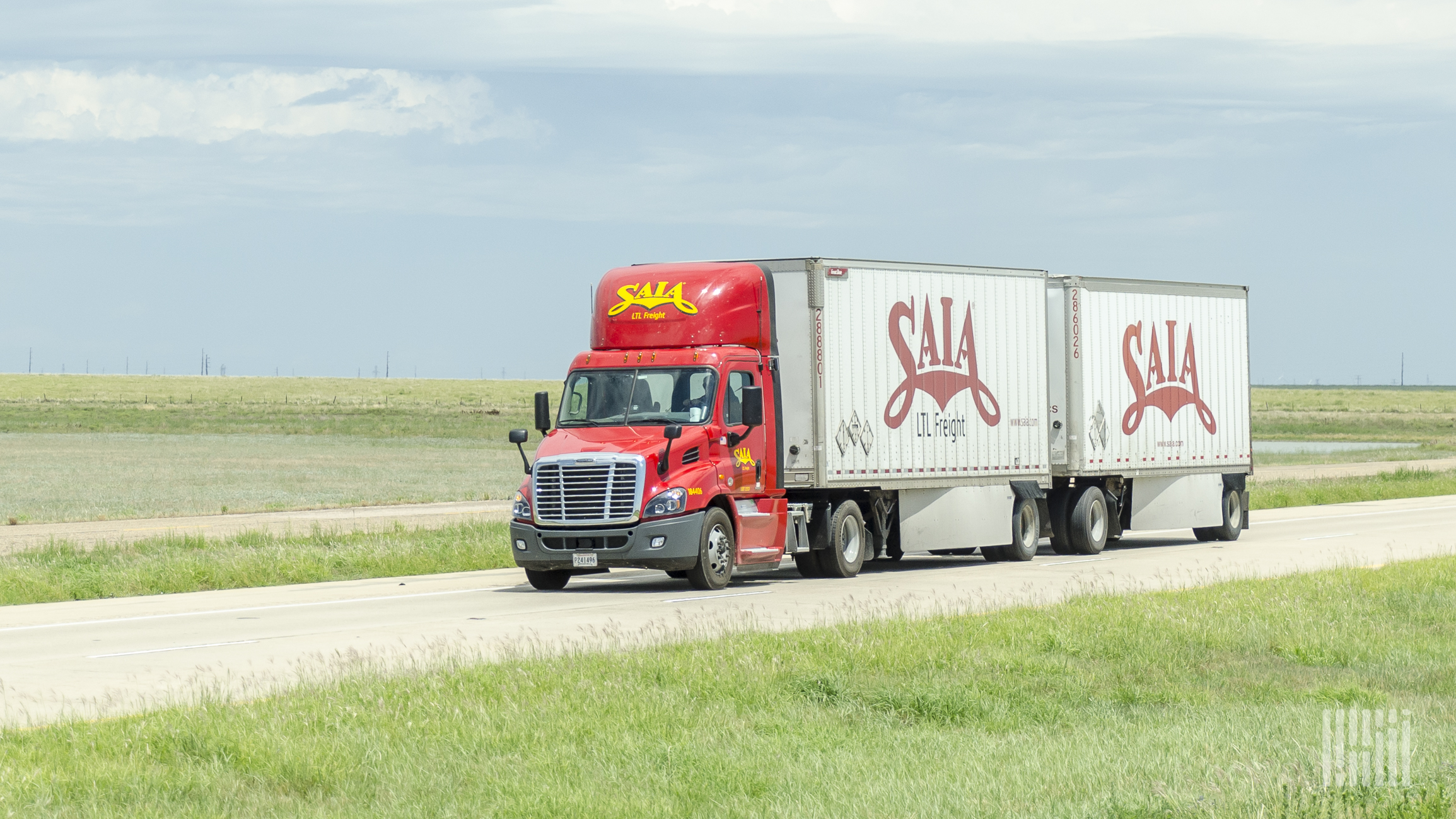
A red Saia daycab pulling two Saia pup trailers

Less-than-truckload carrier Saia said it didn’t get the March lift in demand it normally sees as customers pulled back in response to trade uncertainty.

Johns Creek, Georgia-based Saia (NASDAQ: SAIA) reported first-quarter earnings per share of $1.86 before the market opened on Friday. The result was well light of the $2.76 consensus estimate and the $3.38 the carrier posted in the year-ago period.

Further, the consensus number came down 31 cents in the 90 days ahead of the print as analysts lowered expectations on mounting trade fears.

Click for full report – “Saia’s shares sag 30% as tariffs tank demand, exacerbate growing pains”

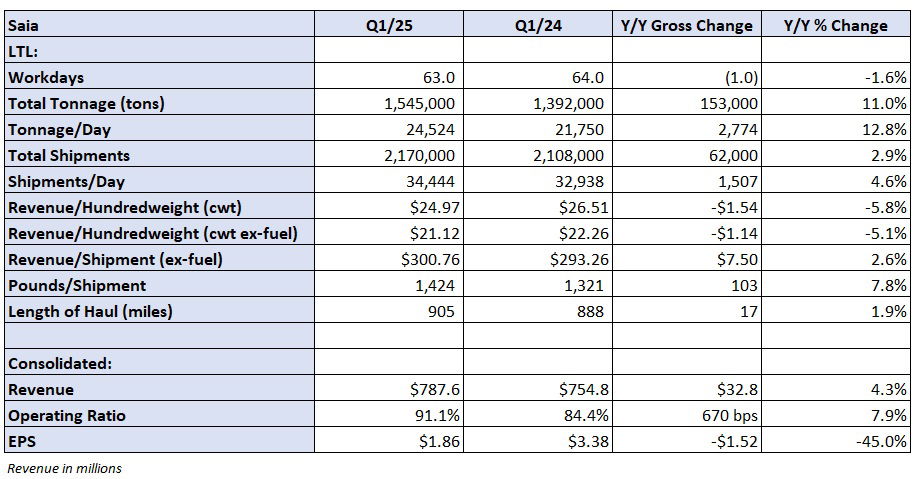
Saia’s revenue increased 4.3% year over year to $788 million (6% higher on a per-day comparison) as tonnage per day increased 12.8% and revenue per hundredweight, or yield, fell 5.8% (5.1% lower excluding fuel surcharges).

The tonnage increase was largely due to recent terminal openings. The decline in the yield metric was driven by a 7.8% increase in weight per shipment.

“Primarily resulting from an uncertain macroeconomic environment, we did not see the typical sequential growth in shipments through the quarter, with March shipments flat to February, causing our first-quarter revenues to fall well below our expectations,” President and CEO Fritz Holzgrefe said in a news release.

Click for full report – “Saia’s shares sag 30% as tariffs tank demand, exacerbate growing pains”

Table: Saia’s key performance indicators

A 91.1% operating ratio (inverse of operating margin) was 670 basis points worse y/y and notably worse than management’s guidance, which implied an OR near 87.5%. Costs from new terminals and abnormally poor weather in January were some of the factors.

Cost per shipment was up 9.4% y/y while revenue per shipment increased just 1.5%, a nearly 800-bp negative spread. Salaries, wages and benefits expenses (as a percentage of revenue) were 410 bps higher y/y, and depreciation expense was up 100 bps y/y.  

A $4.5 million swing from net interest income a year ago to net interest expense was a 13-cent drag on EPS in the quarter. Net debt was up $207 million y/y to fund the terminal acquisitions.

Shares of SAIA were off 23.8% in pre-market action on Friday.

Saia will host a conference call at 10 a.m. EDT on Friday to discuss first-quarter results.

More FreightWaves articles by Todd Maiden:

BNSF, UP battle over California mountain pass trackage rights

Every day Union Pacific and BNSF Railway trains battle gravity and curvature as they wind their way up and down the former Southern Pacific main line through the rugged Tehachapi Mountains of Southern California.

Now UP and BNSF are engaged in a different sort of fight: The railroads have been unable to come to terms on a new deal for BNSF’s use of the line. And so UP (NYSE: UNP) has brought a rare trackage rights dispute to the Surface Transportation Board.

The railroads filed final briefs in the case this month. Barring a settlement, regulators will determine how much BNSF ultimately will pay UP for continued use of the line that links Northern and Southern California.

Union Pacific says payments are so low under the current agreement that UP is subsidizing rival BNSF’s operations. BNSF says UP’s proposed payment increases would significantly boost BNSF’s costs and stifle competition.

“Through this proceeding, UP seeks to achieve through regulatory fiat what UP could never have achieved through private negotiations: a trackage rights compensation windfall and a dramatic increase in the costs of its competitor,” BNSF told the STB, adding that the trackage rights dispute is part of a broader UP effort to curb competition.

Not so fast, says UP.

“BNSF’s proposed … rental is below the $5.5 million rental accepted in a settlement more than 30 years ago by a financially weak Southern Pacific,” UP told the board. “Union Pacific’s proposed rental may appear large in relation to the current, very low rental, but … the new rental would not reduce BNSF’s or Union Pacific’s incentive or ability to compete vigorously for traffic moving over the Line – it would enhance competition by leveling the playing field.”

The precise trackage rights figures each railroad has proposed are redacted in the STB filings.

The railroads agree that the matter should be settled based on an Interstate Commerce Commission decision that aims to put the trackage rights tenant in the same position as the track owner in terms of variable and fixed costs as well as a return on investment in the line.

But the railroads come to very different conclusions on the annual interest rental payment that BNSF should make to UP based on the current market value of the line. BNSF says UP’s proposal is 36 times higher than the current agreement and 22 times higher than what BNSF has proposed.

The sides are so far apart partly due to the way they look at the tunnel clearance projects that BNSF funded in the 1990s so the line could host double-stack intermodal trains.

BNSF says calculations for determining the line’s current value should exclude earnings from double-stack traffic, as outlined in agreements with UP. But UP says BNSF must pay interest rental based on the Tehachapi line’s fair market value calculated by all the traffic that moves over the route.

UP also says the rental payment should be adjusted for inflation annually. BNSF says UP’s formula erroneously counts inflation three times, which would only widen the gap between the two railroads’ rental rate proposals as time goes by.

BNSF claims that UP’s proposed rate for the Tehachapi route is higher than market-based rates in other areas where they share trackage. “This is a well-functioning market where previously BNSF and UP have voluntarily agreed to fee levels for joint operations that are mutually beneficial,” BNSF told the board.

UP counters that the rate reflects the higher traffic density of the Tehachapi route compared to others shared with BNSF.

Under conditions the STB imposed to preserve competition as part of the 1996 UP-SP merger, BNSF and UP have trackage rights agreements across the West. BNSF operates over 6,000 miles of UP track, while UP runs on 5,000 miles of BNSF trackage.

BNSF’s trackage rights over 67.8 miles of UP’s Mojave Subdivision are much older: They date to 1899. Southern Pacific opened the line in 1876. Rather than build its own line through the pass, the Atchison, Topeka & Santa Fe gained trackage rights through an 1899 deal with the SP. The agreement has been updated several times over the decades through both voluntary agreements and ICC orders.

UP says it should not be bound by “the terms of an ancient, expired, voluntary agreement.”

“ATSF’s long-ago decision to become Southern Pacific’s tenant does not mean Union Pacific must subsidize BNSF’s use of the Line by accepting a below-market return on its investment after the original agreement expired,” UP told the board.

UP filed the case in January 2023, seeking revision of a 1967 ICC order that established conditions for Santa Fe’s continued use of the line after the original agreement expired in 1961. UP argues that the interest rental provision no longer provides fair compensation for BNSF’s use of the line. The railroads last updated the interest rental provision of the trackage rights agreement in 1993.

“BNSF’s current rental is far too low, which is why an appropriate increase appears high,” UP argues. “Placed in the proper context – that is, in the context of competition between Union Pacific and BNSF for origin-to-destination business – the increased rental will modestly increase BNSF’s total operating expenses for traffic moving over the Line. BNSF offers no evidence the increased expenses will make it uncompetitive.”

BNSF says its trackage rights between Kern Junction and Mojave are a crucial part of its network on the West Coast.

“For over 125 years, the Kern-Mojave Line has served as a critical link in BNSF’s rail network. Today, the Line forms a part of the spine of BNSF’s north-south route through the state of California and the Pacific Northwest moving traffic along the I-5 corridor,” BNSF told the STB. “Any freight that BNSF moves between the Pacific Northwest and Central/Southern California, including traffic that moves beyond Southern California and travels across BNSF’s southern transcontinental route, must traverse the Kern-Mojave Line.”

BNSF sends about 20 trains over the line per day, including intermodal, merchandise, grain, automotive and ethanol traffic. UP operates about 16 trains per day over the line.

Related:

Tehachapi Pass line reopened after derailment

First Look: Universal Logistics Holdings

Universal Logistics Holdings’ first-quarter operating revenue decreased 22.3% year over year to $382.4 million, which company officials attributed to a sluggish freight market.

“While we gained positive momentum as the quarter progressed, the early softness posed a significant headwind to our overall performance for the entire period,” CEO Tim Phillips said in a news release. “Lower auto production, combined with sustained weakness in the freight market, resulted in top-line revenues falling short of our expectations and contributed to a compression in our operating margin.” 

Universal Logistics (Nasdaq: ULH) is a Warren, Michigan-based truckload transportation, intermodal and logistics provider. The company provides services across the U.S, Mexico, Canada and Colombia and has more than 10,000 employees.

First-quarter earnings per share came in at 23 cents per share, an 88% year-over-year decrease.

Universal Logistics missed Wall Street analysts’ revenue estimates of $454.1 million in the fourth quarter and earnings per share expectations of $1.04 per share.

The company’s first-quarter results showed year-over-year decreases in its trucking, contract logistics, intermodal and managed brokerage segments.

In the contract logistics segment, which includes Universal Logistics’ value-added and dedicated services, first-quarter revenues decreased 18.4% year over year to $255.9 million.

By the end of the first quarter, Universal Logistics managed 87 value-added programs, including 20 rail terminal operations, compared to a total of 71 programs at the end of the same period in 2024.

Revenue in the intermodal segment decreased 9.8% year over year to $70.7 million in the first quarter. Load volumes declined 3.4% in the intermodal segment during the quarter, and the average operating revenue per load, excluding fuel surcharges, fell by an additional 8.7% on a year-over-year basis.

Trucking segment revenue in the first quarter decreased 20.2% year over year to $55.6 million. Load volumes declined 31.3% year over year, while average operating revenue per load, excluding fuel surcharges, increased 24.3%.

As of March 29, Universal Logistics held cash and cash equivalents totaling $20.6 million, and $12 million in marketable securities. Outstanding debt at the end of the first quarter was $740 million and capital expenditures totaled $52.6 million.

Universal Logistics announced a cash dividend of 10.5 cents per share of common stock. The dividend is payable to shareholders of record by June 2.

The company will hold a conference call to discuss results with analysts at 10 a.m. Friday.

Universal Logistics HoldingsQ1/25Q1/24Y/Y % Change
Operating revenue$382.2M$491.9M(22.3%)
Operating income$15.7M$75.1M(79%)
Trucking revenue$55.6M$69.7M(20.2%)
Intermodal revenue$70.7M$76.7M(7.8%)
Contract logistics segment$255.9M$313.5M(18.3%)
Adjusted earnings per share$0.23$1.99(88%)

Universal Logistics key performance indicators.

Design flaws undercut law to bring chip manufacturing back to US, expert says

On the most recent Bring It Home Podcast, host JP Hampstead spoke with Julius Krein, founder and editor-in-chief of American Affairs, about U.S. industrial policy post-CHIPS Act.

The CHIPS and Science Act of 2022 aims to bring microchip manufacturing back to the U.S. after several decades of companies offshoring the technology.

According to a report by the Council on Foreign Relations – a nonpartisan think tank headquartered in New York – the U.S. produced 40% of the world’s semiconductor supply in 1990. Today, the U.S. produces only 12% as Taiwan has ramped up to over 60% of the world’s supply of semiconductors.

Krein dove into the historical context, challenges and prospects of America’s industrial strategy. He described U.S. industrial policy as targeted interventions aimed at boosting specific sectors to improve economic competitiveness and national security. 

He also critiqued traditional views that often portray such policies as economic externality management, arguing instead that U.S. industrial policy should strategically lower the cost of capital for essential projects to boost growth.

Krein said the CHIPS Act has had its limitations, pointing out its short-term focus and lack of a mechanism for ongoing policy adjustments. He said that mechanism would be vital for the long-term competitiveness of the U.S. semiconductor industry.

“I think the CHIPS Act was necessary,” Krein said. “But in sort of design and execution, I think it had two problems: one in terms of policy design, one in terms of more framing and rhetoric.”

“I think it’s a critical sector, but I’d like to think or at least hope that we could do both a lot better on policy design as well as kind of building a larger framework and ecosystem for all of these projects,” he continued.

Other headlines discussed in this episode included:

  • Recent announcements of large investments by tech conglomerates in the U.S., including Taiwan Semiconductor Manufacturing Co.’s commitment to extending its semiconductor manufacturing operations with a $100 billion investment.
  • Apple’s intention to expand its U.S. manufacturing footprint with a $500 billion investment, focusing on enhancing its supply network. 
  • The Stargate project, a joint venture by OpenAI, Softbank and Oracle aimed at developing AI infrastructure with a $500 billion pledge, reflecting broader trends toward investing in AI as a catalyst for new business models. 

Bring It Home dives into emerging industry trends and the push for reindustrialization in North America. The podcast is available on YouTube, Spotify and Apple Podcasts.

TFI’s Bedard upbeat on revamped US LTL operations even as numbers sink

(For a recap of TFI International’s core financial reporting from Wednesday, see this First look article.)

It may come as a surprise that TFI International CEO Alain Bedard was reasonably cheerful Thursday about 2025’s first quarter.

TFI had posted weak quarterly earnings a day earlier, there was a slide in the company’s stock price – about 40% in a year and just a little less than that over the past three months – and previous quarterly earnings calls have been laments about performance.

But Bedard noted there have been several changes in management in the U.S. LTL group and said, “I feel pretty good about where we’re going.”

Although truckload operations at Quebec-based TFI (NYSE: TFII) have been growing as a percentage of total revenue, primarily because of last year’s acquisition of flatbed operator Daseke, the focus on the earnings call Thursday and in recent quarters remains on its LTL operations. Specifically, the primary point of discussion is the U.S. operations that are primarily the legacy business of UPS Freight, which TFI bought in 2021.

The U.S. LTL group in the first quarter posted an operating ratio of 98.9%, deteriorating from 92.6% in the corresponding quarter a year earlier. It was 97.3% in the fourth quarter.

Bedard in earlier calls has said things such as “We’re too fat” or described some practices in the U.S. LTL group as “stupid.” But he was decidedly more positive Thursday, despite the weak performance of the group and the company’s decline in profitability that has stretched out over several quarters.

“The morale in the group has never been so good,” Bedard said. “The guys are working hard.”

Negative outlook at Merrill

Ken Hoexter at Bank of America Merrill Lynch took a different perspective, calling the U.S. results a “meltdown.”

He noted in a report released prior to the call that tons per day in U.S. LTL were down 4% year on year – he had expected a 2.5% decline – and that they were down sequentially from negative 3% in the fourth quarter of 2024. 

Bedard conceded on the call that the claims rate of 0.9% was “terrible.” Hoexter agreed, pointing out that the rate was 0.7% a year ago.

The truckload operating ratio (OR) of 93.7% was 150 basis points worse than where Hoexter said Merrill Lynch forecast it would come in. The OR for U.S. LTL was 98.9%.

Merrill Lynch has an underperform rating on the stock and has had that opinion since February. Hoexter reiterated it in his report. But he lowered the price objective to $72 from $78.

Jason Seidl of TD Cowen said the OR at the U.S. LTL operations had met Cowen’s forecast, but also said that projection had been reduced “given the continued challenges in the U.S. LTL market.”

Big drop in stock, stronger on Thursday

TFI’s stock is down about 40% in the past year and 38% in the past three months. Although TFI’s earnings did not react significantly at first to the company’s earnings, it climbed significantly later. At about 3:30 p.m., just before the trading day’s close, TFI was up to $84, an increase of $5.57 or 7.11%. The S&P 500 was up slightly less than 2% at that point.

In discussing other reasons for his optimism, Bedard returned to a theme that has been a core message in earlier calls: the need for U.S. LTL operations to increase market share with small to medium customers and reduce reliance on larger companies. “We lost so many of the small and medium-sized accounts, and we replaced them with corporate accounts with sometimes negative margins,” Bedard said. “That trend is reversed right now. We’re starting to see growth on the small and medium-sized accounts.”

He declared: “I feel really good. The guys are very focused, and that’s what we’re seeing so far.”

Bedard said U.S. LTL, which operates as TForce, has implemented better planning to optimize linehaul efficiency, and is doing the same for its package and delivery operations. 

He also cited improved software for pricing and file management, a problem he said has been “a rock in our shoe for so long.” That better pricing technology allows the sales staff to work better in the push to add small to medium-size accounts, Bedard added.

He also said there is better information on the unit’s productivity on a terminal-by-terminal basis.

One benchmark cited by Bedard for his more positive outlook for the LTL segment: missed pickups. A year ago it was about 4%, he said. It’s now down to about 1.7%.

“We are improving in real terms, not just in fantasy land,” Bedard said. “We are improving the reality of our service for the next day and for multiple days. We aren’t where we should be, but we are improving.”

Bedard touted on the call – as he did in the prepared earnings statement released Wednesday – the company’s first-quarter net cash from operating activities of $193.6 million, compared to $200.7 million in the first quarter of 2024. Free cash flow improved significantly, up to $191.7 million from $137.2 million in Q1 2024.

He said a combination of share purchases plus TfI’s dividend payment resulted in about $94 million of “excess cash returned to our shareholders during the quarter, which has always been an important objective of ours.” (With the recent decline in TFI’s stock price, its forward dividend yield, assuming an annual payout of $1.80, is about 2.3%).

Impact of tariffs

Tariffs and the state of the economy were the first subjects broached by analysts. Bedard said, “We’ve been really affected because our end customers are sitting on the fence. We will be seeing where this is going to all go, and this is why it’s very difficult for us to predict.”

Business heading south of Canada into the U.S. has held steady, Bedard said, but the backhaul to Canada is finding many trucks with lots of empty space.

The uncertainty has particularly hit what TFI refers to as its specialty truckload operations, which includes the legacy Daseke business. “The reason it is slow is because nobody knows if you’re a farmer today who is going to buy your crop, because the Chinese are saying, ‘We’re going to buy from Brazil, we’re not buying from the U.S. anymore,’” Bedard said. “Then you’re not going to buy a tractor, you’re not going to do anything until you get better visibility.”

The normally acquisitive TFI, which this year has made two small acquisitions, is not likely to make any major steps this year, Bedard said. Any spinoff of a unit as a stand-alone, like the U.S. LTL operations, would also need to wait for an improvement in the company’s market capitalization, he said. Current capitalization is about $5.9 billion.

“In order to be ready when the right time comes, M&A of a sizable deal is going to have to wait until 2026,” he said.

More articles by John Kingston

A market on the precipice: 5 takeaways from the April State of Freight

Wall Street embraces Ryder’s mildly positive earnings report then pulls back

OOIDA makes now-solo case in court that California’s AB5 should exempt trucking

Covenant Logistics predicts ‘delay’ in improved freight market

Officials at Covenant Logistics Group said uncertainty brought on by evolving U.S. trade policies could delay a long-awaited recovery to the trucking industry.

Chattanooga, Tennessee-based Covenant (NASDAQ: CVLG) reported first quarter-earnings after the market closed Wednesday. Company officials held a conference call to discuss the results with analysts on Thursday.

“Although we were expecting 2025 to be a year of recovery for the freight economy, we recognize that economic uncertainties may create a delay to an improved freight environment,” CFO Tripp Grant said during the earnings call.

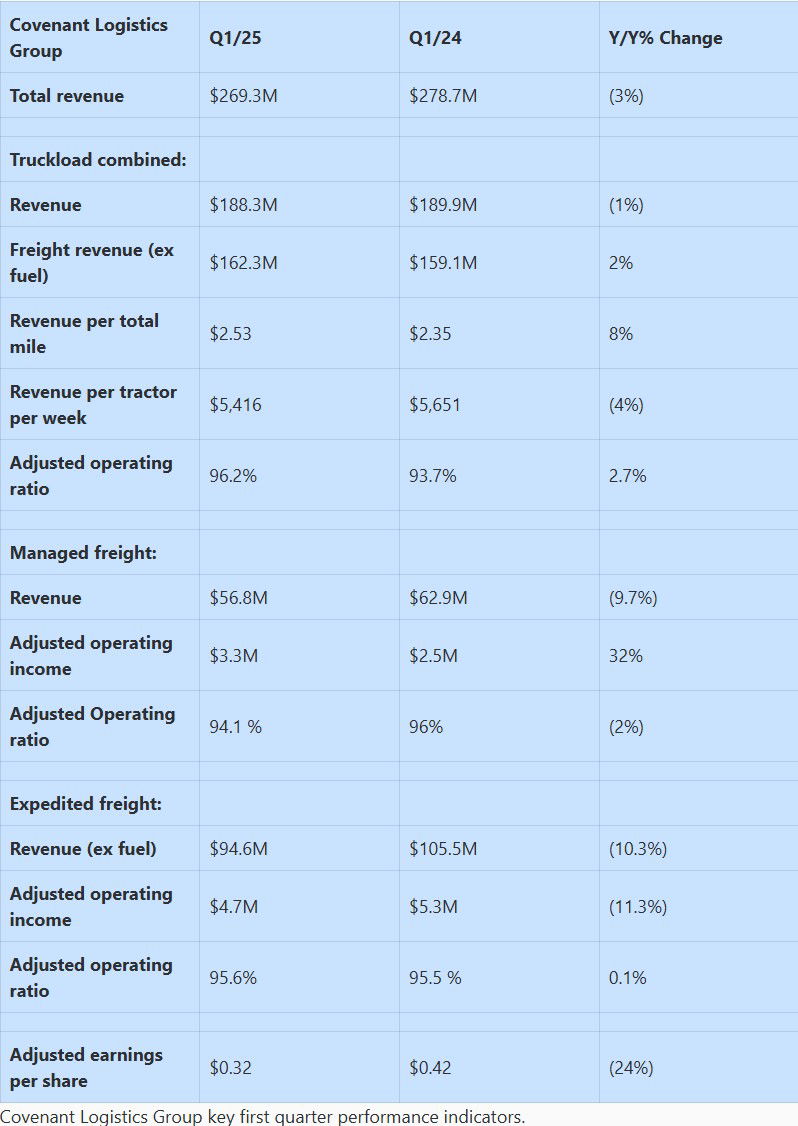
Covenant Logistics posted total revenue of $269.36 million for the first quarter, a 3% year-over-year decrease from the same period in 2024 and short of Wall Street estimates of $278 million.

The company’s first-quarter adjusted earnings were 32 cents per share, 10 cents less than Wall Street estimates of 42 cents.

Freight revenue declined 2% year over year in the first quarter to $243.2 million, while truckload revenue decreased 1% to $188.3 million.

Covenant officials attributed the slowdown to a severe outbreak of avian influenza disrupting its poultry business as well as challenges created by severe weather across the country.

In April 2023, Covenant Logistics acquired  Huntsville, Arkansas-based Lew Thompson & Son, a trucking company primarily involved in poultry-related freight movement.

“There’s some amount of bird flu every year,” Grant said. “Just in talking to the industry folks, this year is probably as bad as any year it has been.”

Grant said the avian influenza shouldn’t affect revenue beyond the first quarter.

“We felt it in the fourth quarter. I would say we felt it in January, February, March; we’re feeling it a little bit in April,” Grant said. “I would say by June, we should be back at 100%. We’re probably at 85% today.”

Company officials said they anticipate growth across their segments over the next several quarters.

The dedicated segment posted revenue of $93.6 million in the first quarter, an 11% year-over-year increase. Revenue in the expedited segment decreased about 10.2% to $94.6 million.

Warehousing revenue declined about 6% year over year to $24 million, while managed freight declined 9.7% year over year to $56.8 million.

“I think we’ll see dedicated margins improve, just like expedited, for a couple reasons,” President Paul Bunn said during the call. “I think the weather significantly affected business in the first quarter. So just with better weather and whatnot, it will help. It will help dedicated. Then, as we continue, the worst of the bird flu will probably be over by January, early February.”

Covenant also recently completed a small tuck-in acquisition of a multistop distribution carrier that is expected to immediately add earnings in the company’s dedicated division. 

Company officials did not disclose any more information about the acquisition.

Trans-Pacific container rates stable as trade war rages

While shipments from China crater in President Donald Trump’s ongoing trade war, ocean container rates have yet to fully reflect the collapse in trans-Pacific volumes. 

Freight rates from Shanghai, China’s busiest container port complex, to Los Angeles, the largest U.S. import gateway, fell 2% to $2,617 per 40-foot container, according to analyst Drewry’s latest World Container Index of spot rates released Thursday.

Shanghai to New York decreased 3%, or $95, to $3,611.

Rates from Los Angeles to Shanghai remained stable.

(Chart: Drewry)

The modest retreat comes in the face of U.S. tariffs of as much as 245% on some Chinese exports that have cratered U.S.-bound exports as shippers cancel factory orders, carriers increase blank sailings and importers scramble to realign supply chains.

Drewry said it expects rates to continue to decline in the coming week due to uncertainty stemming from reciprocal tariffs.

Similarly, rates from Rotterdam, Netherlands, to Shanghai decreased 2% to $481 per FEU, while Rotterdam to New York fell 1% to $2,109 per FEU. New York to Rotterdam increased 1% or $8 to $825 per FEU.

Rotterdam and other major European ports have been dealing with recent severe congestion.

The Drewry WCI composite index decreased 2% to $2,157 per FEU, 79% below the previous pandemic peak of $10,377 in September 2021. That was still 52% higher than the pre-pandemic average of $1,420 in 2019.

The average year-to-date composite index closed at $2,854 per FEU, $38 lower than the 10-year average of $2,891 (inflated by the exceptional 2020-22 Covid period).

Find more articles by Stuart Chirls here.

Related coverage:

Shares of largest US-flag container carrier plunge under Trump tariffs
Trans-Pacific blank sailings soar as ocean shipments plunge

US plans phased approach to port fees for Chinese ships

Trump trade war halts ships, strands empty containers 

Los Angeles police recover over $3.9M in stolen cargo

Two men have been arrested on suspicion they were part of a criminal enterprise to steal, move and sell stolen cargo in the Los Angeles area valued at over $3.9 million.

Detectives from the Los Angeles Police Department’s Cargo Theft Unit partnered with the Los Angeles Port Police, Union Pacific Police Department and the Los Angeles World Airport Police to make the arrests, according to a news release Tuesday by the LAPD.

Oscar David Borrero-Manchola, 41, and Yonaiker Rafael Martinez-Ramos, 25, were arrested by detectives after a long investigation with various search warrants at storage unit facilities in the San Fernando Valley.

The release stated that the two men are “prominent members” of the South American Theft Group.

Detectives recovered over $1.2 million in stolen tequila, speakers, coffee, clothing, shoes, body wash and pet food. They also recovered a stolen shipment of bitcoin mining computers, valued at $2.7 million, from LAX airport as the shipment was about to be loaded onto a plane headed to Hong Kong.

Photos published by LAPD show six storage units filled with boxes containing the stolen cargo.

Both suspects were booked at the LAPD’s Van Nuys Jail. Borrero-Manchola was arrested on a charge of receiving stolen property and was cited then released. Martinez-Ramos was arrested on a no-bail warrant.

“This case highlights the ongoing collaborative efforts among law enforcement agencies to combat cargo theft and protect the integrity of commercial transport operations,” the release stated. “The investigation remains ongoing, and additional arrests may follow.”

Illinois railcar owner doesn’t have to pay damages in Ohio train derailment

GATX, the company that owned one of the railcars in a 2023 Ohio train derailment, will not have to pay a portion of railroad Norfolk Southern’s $600 million settlement with residents.

After a trial that lasted more than three weeks, a federal jury in Youngstown, Ohio, on Wednesday found GATX Corp. not liable in the settlement for damages caused by the incident in East Palestine.

“GATX is pleased with the trial outcome, which affirms what we have known for some time: Norfolk Southern alone is responsible for the derailment and resulting damage in East Palestine,” the company said in a statement, according to The Associated Press.

The train derailment in February 2023 in East Palestine led to the intentional release and burning of toxic vinyl chloride from five railcars three days after the crash.

The derailment and release of the chemicals led to the evacuation of thousands of area residents. Norfolk Southern agreed to a $600 million settlement to resolve a class-action lawsuit brought by residents and businesses affected by the incident.

The National Transportation Safety Board said in June that a GATX-leased railcar’s defective wheel bearing caused the derailment and subsequent hazardous material release in East Palestine.

Chicago-based GATX (NYSE: GATX) is a railcar lessor that owns fleets in North America, Europe and Asia.

The company maintained Norfolk Southern operated and inspected the train and all the cars and was responsible for delivering the cargo safely.

Officials for Norfolk Southern said the verdict was disappointing but won’t change the railroad’s commitments to everyone affected by the derailment.

Atlanta-based Norfolk Southern (NYSE: NSC) is a Class I freight railroad operating in the eastern United States.

“For more than two years, Norfolk Southern has paid the costs related to the derailment while acknowledging and acting on our own responsibility for the accident,” Norfolk Southern said in an email to FreightWaves. “Our belief has always been that GATX shares in that responsibility and should also be held to account. While today’s verdict on our claims against GATX is disappointing, it does not affect our ongoing commitments in East Palestine.”

Norfolk Southern and OxyVinyls, the chemical company that made the vinyl chloride that was released and burned after the derailment, announced an agreement April 17 about how much each side will help pay for the $600 million settlement.

The settlement details between Norfolk Southern and OxyVinyls were not disclosed.

A lawsuit filed in February against Norfolk Southern and other defendants includes seven wrongful death claims related to the incident.

Union Pacific posts flat quarterly results despite volume growth

Union Pacific (NYSE: UNP) reported flat quarterly earnings Thursday as a decline in fuel surcharge revenue offset record freight revenue that flowed from industry-leading volume growth.

“We had a solid start to the year. … [W]e delivered record first-quarter operating performance,” CEO Jim Vena told investors and analysts on the railroad’s earnings call. “Further, we had the strongest carload growth of the Class I’s as we worked closely with our customers to meet their needs in an uncertain environment.”

UP’s operating income and revenue were flat, at $2.4 billion and $6 billion, respectively. Earnings per share increased by a penny, to $2.70. The lower fuel surcharge revenue, combined with the impact of 2024’s being a leap year, was a 19% drag on earnings per share. The railroad’s operating ratio held steady at 60.7%.

Overall volume increased 7% thanks largely to continued international and domestic intermodal growth.

UP’s premium segment — which includes intermodal and automotive business — saw a 13% increase in volume due to strong West Coast imports of containerized cargo. Bulk traffic was up 1% as higher natural gas prices drove increased demand for utility coal. Strong demand for grain products, along with the opening of new processing facilities on UP lines, also helped boost bulk volumes. Industrial traffic declined 1% due to lower shipments of petroleum products and soda ash.

UP is closely following tariff developments and their potential to hit consumer spending, says Kenny Rocker, executive vice president of marketing and sales. The railroad has a positive outlook for grain, chemicals, plastics and domestic intermodal traffic and a negative outlook for food and beverage, petroleum, automotive, and international intermodal. Coal is expected to remain stable in the near term.

Despite ongoing uncertainty over trade policy and the broader economy, UP affirmed its full-year financial outlook. “As we look to the next three quarters, it is likely going to be a bumpy ride,” Chief Financial Officer Jennifer Hamann said.

But Vena said that was no reason for UP to walk back its forecast, particularly since the railroad is operating well and handles products that consumers and industries use every day.

“The easy thing would’ve been to come in this morning and just say, ‘Listen, there’s so much noise, we’re pulling our guidance,’” Vena said. “But we have a job to do, and our job is to react to whatever’s thrown at us at Union Pacific.”

Traffic volume has continued to hold up so far in the second quarter, and Vena says trade policy will be sorted out sooner or later. “I’ve never bet against the United States economy or the United States in general,” he said. “So at the end of the day, I think we end up in a good place, whether that’s in a few weeks or whether that’s in six months.”

The railroad’s key operational metrics improved for the quarter, with record low terminal dwell contributing to a 6% increase in car miles per day. The 215-miles-per-day figure was a first-quarter record.

UP’s intermodal service performance index dropped 1 point, to 94%, while the manifest service performance index improved 6 points, to 93%.

“We are turning our customers’ assets faster, a win-win as we support their growth initiatives while simultaneously generating future growth capacity within our terminals,” says Eric Gehringer, executive vice president of operations.

“Our buffer of resources coupled with improved fluidity … continues to translate into a very high level of service for our customers,” Gehringer said. “And customers are seeing the benefit, rewarding Union Pacific with new business.”

The railroad’s injury and train accident rates improved compared to the three-year rolling average, with the injury rate tying a first-quarter record set in 2016.

Related:

First look: Union Pacific earnings