Prologis sticks with 2025 outlook, but customers grow more cautious
Logistics real estate investment trust Prologis announced that it is sticking with its initial 2025 outlook even as uncertainty around trade policy has some customers delaying leasing decisions. The company said favorable trends in the first quarter had it in position to raise guidance but “Liberation Day” tariffs announced April 2 forced it to pause that decision.
Looking forward, management told analysts on a Wednesday conference call that there are still many unknowns around near-term leasing demand but that longer-term fundamentals and the need for incremental warehousing space remain intact.
“Let’s be clear: The range of outcomes is wide. We see potential for a recession, inflation or possibly both. And let’s also not dismiss the potential for a quick resolution,” CFO Tim Arndt said on the call.
He said the company was “designed to weather any environment,” noting a diverse customer portfolio, built-in rent escalators and a strong balance sheet, but that “customers simply lack a steady backdrop upon which to plan their businesses.”
Prologis (NYSE: PLD) reported first-quarter core funds from operations (FFO) of $1.42 per share before the market opened on Wednesday, which was 4 cents above consensus and 14 cents higher year over year.
Total revenue was up 9% y/y to $2.14 billion as new leases commenced increased 35% to 65.1 million square feet, but occupancy slid 190 basis points to 94.9%. (Occupancy ended the period at 95.2%.)
Table: Prologis’ key performance indicators
Arndt said many customers have been pulling forward inventories ahead of tariffs and some are now looking for more storage space. Port markets could also see a near-term lift given a 90-day pause on some tariffs as customers continue to build stockpiles.
Deals are still getting done currently but at a reduced pace. Overall leasing activity for Prologis was down 20% over the past two weeks. It signed 80 leases covering 6 million square feet in that period. However, the company believes the need for space will increase in a “disconnected world” as many players will be required to stand up new supply chains.
Prologis maintained its full-year 2025 guidance for core FFO to range from $5.65 to $5.81. The outlook continues to assume average occupancy in a range of 94.5% to 95.5%. It did lower its forecast for development starts by 30% at the midpoint of the new range of $1.5 billion to $2 billion until visibility improves.
The bottom end of the FFO guidance range contemplated worst-case scenarios from past downturns like the Great Financial Crisis when rents fell 18% and vacancies declined 170 bps.
“But please, this is not a prediction. We are incapable of making a prediction in this environment,” said Hamid Moghadam, Prologis co-founder and CEO.
The concern over tariffs had little impact on the quarter as global rents fell 1.5% and were down just 0.5% excluding Southern California.
Shares of PLD were 2% higher at 2:42 p.m. EDT on Wednesday compared to the S&P 500, which was down 2.6%.
Port of Huntsville on the power of inland ports; navigating a trade war | WHAT THE TRUCK?!?
On Episode 827 of WHAT THE TRUCK?!?, Dooner is talking about the shockwaves that have been reverberating throughout the trade community due to the trade war. The Maritime Professor Lauren Beagan drops in to talk about the massive collapse in container bookings that has happened over the past month. How soon will we feel the pain in volumes on the trucking side?
Beagan also breaks down recent maritime policy regarding new port fees as well as the Panama and Suez canals.
Port of Huntsville CEO Butch Roberts believes we’re in for an inland port renaissance. We’ll find out how the port works, whom it serves and why big investments in air and intermodal will be a boon for shippers.
Plus, gambling bookkeeper busted; Kodiak goes SPAC; Indiana Jones and the Great Circle drops on PS5; and more.
The power of inland ports | Port of Huntsville 08:15
It’s not a Bug, it’s a feature 22:12
Navigating a trade war | Lauren Beagan 22:44
Port fees and maritime policy | Lauren Beagan 42:12
Catch new shows live at noon EDT Mondays, Wednesdays and Fridays on FreightWaves LinkedIn, Facebook, X or YouTube, or on demand by looking up WHAT THE TRUCK?!? on your favorite podcast player and at 5 p.m. Eastern on SiriusXM’s Road Dog Trucking Channel 146.
Analyst warns of ‘carnage’ on shifts in container shipping
Significant shifts in the container shipping marked by record-breaking capacity and unexpected rate increases are pointing to potential severe near-term disruptions.
Capacity from the Far East to North Europe is set to reach an all-time high in mid-April, according to data from analyst Xeneta. This surge surpasses the previous record set during the height of pandemic disruptions in November 2021, when capacity hit 336,800 twenty-foot equivalent units.
Simultaneously, average spot rates on this route had increased by 4.8% as of Tuesday, reaching $2,457 per forty-foot equivalent unit. The Mediterranean route has seen an even steeper rise, with rates jumping 6.8% to $3,270 per FEU.
“We are looking at record-breaking container shipping capacity leaving the Far East for North Europe this week, which means carriers know something is boiling,” said Peter Sand, Xeneta’s chief analyst, in a research note. “This suggests a nervous market, but the demand must also be there to put upward pressure on rates.”
The unusual combination of increased capacity and rising rates during what is typically a slack period has led to speculation about the influence of tariffs on trade flows. Sand suggests that shippers may be redirecting goods from the Far East to Europe instead of the United States, where tariffs on some Chinese imports have reached 245%.
While the Far East to Europe routes are seeing increases, other major trade lanes show different trends:
Far East to U.S. East Coast rates remain steady at $3,951 per FEU.
Far East to U.S. West Coast rates hold at $2,910 per FEU.
North Europe to U.S. East Coast rates are unchanged at $2,158 per FEU.
Year to date, all fronthaul trades have seen significant rate decreases, ranging from 20% for North Europe to U.S. East Coast to 50% for Far East to U.S. West Coast. That comes as carriers announce general rate increases and surcharges in an effort to shore up prices.
Adding to the complex market dynamics is port congestion in North Europe. Antwerp in Belgium, Le Havre in France, London Gateway and Germany’s Hamburg are experiencing heavy congestion due to various factors including weather, crane maintenance and labor unrest.
Sand warns of potential “carnage” when the record capacity from the Far East arrives in North Europe, given the average transit time of 55 days. “As we saw in 2021, congestion is toxic for ocean container shipping and can quickly spread across global supply chains.”
By every metric, China dominates global manufacturing. But how did this country, which was backward and impoverished, with a GDP per capita under $1,000 as late as 1999, transform itself into an industrial powerhouse? And what can other nations, particularly the United States, learn from China’s manufacturing success story?
This is JP Hampstead, co-host with Craig Fuller of the Bring It Home podcast. Welcome to the 21st edition of our newsletter, where we ask how China did it and what the U.S. can and can’t take from the Chinese example.
To understand the rise of Chinese manufacturing, we need to go back. In the late 1970s, China began opening up its economy under Deng Xiaoping’s leadership. This marked a significant shift from the country’s previously closed, centrally planned system to a more market-oriented approach. The timing was perfect: It was the high-water mark of union membership in the U.S., Western companies were seeking ways to reduce production costs, and China offered an abundance of low-cost labor.
Initially, China’s role in global manufacturing was primarily as a low-cost producer of simple, labor-intensive goods. However, over the decades, the country has transformed its manufacturing capabilities, moving up the value chain to produce increasingly sophisticated products. Today, China is not just a hub for textiles and toys but also for high-tech electronics, automotive parts and advanced machinery.
Several aspects of Chinese culture, institutions and public policies have contributed to this manufacturing success. First, there’s the cultural emphasis on hard work and collective achievement. The Chinese workforce is known for its diligence and willingness to put in long hours; alternatively, one could speak of the Chinese people’s pain tolerance and low expectations for quality of life.
Top-down industrial policies from Beijing have been instrumental in China’s manufacturing rise. The Chinese government has consistently prioritized industrial development, offering various incentives to attract foreign investment and technology transfer. These include tax breaks, subsidies and the establishment of special economic zones. The government has also invested heavily in infrastructure – including $153 billion for domestic ports between 2012 and 2019 alone – creating an environment conducive to large-scale manufacturing operations.
Another key factor is China’s vast and well-developed supply chain ecosystem. The concentration of suppliers, assemblers and logistics providers in manufacturing clusters allows for rapid prototyping, efficient production and quick turnaround times. This ecosystem is particularly evident in regions like Shenzhen, which has become a global hub for electronics manufacturing.
However, it’s important to note that China’s manufacturing success hasn’t come without high costs. Issues such as intellectual property infringement, labor rights concerns and environmental degradation have been persistent problems. Beijing is still choked with vast slums.
So, what can the United States learn from China? While some aspects of China’s approach may not be replicable or desirable in the U.S. context, there are certainly lessons to be drawn.
First, the importance of a coherent, long-term industrial policy cannot be overstated. The U.S. could benefit from a more strategic approach to supporting its manufacturing sector, including targeted investments in key industries and technologies.
Second, the U.S. could take cues from China’s emphasis on vocational education and training. Strengthening partnerships between educational institutions and industry could help create a workforce better aligned with the needs of modern manufacturing.
Third, the development of manufacturing ecosystems or clusters, similar to those in China, could enhance efficiency and innovation in U.S. manufacturing. This might involve incentives for co-location of suppliers and manufacturers in specific regions, or even the creation of special economic zones. Balaji Srinivasan recently tweeted in support of a “special Elon zone” without taxes or regulations around SpaceX’s Starbase in Texas.
But the U.S. can’t simply replicate China’s formula for success. Our federal government is divided and often at cross-purposes with itself, making ambitious policies difficult to achieve; our hard-tech sector often bears the cost of R&D that benefits the entire world; American workers have high expectations for their quality of life. So the U.S. must forge its own path to manufacturing competitiveness.
While China’s manufacturing success story offers valuable insights, the key for the U.S. lies in adapting relevant lessons to its own unique context and perhaps a strategy that leans into innovation rather than sheer scale, automation rather than cheap labor, critical machines rather than retail goods, and sustainable partnerships between labor and management.
Quotable
“China’s door of opening up will not be closed but will only open wider, and our business environment will only get better.” – China Vice Premier Ding Xuexiang at Davos 2025
Within the next four years, Nvidia plans to produce up to half a trillion dollars of AI infrastructure in the United States through partnerships with TSMC, Foxconn, Wistron, Amkor and SPIL. These world-leading companies are deepening their partnership with Nvidia, growing their businesses while expanding their global footprint and hardening supply chain resilience.
Swiss drugmaker Novartis said on Thursday it plans to spend $23 billion to build and expand 10 facilities in the U.S., as it grapples with renewed threats of drug import duties from the Trump administration. Novartis said it plans to build six new manufacturing plants, some of which will make raw pharmaceutical ingredients, as well as a new R&D site in San Diego.
On LVMH’s first-quarter 2025 earnings call on Monday, the French luxury giant revealed slightly lowered sales while highlighting recent successes like the debut of Sarah Burton designing for Givenchy and Tag Heuer’s return to sponsoring Formula 1.
But the question on every analyst’s mind was: How is LVMH feeling about tariffs? President Donald Trump’s rollout of disruptive tariffs has been causing headaches for fashion brands for weeks. LVMH is a leader in the fashion space, and CEO Bernard Arnault has close ties to Trump. The company’s reaction to the tariff rollout could serve as an indicator for the rest of the industry of just how dire things could be.
Most recent episode
C.H. Robinson delivers on AI, but investors still skeptical
C.H. Robinson (NASDAQ:CHRW) revealed Wednesday it has executed more than 3 million shipping tasks through its proprietary generative AI agents.
“Each additional shipping step we’ve automated beyond those has created new leaps in efficiency for global supply chains and freed our people to do more high-value work for our customers,” said Arun Rajan, chief strategy and innovation officer, in the release.
For context, Robinson isn’t new to AI. According to the global logistics provider, it has spent more than a decade integrating artificial intelligence at scale. In 2023, C.H. Robinson launched its first generative AI agent and began rolling out its features throughout 2024.
Rajan explained that more than 1 million price quotes and 1 million orders have already been processed by AI. Beyond quoting and ordering, these agents handle appointment setting for pickups and deliveries, monitor loads in transit and send tracking updates.
One area seeing particularly strong traction in its AI investments is less-than-truckload shipping. Since incorporating LTL into its AI-driven quoting system, Robinson has reported monthly quote volumes jumping by at least 30%.
“In February and March, our AI took care of just as many LTL orders as truckload orders. … We first applied our orders AI agent to emails from our biggest customers with the most truckload volume. Now in 2025, we’re extending it to more of our customers in the small and medium business sector, who are heavy users of both email and LTL shipping. Instead of waiting up to four hours for a person to get to their shipment in an email queue, over 5,200 customers are getting their loads accepted in under 90 seconds,” said Mark Albrecht, VP for artificial intelligence, in the release.
In January, Robinson also launched an AI agent specifically designed to process inbound carrier emails offering truck capacity. Within a month, the system reportedly was uploading 10 times more trucks into the company’s real-time capacity center.
March had its own AI updates as well, including an upgraded appointment-scheduling AI, a pilot voice AI capability used for carrier status updates and a new model to automate responses to customer tracking requests.
For anyone who’s followed the company’s earnings calls, these updates shouldn’t come as a surprise. CEO Dave Bozeman and Rajan have been consistently transparent about the company’s digital ambitions, especially as the freight market remains stuck in what Bozeman has called a “prolonged freight recession.”
Robinson’s fourth-quarter 2024 earnings painted a mixed picture: strong year-over-year gains in profitability, with its adjusted operating margin climbing to 26.8% and North American Surface Transportation income up 41.2%, even as revenue slid 6.6%.
Yet, sequential declines across some segments and cautious forward guidance underscored that the company’s earnings strength isn’t riding on a market rebound. Instead, its focus remains on operational transformation.
Rajan made this clear on the last earnings call when he shared how generative AI is already helping automate nearly 10,000 transactions a day by parsing the flood of emails that logistics firms juggle.
The results shared Wednesday are important given how wary investors reacted to Robinson’s last earnings, when the stock slid nearly 6% despite margin improvements, as Wall Street remained skeptical about the freight recession’s grip. Since those earnings, its stock has declined approximately 8.8%.
C.H. Robinson’s next earnings call is set for April 30.
Hongkong Post to stop handling US-bound packages amid tariff conflict
Hongkong Post said on Wednesday it will suspend mail service on April 27 for small parcels sent by air to the United States, escalating the trade war between Washington and Beijing after the United States announced plans to eliminate duty-free treatment for small-dollar goods from China and Hong Kong.
Hong Kong’s postal service also said it has immediately cut off acceptance of shipments moving to the U.S. by ocean. Postal items in its system that have not yet shipped will be returned to senders.
Hongkong Post said the moves are in response to “bullying” by the Trump administration, which is canceling a tariff-free program for parcels from China and Hong Kong effective May 2. The de minimis program for goods valued below $800 enticed online marketplaces and other merchants to ship digital orders directly to U.S. consumers rather than to distribution agents who must file formal customs entries. Parcels from Hong Kong and China moving by post will face a 90% duty or a flat fee of $75. On June 1, the flat fee goes to $150. Shippers can choose each month which method they prefer.
Parcels moving by commercial channels will be subject to a new 145% tariff applied by the Trump administration. China has countered with a 125% tariff on U.S. imports. On Wednesday, however, the White House threatened China with tariffs as high as 245% on certain goods found to be imported unfairly.
Hongkong Post said it won’t collect any tariffs on behalf of the United States. Postal items containing documents will not be affected by the new rules, it added.
“For sending items to the US, the public in Hong Kong should be prepared to pay exorbitant and unreasonable fees due to the US’s unreasonable and bullying acts,” it said in a news release.
U.S. Customs and Border Protection has said the ability of electronic retailers to bypass normal import controls through de minimis has generated a tidal wave of volume and made it difficult to target shipments for smuggling or other illicit purposes.
Nearly 4 million de minimis shipments per day enter the U.S., the majority of them from China. The number of de minimis transactions has increased sevenfold in eight years to nearly 1.4 billion shipments annually, worth $54.5 billion in 2023, according to the agency.
The White House said it ended de minimis for China and Hong Kong parcel shipments over concerns that criminals were taking advantage of the expedited entry system to smuggle fentanyl, a dangerous opioid, and to stop ultra-cheap goods from undercutting U.S. manufacturers and retailers.
Hongkong Post’s actions add to the potential decrease in business for the air cargo industry from the U.S. elimination of de minimis for China and Hong Kong. Air transport is the primary mode used for e-commerce because of its speed. Retailers are expected to shift a large portion of their imports away from air, or to other countries, because of the tariffs. Postal services contract with airlines to move parcels on their behalf.
Hong Kong is a special administrative region of China, but the U.S. has hit it with the same tariffs as China because it no longer enjoys special status as a financial hub under U.S. law.
Imports from China now face tariffs of up to 245%, White House says
Imported goods from China to the U.S. could be hit with tariffs as high as 245%, the White House said.
The Trump administration released a fact sheet late Tuesday detailing an executive order to review any national security risks posed by relying on foreign imports of rare earth minerals.
“China now faces up to a 245% tariff on imports to the United States as a result of its retaliatory actions,” the fact sheet said. “This includes a 125% reciprocal tariff, a 20% tariff to address the fentanyl crisis, and Section 301 tariffs on specific goods, between 7.5% and 100%.”
China has raised its duties on imports of U.S. goods to 125%, up from 84%. On April 4, China also began restricting exports of rare earth materials to the U.S., which are used in high-tech products such as computer chips and electric vehicle batteries.
China was the third-ranked U.S. trading partner in 2024 at $582 billion in two-way international commerce.
The U.S. imports a wide range of goods from China, including electronic devices like smartphones and computers, along with industrial machinery, household appliances and furniture, toys, rare earth metals, and more.
Key U.S. exports to China include oil, gas, aircraft, pharmaceutical products, cars and agricultural goods.
The Trump administration said on Tuesday the next move is China’s.
“The ball is in China’s court. China needs to make a deal with us. We don”t have to make a deal with them,” press secretary Karoline Leavitt said from the White House, reading a statement to reporters from President Donald Trump. “There’s no difference between China and any other country except they are much larger. And China wants what we have, what every country wants – the American consumer. Or, to put it another way, they need our money.”
Officials in China said they are willing to negotiate with the Trump administration, but the White House should “stop threatening and blackmailing.”
“If the U.S. genuinely wants to solve the problem through dialogue and negotiation, it should give up its approach of imposing extreme pressure, stop threatening and blackmailing, and engage in dialogue with the Chinese side on the basis of equality, respect and mutual benefit,” China Foreign Ministry spokesman Lin Jian said on Wednesday, according to China Daily. “China’s position has been very clear. There is no winner in a tariff war or a trade war. China is not willing to fight, nor is it afraid of fighting.”
The Trump administration launched its broad “reciprocal” tariff plan for about 90 U.S. trade partners April 2, including a baseline 10% tariff on trade partners, as well as 25% tariffs on certain imported vehicles and auto parts.
A few hours after the reciprocal tariffs went into effect, Trump announced he was pausing the higher tariffs, except for China.
All U.S. trading partners still currently face a 10% baseline levy, except for Canada and Mexico.
Trump on Sunday said he would be announcing new tariff rates on imported semiconductor chips soon.
“We wanted to uncomplicate it from a lot of other companies, because we want to make our chips and semiconductors and other things in our country,” Trump told reporters aboard Air Force One, according to Reuters.
Autonomous rail intermodal cars to begin testing this month
Parallel Systems, which is developing battery-electric railcars that operate autonomously, will launch testing this month on two Georgia railroads, Parallel said on Monday.
The Los Angeles-based company also announced it had raised an additional $38 million in funding, bringing its total to date to about $100 million.
“Federal Railroad Administration approval and closing our Series B funding round are two critical milestones for Parallel Systems,” Matt Soule, Parallel founder and chief executive, said in a release. “Together with our strategic partnerships within the rail industry, Parallel Systems is now poised to fully commercialize our battery-electric rail system, starting with the FRA-approved project in Georgia.”
In January, the Federal Railroad Administration approved a request from Parallel, Georgia Central and Heart of Georgia Railroad to test its self-propelled intermodal flatcars, but the company had not previously identified when testing would begin.
The seven-phase testing program on the two Genesee & Wyoming short lines will begin with testing on 2 miles of track on the Heart of Georgia that will be disconnected from the rest of the railroad. It will gradually progress to platoon operation of the cars with loaded containers over a 160-mile segment of the two railroads.
The company said the latest funding will be used to “propel commercialization” of its project with railroad partners in the U.S. and Australia, where it has also demonstrated its product.
Parallel said it already had a backlog of more than 300 of its autonomous railcars with leading railroads and expects to launch commercial operations in 2026. The company said it is scaling production of its Generation 3 equipment and related autonomy software train control systems, and has tested its technology’s compatibility with positive train control in collaboration with Union Pacific.
Competitor Intramotev of St. Louis has deployed autonomous railcars in commercial operations at a calcium mine in Missouri and told FreightWaves it is close to signing a deal for autonomous intermodal cars with a customer outside the United States.
Logistics warehouse operator Prologis beat first-quarter expectations Wednesday before the market opened. The San Francisco-based real estate investment trust reported core funds from operations (FFO) of $1.42 per share, which was 4 cents higher than the consensus estimate and 14 cents higher year over year.
Total revenue was up 9% y/y to $2.14 billion. New leases commenced covered 65.1 million square feet, a 35% y/y increase, but occupancy fell 190 basis points to 94.9% in the quarter.
Prologis (NYSE: PLD) maintained its full-year 2025 guidance for core FFO of $5.65 to $5.81. The guide continues to assume average occupancy will range from 94.5% to 95.5% across the portfolio.
“In the near term, policy uncertainty is making customers more cautious,” said Hamid Moghadam, Prologis co-founder and CEO, in a news release. “But over the long term, limited new supply and high construction costs support continued rent growth. We’re confident in the strength and resilience of our business.”
The company lowered guidance for new development starts in 2025 by 30% (at the midpoint) to a range of $1.5 billion to $2 billion.
Prologis will host a call at noon EDT on Wednesday to discuss first-quarter results.
J.B. Hunt’s intermodal bid season delivers mixed results
J.B. Hunt Transport Services said it has seen mixed results so far this intermodal bid season, capturing rate increases and adding volume in some empty lanes of the network while also losing business to competitors as it remains disciplined and tries to up its freight mix.
The Lowell, Arkansas-based company’s intermodal head, Darren Field, said on a Tuesday evening call with equity analysts that J.B. Hunt (NASDAQ: JBHT) has had “only modest success in repairing rates while retaining existing business.” The company is getting rate increases in headhaul markets while walking from lower-margin business in other areas.
A changing tariff landscape has the management team contemplating multiple volume scenarios.
Roughly 20% to 30% of its intermodal volume comes off the West Coast, but it didn’t say how much of that freight originates in China. Field said there hasn’t been a notable change in demand indications from customers. Most customers also haven’t said they pulled forward freight ahead of recent tariff implementations, which if they have, would create a void in demand later this year.
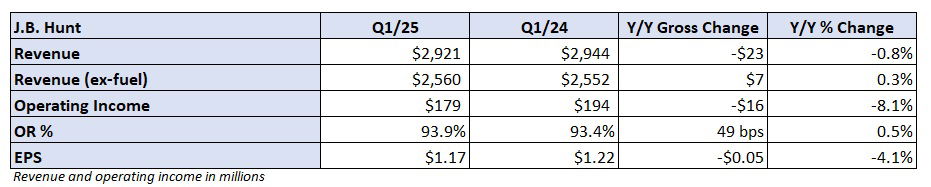
The multimodal transportation provider reported first-quarter earnings per share of $1.17 after the market closed Tuesday. The result was 3 cents ahead of the consensus estimate but 5 cents lower year over year. Of note, earnings estimates for transportation companies have been coming down in recent weeks as trade risks rise and as March failed to live up to typical seasonality. J.B. Hunt’s first-quarter consensus estimate moved from $1.42 90 days ago to $1.14 ahead of the print.
Consolidated revenue of $2.92 billion was 1% lower y/y. Operating income fell 8% y/y to $179 million. Higher costs (insurance and claims, medical insurance, and maintenance) were the culprits. The company slightly beat its guidance calling for a 20% to 25% sequential decline in operating income for the period.
Record Q1 intermodal volumes, margin lags again
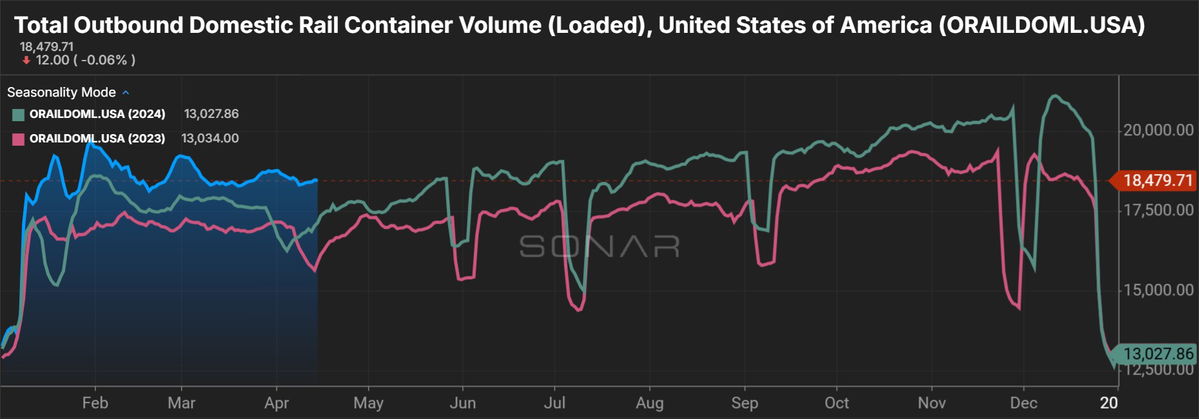
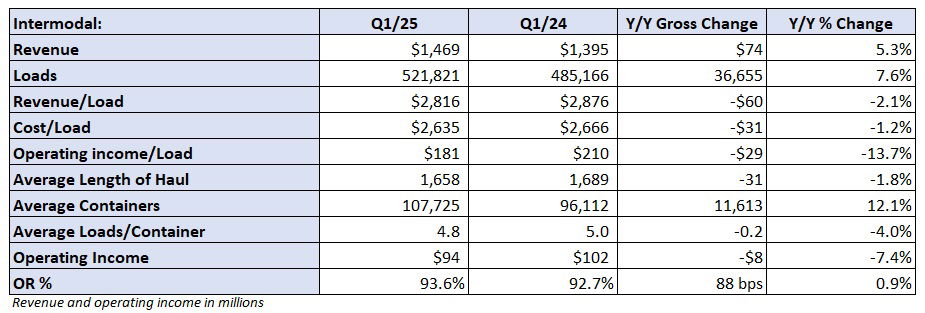
Intermodal revenue of $1.47 billion was 5% higher y/y as the company reported record first-quarter volumes. Total loads increased 8% as transcontinental loads were up 4% and shipments in the Eastern network were up 13%. Loads were up 9% y/y in January, 6% in February and 7% in March. That compared to a 9% y/y increase in total intermodal traffic on the U.S. Class I railroads during the quarter, according to the Association of American Railroads.
SONAR: Outbound Domestic Rail Container Volume Index for 2025 (blue shaded area), 2024 (green line) and 2023 (pink line). The daily volume of intermodal containers moving in the United States, Canada and Mexico. The index is a 7-day moving average using the date that containers were in-gated at a point of origin. Intermodal trailers (trailer-on-flatcar, or TOFC) are excluded. To learn more about SONAR, click here.
Revenue per load declined 2% y/y (down just 1% from the fourth quarter). A higher growth rate in the East was a modest drag on yields given the shorter length of haul. The company still has some large bids to be negotiated in the coming months.
Even with the record volumes margins continued to back up. The segment recorded a 93.6% operating ratio (inverse of operating margin), which was 90 basis points worse y/y. Average loads per container were off 4% y/y, and operating income per load fell 14%. The company didn’t commit to margin improvement in the unit this year given the difficult operating environment that’s being further complicated by trade uncertainty.
“We wanted to get the business on a trajectory to see an improvement in our margins in 2025, and we still have a long way to go to know if we will be successful or not,” Field said.
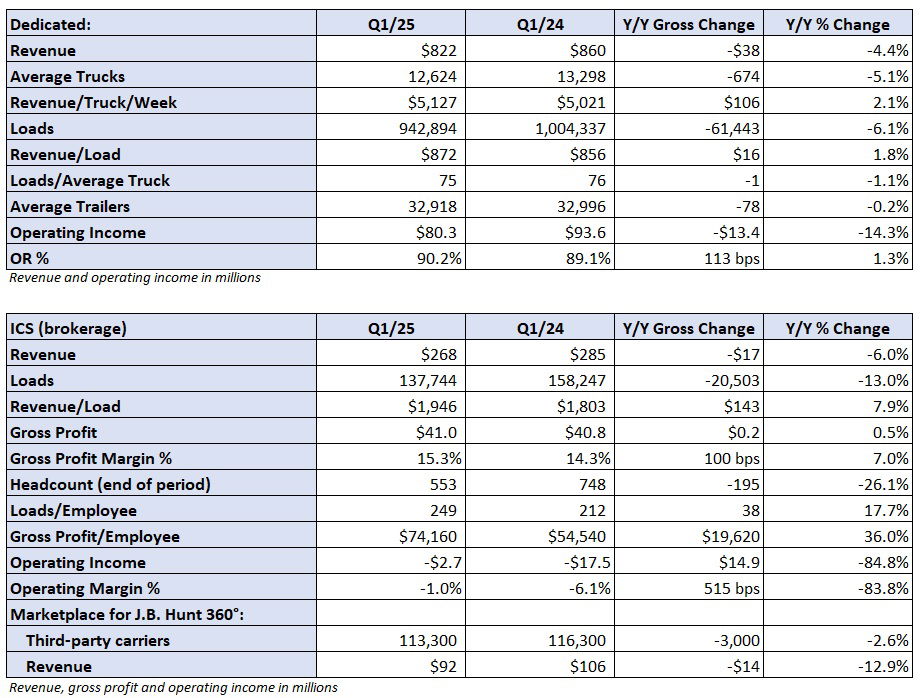
The dedicated segment reported a 4% y/y revenue decline to $822 million. Average trucks in service fell 5%, but revenue per truck per week increased 2% (up 4% excluding fuel surcharges). Severe winter weather was a headwind in the quarter, and J.B. Hunt’s lawn and garden customers haven’t seen the typical “spring surge.”
It sold service on 260 dedicated trucks in the period, but the timing of future deals will dictate if it returns to net fleet growth this year. Those additions will also determine if the company is able to grow operating income.
The brokerage unit reported a 6% y/y revenue decline to $268 million. Total loads fell 13% but revenue per load increased 8%. The unit booked a $2.7 million operating loss, which was the smallest of this downcycle as both loads per employee and gross profit per employee increased 18% and 36% y/y, respectively.
Shares of JBHT were off 5.8% in after-hours trading on Tuesday.