How to Maximize Your MATS Experience as a Small Carrier/Owner-Operator

Attending the Mid-America Trucking Show (MATS) can be overwhelming. With over 50,000 attendees, thousands of vendors, and over a million square feet of exhibition space, it’s easy to get lost in the spectacle. If you go in without a plan, you’ll end up wandering aimlessly, snapping pictures, and walking away with a bag full of brochures but no real business impact. If you’re intentional, MATS can be one of the most productive events of your year.

I remember my first time at MATS over a decade ago—I walked the entire show, letting the sheer size and excitement consume me. Now, my approach is completely different. I go in with a focused strategy, maximizing my time and ensuring my company benefits. If you’re a small carrier or owner-operator, here’s how you can do the same.

1. Have a Business Objective

Before you even step foot in the convention center, ask yourself: What do I want to achieve at MATS? Are you looking to make your fleet more efficient? Seeking better fuel solutions? Exploring compliance software? Networking with brokers or factoring companies? Identify your top three priorities and let those guide your experience.

For example, if fuel efficiency is your focus, you should target exhibitors that offer fuel management technology, alternative fuel solutions, and aerodynamic enhancements. If you want to improve compliance, visit booths featuring ELD providers, safety equipment, and regulatory consultants. This isn’t a field trip—it’s an investment in your business, and every move you make should support that investment.

2. Download the Exhibitor List and Plan Your Visits First

MATS provides an exhibitor list ahead of time—download it. Identify the vendors that align with your objectives and map out a plan to visit them first. The show floor is massive, and if you just wander around, you’ll waste valuable time. Prioritize key exhibitors, have a list of questions ready, and make real business connections.

3. Be Strategic with Your Time

Trying to see everything at MATS is a rookie mistake. I don’t try to walk the entire show anymore, and neither should you. I go straight to the exhibitors that align with my business goals, have productive conversations, and if I have extra time, then I might explore. You should do the same.

For example, if you’re a fleet owner considering expanding into dedicated freight lanes, schedule time with brokers, shipper representatives, and technology providers that specialize in lane optimization. If you’re thinking about adding trucks, visit financing and leasing exhibitors. This keeps you focused and ensures you leave with actionable takeaways rather than just sore feet.

4. Plan for the Scale of the Event

MATS is over a million square feet—trust me, it’s easy to get lost in the different wings. Make sure you know where your key exhibitors are located and plan your route accordingly. Trying to bounce back and forth across the entire venue is a time-waster. Stay organized and move efficiently.

Consider using the MATS app if available or even printing out a map and marking your must-visit booths. Think about what you need to accomplish first and structure your day around that. For example, hit up technology vendors in the morning, financing companies in the afternoon, and spend any leftover time checking out new industry innovations.

5. Attend MATS Pro Talks—but Be Strategic

MATS offers Pro Talks, a series of educational sessions featuring industry experts discussing the latest trends, best practices, and strategies for small carriers and owner-operators. These sessions can be extremely valuable, but again, be strategic about which ones you attend.

If you’re focused on reducing operational costs, look for talks on fuel efficiency, maintenance strategies, or negotiating better rates. If growing your business is your goal, attend discussions on shipper relationships, government contracting, or carrier compliance. Don’t just attend a session because it sounds interesting—make sure it directly benefits your business objectives.

A good strategy is to review the Pro Talks schedule in advance, highlight the sessions that align with your goals, and plan them into your day without sacrificing time on the show floor visiting key exhibitors. You want to balance learning with making direct industry connections.

6. Get the ‘Ohhs and Ahhs’ Out of the Way on Thursday

If it’s your first time at MATS, you will be overwhelmed. The lights, the displays, the custom rigs—it’s a lot to take in. That’s why I recommend using Thursday as your day to soak it all in. Walk the floor, take your pictures, and let yourself enjoy the spectacle. But come Friday and Saturday, it’s all business. Get focused, have meetings, and execute your plan.

For example, if you’ve never seen a decked-out, show-ready Peterbilt in person, go ahead and check it out on Thursday. If you’re curious about the latest truck interior upgrades or sleeper cabs, browse those areas early. But when business time comes, don’t get sidetracked by shiny objects.

7. Bring Comfortable Shoes and Plan for Long Days

This isn’t a quick trip to the grocery store—it’s a massive event with miles of walking. Wear comfortable shoes. Your feet will thank you. Also, plan to leave your hotel early. Traffic around the convention center is no joke, and if you’re using Uber, be patient. Drivers sometimes struggle to find pickup spots in the chaos.

For instance, if your hotel is 15 minutes away under normal conditions, expect it to take 30-40 minutes during peak MATS hours. Plan ahead, and if you have meetings or appointments with exhibitors, account for the extra travel time so you’re not rushing.

8. Don’t Go Just to Be Entertained—Be Intentional

Too many people attend MATS just to walk around, take pictures, and grab free swag. That’s a wasted opportunity. You’re the CEO of your company—treat this event as a business development opportunity. Every conversation should have a purpose. Every vendor visit should serve your business goals.

For example, instead of just collecting brochures, ask real questions: “How can your product improve my bottom line?” “What kind of return on investment have other small carriers seen using your service?” “What’s the biggest challenge your customers face, and how do you solve it?” Treat MATS like a business meeting, not a sightseeing trip.

9. Network with Purpose

MATS isn’t just about the exhibitors—it’s about the people. You’ll be surrounded by industry leaders, successful fleet owners, and service providers. Have meaningful conversations, exchange contacts, and follow up afterward. Relationships built at MATS can open doors long after the show ends.

For instance, if you meet a shipper looking for capacity, exchange information and follow up with an email the next week. If you meet a factoring company representative, discuss what kind of rates and services they offer that could be better than your current setup. Every handshake should have a purpose.

Final Thoughts

MATS is the largest trucking show in the world. If you leverage it correctly, it can be a game-changer for your business. Go in with a plan, stay focused, and be intentional. Whether you’re looking to optimize your fleet, build partnerships, or explore new technologies, MATS is your opportunity to gain a competitive edge.

And don’t forget—make Booth #38248, FreightWaves Playbook, a priority stop to gain exclusive insights that can take your business to the next level.

Don’t just attend—maximize it.

American Truckers United exposes labor dumping in trucking; will Trump fix it? | WHAT THE TRUCK?!?

On Episode 810 of WHAT THE TRUCK?!?, Dooner is talking to American Truckers United’s Shannon Everett about the labor dumping problem in trucking. Did the pandemic-fueled bull freight market open the floodgates for inexperienced and dangerous drivers to enter the industry? Will Trump’s executive orders clamp down on the issue? Everett breaks it all down.

Sentry Logistics’ Luke Havener is a home furnishing logistics expert. We’ll find out how this type of freight works and what’s harder to deliver to: warehouses or people’s houses.

Plus, tariff Tuesday fallout; Squats Across the World continues; and a rate the strap work that would make OSHA blush. 

Catch new shows live at noon EDT Mondays, Wednesdays and Fridays on FreightWaves LinkedIn, Facebook, X or YouTube, or on demand by looking up WHAT THE TRUCK?!? on your favorite podcast player and at 5 p.m. Eastern on SiriusXM’s Road Dog Trucking Channel 146.

Tariffs in 7 SONAR charts

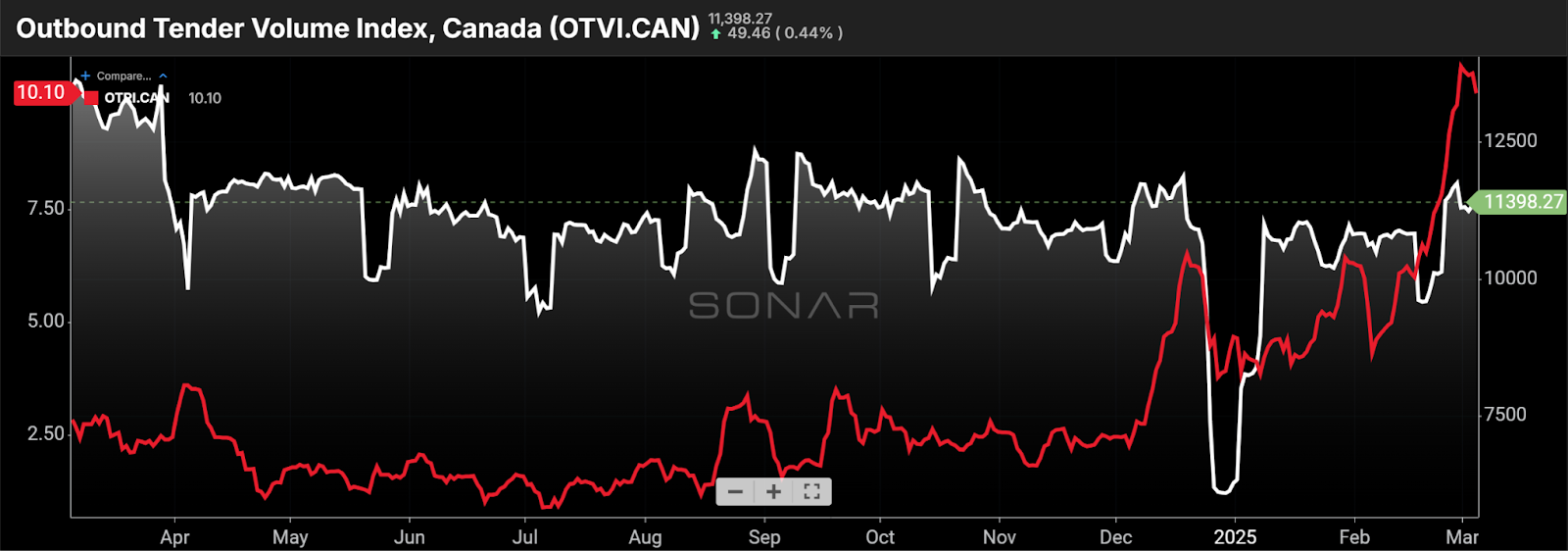
Tariffs are making Canadian highway capacity scarcer

An index of outbound Canadian tenders, or shippers’ requests to move loads, is shown in white on the right axis. The percent of those tenders that are rejected by carriers is shown in red, on the left axis. (Chart: SONAR)

A week ago, it wasn’t clear whether the tariffs on Canada and Mexico would actually be implemented. But, as the first business days of March approached and it became clearer that the North American tariffs were all systems go, shippers rushed to move freight from Canada to the U.S. to avoid the tariffs that went into effect Tuesday. That led to an increase in outbound Canadian freight tender volume (white line above), which includes a large portion of cross-border loads, and an even sharper increase in the portion of those tenders that were rejected by carriers due to a lack of capacity and/or the availability of more lucrative spot loads. Specifically, after carriers rejected an average of 4.8% of outbound Canadian tenders in January and 6.6% in February, carriers have rejected 10.1% of outbound Canadian tenders in the past seven days.

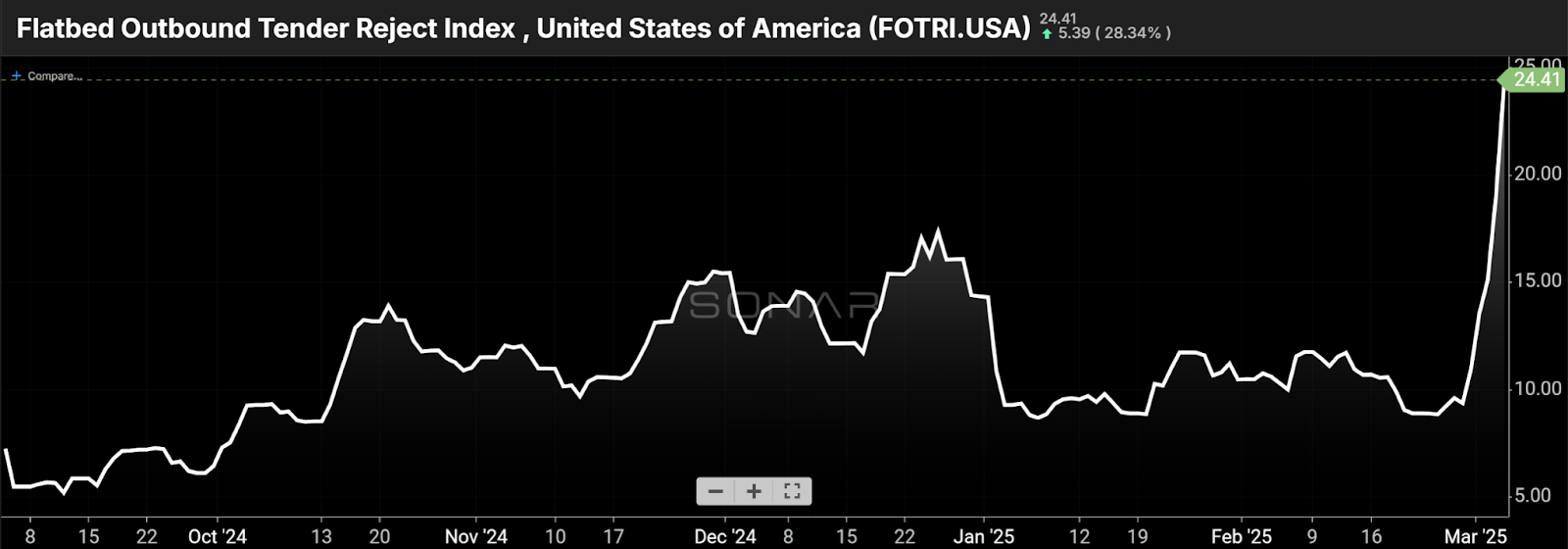
US flatbed tender rejection rate spikes

Flatbed carriers are now rejecting 24% of tenders, up from around 10% in mid-February. Presumably, that is related to moving Canadian lumber in a last-ditch effort to avoid tariffs. (Chart: SONAR)

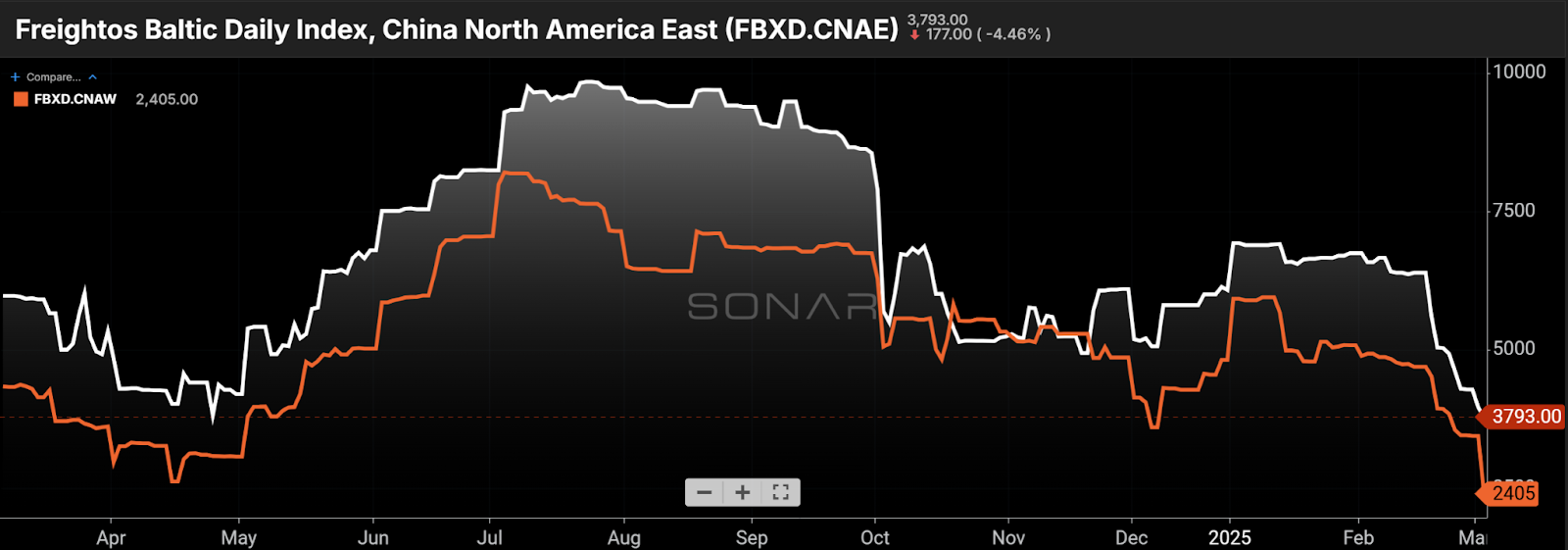
China-to-US ocean spot rates hit 52-week low

Ocean spot rates from China to the U.S. are sinking, down 59% and 45% since the first business day of the year for routes from China to the West and East coasts, respectively. That decline in rates reflects more than just tariffs – shipbuilding is adding capacity and it’s a seasonally weak time. It also appears to reflect demand that has been slow to return following Chinese New Year and also a pull-forward of imports. (Chart: SONAR)

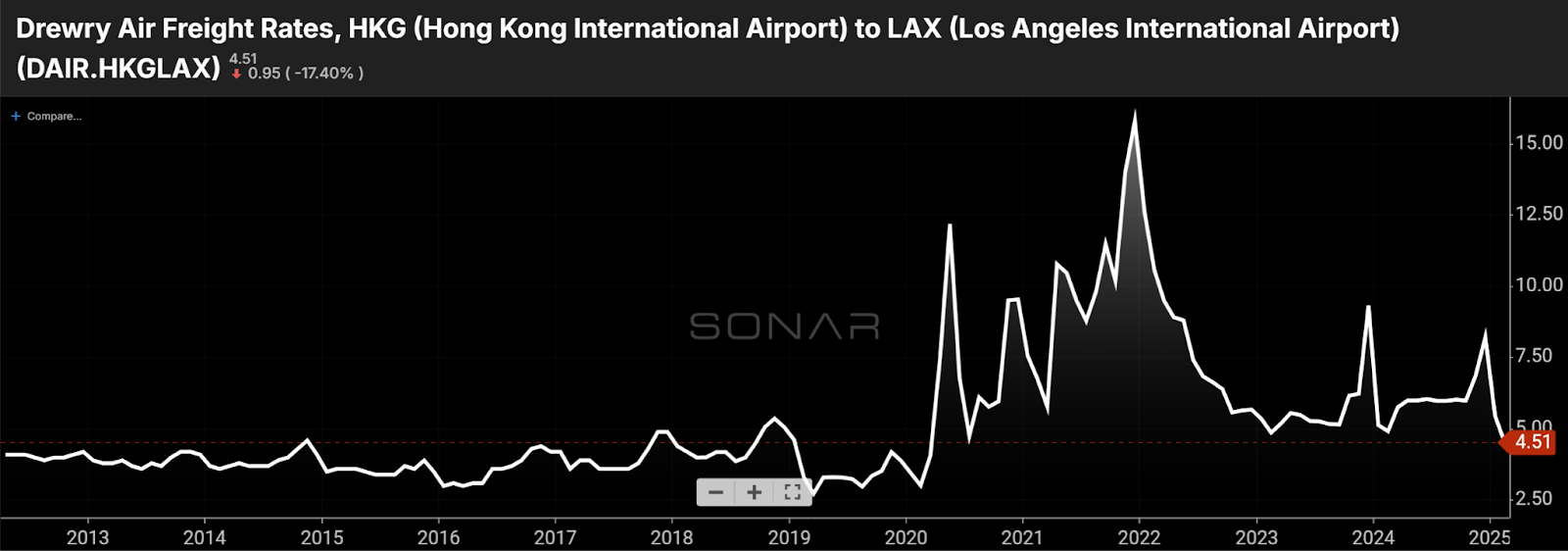
Air cargo rates sink to lowest level since early 2020 

Air cargo rates never returned to pre-pandemic levels – but may be headed there now. A permanent reduction in business travel has reduced available belly space in passenger planes. In addition, with help from the de minimis exemption, cheap e-commerce volume exploded and those companies’ made-to-order business models created air cargo demand from categories where none previously existed. Now, the U.S. seeks to do away with the de minimis exemption as soon as it can figure out how to process 1 billion annual low-value shipments without slowing other imports. (Chart: SONAR)

US import bookings still above year-ago levels, for now

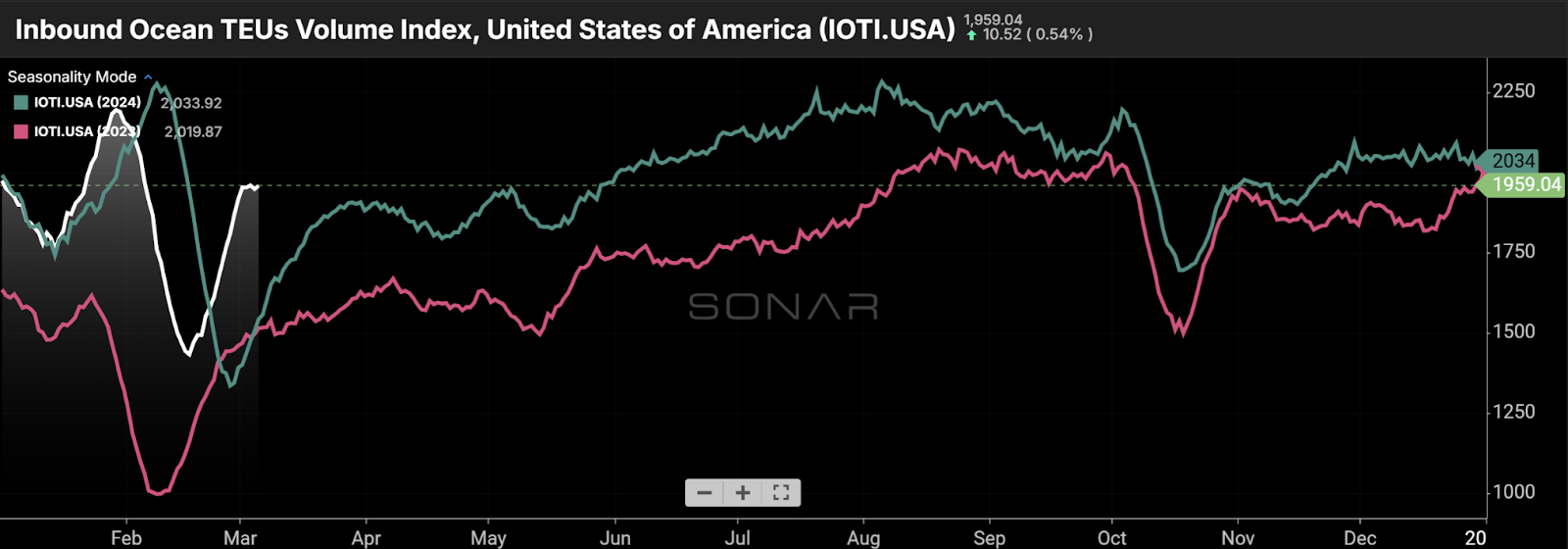
Record-setting import volume, particularly at the U.S. West Coast ports, was one of the major freight events of 2024. That strength has continued to start the year, but the question is – for how long? Major industry players, including the National Retail Federation and Western Class I railroad Union Pacific, believe there was a pull-forward of imports to avoid tariffs. That could lead to a sharp falloff later this year. (Chart: SONAR)

Warehouses are getting full and costs are rising

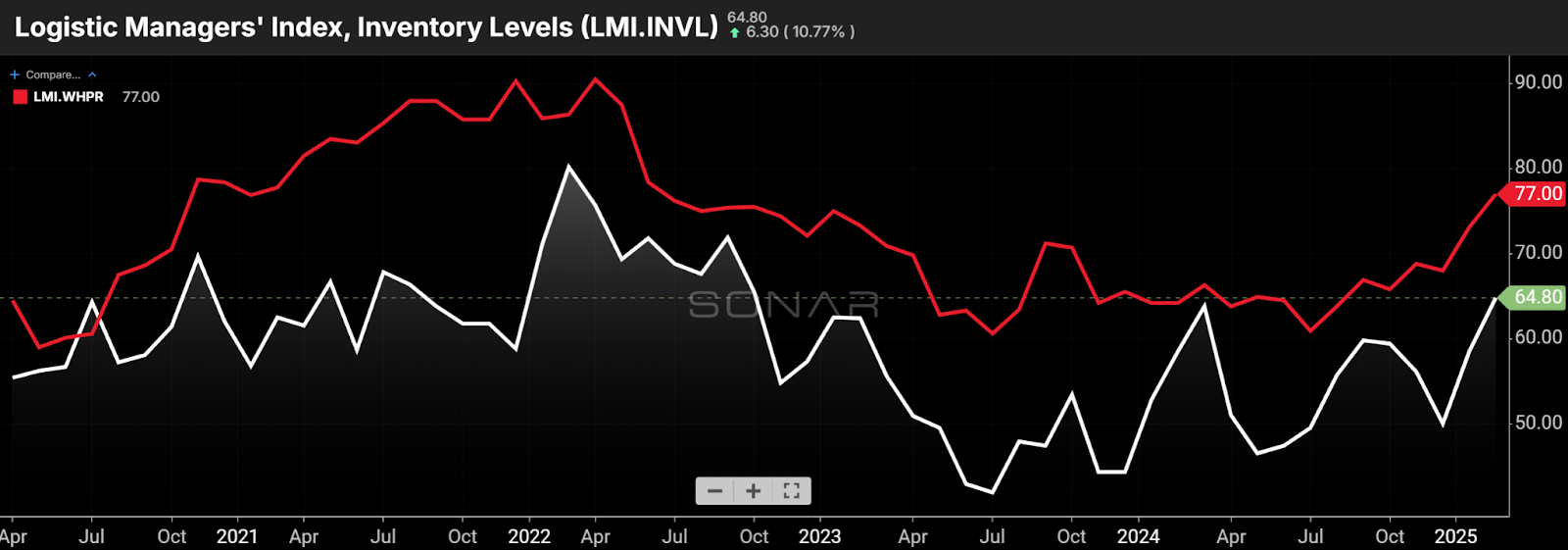
Providing further support for the view that an import pull-forward to avoid tariffs had major impacts on freight markets, the Logistics Managers’ Index showed a dramatic inventory spike, particularly for upstream inventories. The index of inventory levels (white line) and warehousing prices (red line) are 65 and 77, both well above the threshold of 50, which marks expansion. See article here for detail. (Chart: SONAR)

Intermodal volume outperforming truckload volume

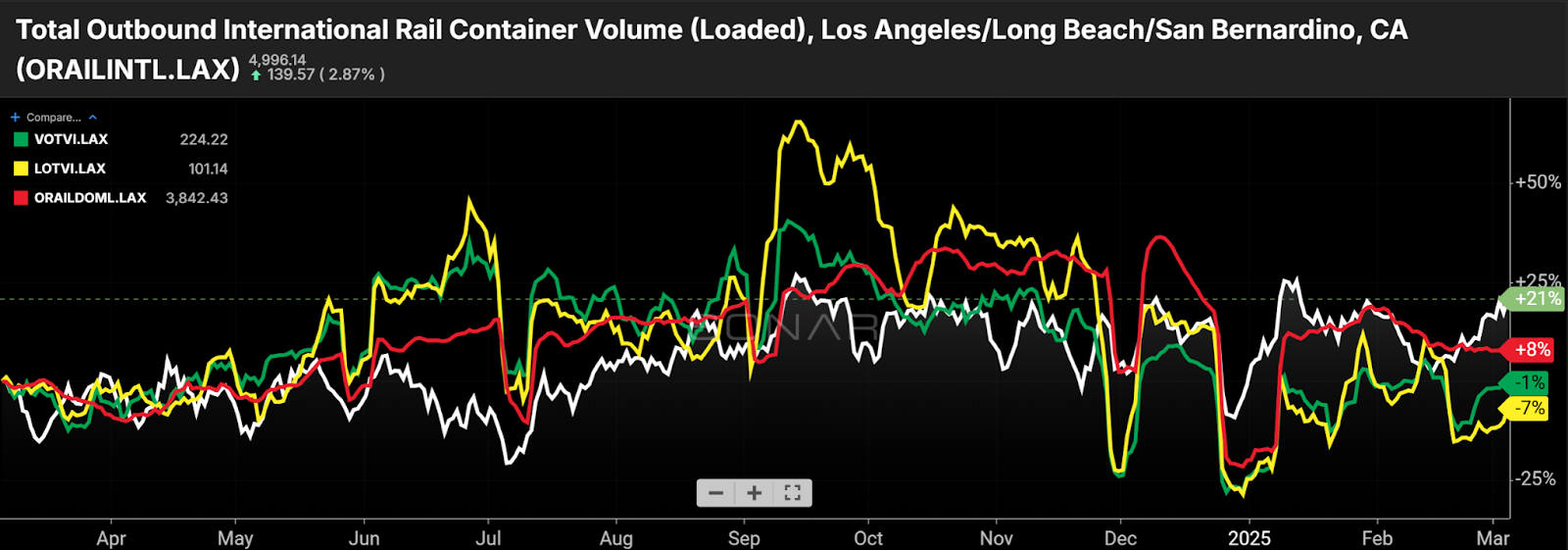
Volume in the slower and low-cost options, such at international intermodal (white) and domestic intermodal (red), are outperforming volume in the higher-speed truckload options – dry van truckload (green) and long-haul truckload (yellow) – because a pull-forward of imports has made freight less time-sensitive. All data in the chart above is outbound from Greater Los Angeles. (Chart: SONAR)

For more on SONAR or to request a demo, visit gosonar.com

The Stockout Show: Why did Walmart buy a shopping mall?

(Image: FWTV)

On Monday’s The Stockout show, Grace Sharkey and I discussed the FreightWaves 3PL Summit, the weakening air cargo market, the domestic freight markets and Walmart’s purchase of a Pittsburgh-area shopping mall.

Walmart’s acquisition of Monroeville Mall, a major shopping center, may or may not mark an evolution in its strategy. It could just be a real estate deal for a property that Walmart considered a good value. After all, it’s less burdensome to put a store on an existing commercial site with infrastructure in place rather than dealing with zoning laws and other regulatory hurdles. The counterpoint is that the deal sounds consistent with a 2018 Walmart announcement in which the retailer described its intention to develop malls in current superstore parking lots, referring to the space as Town Centers. At that time, the company said it wanted to provide pedestrian connectivity from stores to other amenities. From that perspective, it may be part of a broader revenue growth strategy to attract higher-income consumers who reside in urban centers. 

Check out Monday’s show and the full The Stockout playlist.

Teamsters to appeal decision that freed Yellow from WARN liability

Faded signage and exhaust stains on Yellow trailers parked at a terminal

The Teamsters union told former Yellow Corp. union employees that it will file an appeal on their behalf after a federal bankruptcy court in Delaware last week denied their claims that the company had failed to provide adequate notice ahead of layoffs.

Worker Adjustment and Retraining Notification Act claims from approximately 22,000 members accused the company of failing to provide 60 days’ notice prior to mass layoffs in 2023. In its Feb. 26 ruling, the court decided that Yellow (OTC: YELLQ) was a “liquidating fiduciary” winding down affairs and no longer an employer subject to WARN liability when the terminations occurred.

The court also said that if its determination of Yellow’s operating status at the time of the layoffs is incorrect, then the claims should be reduced to just 14 days’ pay and benefits, not the 60 days allowed under the law, as Yellow acted in good faith planning and preparing the WARN notices.

“The union takes several issues with the ruling that will require appeals to higher courts,” a Tuesday memo from John Murphy, Teamsters national freight director, explained to the rank and file. “The union also believes Yellow was still a business enterprise on July 30, 2023, and that the Court lacked the discretion to reduce Yellow’s WARN liability.”

The notice said the Delaware court’s decision to allow Yellow to shut down and then fire employees without any liability renders the WARN Act meaningless.

Yellow showed at a January hearing that its last shipment to a customer was made on July 29, 2023, at 11:30 p.m. EDT. While it was still making linehaul moves between facilities and prepping freight for customer pickup at its terminals when employees were notified of the layoffs on July 30, it was not engaged in “ordinary course” activities, the court ruled.

The court’s ruling on the timing of the last shipment means nonunion employees, who were terminated on July 28, 2023, while Yellow was “still making deliveries to customers,” fall under the WARN Act.

The union’s memo made clear that the outcome of its WARN litigation against Yellow does not impact “its ongoing efforts to reconcile member claims related to unpaid vacation or sick time with Yellow, nor the timing of Yellow’s payment to members of their contract-based claims.”

No timeline for the appeals process was provided.

“The union will continue to pursue and advocate for members’ claims to ensure that members receive the compensation they are owed under contract and under law,” the notice concluded.

Friday court filings showed Yellow agreed to settle two WARN claim class actions representing approximately 3,700 former employees for $12.3 million.

A separate filing with the court on Friday showed an appeal from Yellow and its largest shareholder seeking to toss out rules allowing multiemployer pension funds to delay recognition of federal bailout money (keeping employers on the hook for withdrawal liability) will proceed in the U.S. Court of Appeals for the 3rd Circuit. The outcome of the appeal has bearing on the $6.5 billion in pension claims Yellow faces.

As the litigation continues, the meter keeps running. A January monthly operating report for Yellow’s estate showed $168 million in professional and legal fees have been paid since the August 2023 bankruptcy filing.

More FreightWaves articles by Todd Maiden:

Trump says US plans tax breaks, investment in shipbuilding

The Trump administration may offer tax breaks as part of a wide-ranging effort to revitalize U.S. shipbuilding and blunt the dominance of China in the global maritime industry.

In a speech Tuesday to a joint session of Congress, President Donald Trump reiterated his support for the latest proposals to resurrect domestic capacity for the national defense and merchant maritime sectors.

Plans include a new office of shipbuilding within the White House, part of a package of proposals included in a bill introduced in the House of Representatives on Feb. 24.

“We used to make so many ships. We don’t make ’em anymore very much, but we’re gonna make them very fast, very soon,”Trump said.

Trump’s speech came on the same day a U.S.-based consortium of BlackRock (NYSE: BLK) and MSC Group of Geneva announced the $22.8 billion acquisition of CK Hutchison (0001.HK), an operator of global port terminals based in China. The deal includes the ports of Cristobal and Balboa in Panama, and follows Trump’s ongoing assertions that the U.S. would take back control of the Panama Canal.

“To further enhance our national security, my administration will be reclaiming the Panama Canal. And we’ve already started doing it,” he told Congress. 

Trump repeated a claim, without evidence, that China controls the canal. 

“We didn’t give it to China, we gave it to Panama, and we’re taking it back.”

The White House is preparing an executive order based on previous proposals including fees on Chinese ships calling U.S. ports, and berthing preference for U.S.-flagged ships.

The order also calls for charges on container cranes manufactured in China, higher pay for workers at shipyards building nuclear-powered vessels, and a review of procurement by the Navy and other federal entities, according to The Wall Street Journal, which reviewed a draft summary of the order.

In 2024 China became the world’s leading builder of container ships, for the first time accounting for more than half of the combined current fleet.

The executive order would direct the port charges to fund new Maritime Opportunity Zones and a Maritime Security Trust Fund.

Shipping executives and analysts say that the U.S. port charges could raise rates on a container moving from Asia to the United States by $800, and cost as much as $20 billion overall. They warned smaller ports may lose services if carriers decide the high fees make calls there unprofitable.

Find more articles by Stuart Chirls here.

Related coverage:

After Trump pressure, China sells Panama port terminals to US private equity firm, MSC

VIDEO: Containers in the water as ONE vessel crashes into Maersk boxship

After buoyant year, CMA CGM sees ‘unprecedented uncertainty’ in 2025

US chassis makers allege foreign dumping again

Former CN and CP executive to lead Belt Railway of Chicago

The Belt Railway of Chicago (BRC) has appointed longtime railroad executive Jerry Peck as president and general manager.

Peck, who started railroading in 1973 in train service with the Illinois Central, later worked for two decades at Canadian National (NYSE: CNI), ascending to general manager before taking the same position with Canadian Pacific (NYSE: CP), in the U.S. East region. He most recently served as a consultant with Loram, a provider of rail maintenance-of-way services.

The Belt Railway is collectively owned by the six Class I railroads that connect to it in Chicago — BNSF, CN, CPKC, CSX (NASDAQ: CSX), Norfolk Southern (NYSE: NSC), and Union Pacific (NYSE: UNP). It dispatches more than 8,400 railcars per day through its Clearing Yards just south of Midway International Airport, and operates 28 miles of mainline track with more than 300 miles of switching track.

“The Belt Railway Company has a long and important history in North American railroading and I am excited to continue to build on its legacy,” Peck said in a release. “Many people don’t realize the magnitude of importance that Chicago and the BRC plays in our economy and supply chains. I’m confident that my background and experience in operations, planning, and execution will serve the BRC well and will help develop the next generation of leaders in the railroad industry.”

Among other duties, Peck will continue working closely with partners at the state, local and federal levels to streamline railroad shipments as part of the Chicago Region Environmental and Transportation Efficiency program.

Subscribe to FreightWaves’ Rail e-newsletter and get the latest insights on rail freight right in your inbox.

Find more articles by Stuart Chirls here.

Related coverage:

Railroads say freight theft cost more than $100 million in 2024

Machinists union ratifies CSX pact

Canadian National finalizes acquisition of Iowa Northern

Tariffs call for cautious approach, rail executives say

Northeast-based regional LTL carrier A. Duie Pyle expanding in Ohio

Regional less-than-truckload carrier A. Duie Pyle (ADP) is pushing westward, with plans for several service centers in Ohio even as it retains a long-standing agreement with another LTL carrier that had allowed it to serve customers in the Buckeye State.

John Luciani, chief operating officer for the company’s LTL operations, noted that the company – which recently celebrated its centennial – had always been focused on the Northeast. In a 2023 interview with FreightWaves at ADP’s Carteret, New Jersey, facility, Luciani said the LTL carrier was going to stay focused on the Northeast.

In the same way ADP has serviced customers on the Eastern Seaboard south of the Mason-Dixon Line through a partnership with LTL carrier Southeastern Freight Lines, since 2003 ADP has had an arrangement with Dayton Freight Lines to serve Ohio. 

One-day versus two-day

But the arrangement only allowed Pyle to serve an Ohio customer on a two-day basis. That isn’t enough in today’s world.

So ADP’s bigger footprint in Ohio will bring new facilities there despite Luciani’s comment in that 2023 interview that expanded service facilities in West Virginia and Virginia – in Southeastern’s territory – were going to be the last expansions in the Pyle network. 

Pyle does have a service center in Streetsboro, Ohio, a Cleveland suburb. “That has been our gateway into the Dayton network,” Luciani said.

An expansion into Ohio, with its heavy industrial base, seems like it would have been a natural move for Pyle long before now, and beyond the relationship it has had with Dayton Freight. 

But Luciani said the company needed to grow a larger base in its home markets before such an expansion. “In 2010, we had 13 terminals,” he said. “By the end of the second quarter, we’ll have 34. We really weren’t ready to assimilate Ohio before, but we are now.”

The most recent opening was in mid-January: a terminal in Erie, Pennsylvania.

“The reason we’re going west is because we need to,” Luciani said. “We need to expand our direct overnight service into Ohio.”

A. Duie Pyle is “at a competitive disadvantage out of the mid-Atlantic and into Ohio when you look at the competition,” Luciani said, citing LTL carrier Pitt Ohio as an example. 

“We extended our territory to better serve our customers, reinforcing our commitment to providing the fastest and most reliable transit times in the market,” a spokeswoman added. “This improvement enhances our ability to deliver best-in-class LTL services in next-day lanes, ensuring greater efficiency and satisfaction for our customers.”

The company decided to make its move into the state with a network of terminals by seeing how it could expand its partnership with Dayton Freight, Luciani said. But ultimately ADP concluded “the juice wasn’t worth the squeeze.”

The spokeswoman said ADP had “worked with Dayton for a year to collaborate on various operational means of improving transit times via our existing networks. In the end we both agreed that the most efficient way was to open physical facilities.”

Luciani added, “We talked to Dayton about creative ways to provide overnight service into Columbus, Toledo and Cincinnati.” But when a workable arrangement couldn’t be reached, he added, Pyle decided to expand in Ohio through its own terminals.

At the same time, he said, Dayton was looking to push east into Pennsylvania.   

Luciani said the current level of freight exchanged between Pyle and Dayton Freight is about 500 shipments per day. (The figure between Pyle’s and Southeastern Freight’s networks is about 800 shipments per day, Luciani said.)

Relationship with Dayton Freight is still in place

If it sounds like the formula for a rupture in a relationship, Luciani said it wasn’t. “They’re a long-term strategic partner, and I don’t see that changing.” For example, Pyle freight shipments that need to go further west than Ohio – into Michigan or Indiana, for example – could still tap into the Dayton network, which has facilities in those states where, Luciani said, “we can provide second-day service through the partnership.”

But not necessarily: Luciani also said a shipment out of a new Pyle Ohio facility could go overnight into Michigan.

At present, freight given to Pyle at its key Carteret facility that was headed to Ohio would be given to the Dayton Freight network. Instead, it will now stay within the Pyle network, which saves a day’s transit, he said.

“The sole motivation to open more facilities is to expand a direct overnight footprint out of the mid-Atlantic region,” Luciani said.

He laid out the current pathway. Freight originating at the Streetsboro terminal near Cleveland goes into what he called a “consolidation trailer,” which is then transported to Dayton Freight’s Cleveland terminal. A break bulk operation is then undertaken, and the shipments are loaded into trucks servicing the Dayton Freight network. 

“The problem is, you’ve built an extra 12 hours of transit time,” he said.

When the network plan is completed for Pyle in Ohio, a shipment out of Carteret might go to the new Columbus terminal and be delivered right out of there, Luciani said.

One of the terminals that will serve Pyle’s expanded operations in Ohio came out of an acquisition of a former Yellow terminal earlier this month in Bowling Green, Ohio.

The Bowling Green acquisition is viewed by Pyle as putting the company into the Toledo market. Luciani also said the company has leased a facility in Columbus, and “we’ve got our eyes on a service center in Cincinnati as well.”

More articles by John Kingston

Penske Truck Leasing hangs on to investment-grade debt rating from Moody’s

XPO lawsuit against 2 ex-employees gives look into noncompete agreements

‘What did these men do?’ judge asks in throwing out indictment of NFI’s Brown

XPO sees improvement in February, tonnage still down y/y

A pair of XPO trailers at a warehouse

At first blush, XPO’s February update showed volumes fell at the same pace as they did in January. However, the carrier was facing a more formidable comp in the recent month, suggesting the falloff was less severe.

The Greenwich, Connecticut-based LTL carrier announced Tuesday after the market closed that tonnage was down 8.1% year over year in February following an 8.5% decline in January. The February result was the combination of a 6.2% decline in shipments and a 2% decline in weight per shipment.

However, January was comping to a 1.1% decline from a year ago whereas February was up against a positive-3.5% comp.

There’s little doubt that demand across the less-than-truckload space remains tepid but XPO’s two-year-stacked comps are improving. Tonnage was down 4.6% in February after a cycle-low 9.6% decline in January. The current guide implies further improvement to the two-year-stacked result in March.

Source: Company reports

XPO’s (NYSE: XPO) tonnage for the first two months of the year was in line with management’s guidance for a mid-single-digit-plus y/y decline in the first quarter (roughly flat sequentially).

The company is actively changing a portion of its freight mix to include more volume from local accounts, which have better margins, and more shipments that incur accessorial charges. The increased selectivity presents a headwind to volumes but should continue to deliver improved margins.

The start of 2025 hasn’t been easy as severe winter storms across the southern and eastern U.S. resulted in increased service interruptions across carrier networks. XPO previously said abnormally harsh weather was a 3-point drag on its January tonnage result.

Also, the manufacturing complex, which can account for two-thirds of total freight for some carriers, remains tepid but improving.

The Institute for Supply Management’s Purchasing Managers’ Index (PMI) remained in expansion territory for a second consecutive month in February following 26 months of contraction. A 50.3 reading (50 is neutral) was 60 basis points worse than in January, but the new orders index, which is predictive of future manufacturing demand, dropped 6.5 percentage points to 48.6.

LTL volumes normally lag the PMI data by three to four months.

“Our February volume outperformed seasonal trends relative to January, aligning with our expectations for the quarter-to-date,” said XPO CEO Mario Harik in a news release. “The industry pricing environment is favorable, and we’re executing on our initiatives to drive sequential pricing growth throughout 2025, supporting our margin outlook.”

SONAR: Longhaul LTL Monthly Rate per Ton Mile, Class 50-65 Index. Less-than-truckload monthly indices are based on the median rate per ton mile for four National Motor Freight Classification groupings and five different mileage bands. To learn more about SONAR, click here.
SONAR: Midhaul LTL Monthly Rate per Ton Mile, Class 50-65 Index. To learn more about SONAR, click here.

XPO said on its fourth-quarter call Feb. 6 that it normally sees 50 bps of deterioration to its operating ratio (inverse of operating margin) from the fourth to the first quarter each year, but that it expects to outperform that change rate this year and to outperform the 86.2% OR it generated in the fourth quarter. That would likely mean a flat y/y result with the 85.7% OR posted in the 2024 first quarter.

Other carriers are calling for modest sequential degradation in the first quarter, implying 300 bps of y/y deterioration.

XPO previously forecast 150 bps of y/y OR improvement in 2025 even though it is carrying 30% excess capacity after acquiring terminals from bankrupt Yellow Corp. (OTC: YELLQ). It opened 25 new terminals last year, all of which were accretive to the OR.

The company doesn’t provide revenue-based metrics like yields in its intraquarter updates but previously guided for sequential pricing growth in every quarter of 2025.

More FreightWaves articles by Todd Maiden:

After Trump pressure, China sells Panama port terminals to US investment firm, MSC

In a blockbuster deal that could shift the balance of power in global port operations, a consortium of U.S. private equity firm BlackRock and MSC of Geneva has agreed to purchase the non-Chinese assets of Hong Kong-based subsidiary Hutchison Port Holdings, including terminals at the ports of Balboa and Cristobal in Panama.

The news follows disputed claims by President Donald Trump that the Chinese military was controlling the Panama Canal, and that American vessels were being cheated on transit tolls. Trump also threatened U.S. action to wrest control of the waterway, a key route for military and merchant vessels between the Pacific and Atlantic oceans, which was handed over to Panama in 1999. 

In a release, Hutchison (0001.HK) denied that the sale was a result of political pressure. 

The U.S. on Tuesday doubled to 20% tariffs on Chinese goods in an effort to force Beijing to stop the flow of fentanyl into the U.S.

The deal announced Tuesday will see the consortium BlackRock-TiL acquire 90% of Hutchison’s stake in the Panama facilities as well as the China company’s 80% controlling interest in 199 berths at 43 ports in 23 countries. 

Hutchison does not operate terminals at U.S. ports.

BlackRock’s (NYSE: BLK) Global Infrastructure Partners unit partnered on the $22.8 billion deal with Terminal Investment Limited (TiL), backed by MSC, the world’s largest ocean container line. It does not include HPH port properties in Hong Kong or China.

Hutchison is the world’s sixth-largest terminal operator, handling 43 million TEUs (twenty foot equivalent units) in 2023, or 5% of global volume, according to shipping analyst Drewry. MSC ranks seventh, at 42.3 million TEUs, or 4.9%. Privately-held PSA International of Singapore is first, with volume of 62.6 million TEUs, a share of 7.2%.

It was not immediately clear how the sale to MSC would affect operations of competing liner operators at former Hutchison ports.

The sale is subject to approval by the government of Panama. 

MSC did not immediately respond to requests for comment.

This article was updated March 5 to add information on global port operator rankings.

Find more articles by Stuart Chirls here.

Related coverage:

VIDEO: Containers in the water as ONE vessel crashes into Maersk boxship

After buoyant year, CMA CGM sees ‘unprecedented uncertainty’ in 2025

US chassis makers allege foreign dumping again

Southern California port, NYK Line team on green auto shipping corridor

Project44 and MyCarrier can both claim partial win in Delaware court decision

(Editor’s note: the story has been edited to reflect the fact that arbitration and not a trial is expected to settle the dispute).

A judge’s decision Tuesday in the legal battle between FreightTech providers project44 (p44) and MyCarrier could be viewed as a win-win or loss-loss for both companies.

A Delaware Chancery Court Judge Kathaleen McCormick did not impose a preliminary injunction against MyCarrier in its effort to create its own software that mimics the functionality p44 data services, which it provides to its less-than-truckload customers.

McCormick also found that while p44 faced no “irreparable injury” by MyCarrier’s efforts to develop its own LTL software solutions — the test for granting a preliminary injunction — its actions in the conflict with p44 mean the latter will likely prevail when the lawsuit goes to arbitration.

But observers who spoke to FreightWaves noted that even a victory for p44 in that litigation, in order to be a total triumph, would likely need to somehow bar MyCarrier from doing what it wants to do going forward: build its own LTL software functionality, including an electronic bill of lading (eBOL) capability, and continue working with SMC3, which MyCarrier is now using in place of p44 to push its LTL solutions out to customers. A preliminary injunction would have stopped MyCarrier from working on its own or in conjunction with SMC3 to achieve those capabilities.

And while the judge’s review of the back-and-forth between p44 and MyCarrier seems to come down solidly on the argument that MyCarrier breached its contract with p44, that was not enough to show irreparable harm or injury. It means MyCarrier, for now at least, can keep doing what it has been doing for several months.

The two sides appeared before Judge McCormick in late January. The full decision can be accessed here.

Arbitration ongoing

Representatives from both companies told FreightWaves MyCarrier and p44 are engaged in arbitration in Delaware that began months ago. 

“It’s ultimately the arbitrators who will resolve it with finality,” Taylor Mitchell, MyCarrier’s CFO, said in an interview with FreightWaves.

Mitchell said whatever the outcome of arbitration, MyCarrier sees a strong likelihood it will be able to continue not only its relationship with SMC3 but its own development efforts.

“It’s really just going to be, OK, you guys need to split up,” Mitchell said. “But it’s not expected to be anything other than resolution from a monetary perspective.”

P44 General Counsel Jennifer Coyne said the judge’s view of MyCarrier’s actions would be beneficial in arbitration. “The ruling affirmed that MyCarrier’s conduct was in breach of the agreement, setting a strong foundation for arbitration,” she said.

The decision spelled out the basis of the relationship between the two companies.

“MyCarrier uses P44’s Freight API platform to connect carriers and shippers in the supply chain by providing data and information regarding shipments,” McCormick wrote. “P44 essentially serves as the pipe through which MyCarrier accesses the systems of the carriers that it then connects to the shippers.”

Judges rejects p44 arguments on injunction

The judge ticked off four p44 arguments regarding irreparable harm and dismissed them all. 

The first is that by pushing out p44 in favor of a new alliance with SMC3, MyCarrier’s actions would “distintermediate” p44 and cause it to lose business. But with total revenue of about $125 million, p44 can now show that a loss of about 8% of that if MyCarrier stays away “does not amount to irreparable harm.”

An argument by p44 that the severing of relationships with MyCarrier has damaged its reputation “fails,” the judge wrote, because it is backed up only by a statement from p44 management. “This sole statement is too little to go on,” McCormick wrote.

A third argument by p44 is that the data provided by MyCarrier was being used to strengthen the overall data offerings of p44, and now it is gone. But McCormick noted that the data is only kept for three to six months, and the MyCarrier data was too small a percentage of total data ingested by p44 to make a huge difference. 

McCormick also found that the contractual relationship between the two companies did not give p44 an “independent right” to the data. That ties into p44’s fourth argument about the use of data, and with the third argument having been rejected, the fourth was as well.

The half-empty, half-full nature of the decision was reflected in the two companies’ formal statements about McCormick’s ruling.

“We are very pleased with the Delaware Court of Chancery’s March 3rd opinion, holding that p44 is ‘likely to prevail’ on the merits of its claims for breach of contract based on MyCarrier’s development of eBOL and transition to SMC3 during the term of the parties’ 5-year agreement,” Coyne said in a statement emailed to FreightWaves.

“Although we are disappointed that the Court did not grant the motion for preliminary injunction, we recognize this ‘extraordinary form of equitable relief’ is a very difficult bar to meet,” Coyne added, quoting the court’s words. But she declared a larger victory: “We just essentially defeated all of MyCarrier’s twisted language arguments that they weren’t violating the contract. The contract itself held up entirely.”

And from MyCarrier CEO Michael Bookout: “We are gratified that the Delaware Court of Chancery denied project44’s motion to enjoin MyCarrier. This ruling allows MyCarrier to continue to drive innovation for our customers.”

Reviewing the history

McCormick’s review of the events that led to the fissure between the two companies came down mostly on the side of p44’s arguments that MyCarrier had broken the terms of the two companies’ agreements.

She went over the several key developments between the two: an original deal signed in 2017 at a highly favorable price for MyCarrier, with p44 hoping to benefit from the data the deal would provide it into its larger offerings; a 2023 renewal that came despite MyCarrier’s misgivings about the p44 eBOL offering, particularly in regard to how it interacted with new standards from the National Motor Freight Traffic Association, an LTL trade group; and efforts by MyCarrier to begin constructing its own eBOL solution, which p44 says were a violation of the terms of the two companies’ agreement.

(Coyne said in her statement to FreightWaves that p44 has “doubled down on its commitment” and launched an eBOL product in July that is compliant with NMFTA standards.)

McCormick said Bookout had told Jett McCandless, his counterpart at p44, that he “100 percent” wanted to stay with p44. But she added that what Bookout said was an “overstatement.” “In fact, at the time he made that statement, MyCarrier was actively looking for ways to replace p44, including by building their own ‘proxy’ Software,” McCormick wrote. 

She recapped the back-and-forth between the two companies over whether MyCarrier was trying to build an alternative – the evidence leaves little doubt that was going on, but MyCarrier was arguing an interpretation of the contract that would have provided a “carve-out” for its activities – and whether that violated the agreement between the two companies. 

The dispute began coming to a head in June 2024 when p44 sent MyCarrier a cease-and-desist letter, saying MyCarrier’s efforts to develop eBOL technology was in violation of the agreement. That set off a series of legal claims and counterclaims. 

In September, MyCarrier announced its deal with SMC3 that effectively put p44 on the shelf and substituted SMC3. P44’s services are no longer available through MyCarrier. 

In October, according to McCormick’s ruling, “MyCarrier gave p44 five days’ notice that it would ‘resume eBOL work, but only such work as is not stand-alone and is not sold in competition with p44’s products or services.’”

But she saw that as a violation of the contract. MyCarrier cited an “exclusion” in the contract as its defense of the work it was doing with SMC3. But, McCormick wrote, “this exclusion does not permit MyCarrier to transition to an alternative provider such as SMC3 for the same services P44 used to provide and cease using P44 altogether.”

More articles by John Kingston

Penske Truck Leasing hangs on to investment-grade debt rating from Moody’s

XPO lawsuit against 2 ex-employees gives look into noncompete agreements

‘What did these men do?’ judge asks in throwing out indictment of NFI’s Brown