Check Call: Q3 data promises more cargo theft issues in the future 

people gathered around a desk of computers. Check Call news and analysis for 3pls and brokers
(GIF: GIPHY)

It seems that no matter how hard Dora tries, Swiper will always continue to swipe. Overhaul has released some new quarterly cargo theft data for Q3. To no one’s surprise, cargo theft numbers haven’t improved. Overall cargo theft is up 6.2% compared to Q2. 

The average loss value of shipments was $176,290 in Q3 with 5.56 cargo thefts happening on an average day in the U.S.. The main type of cargo theft was pilferage (65%) which is atypical with some of the larger cargo theft trends in which a full truckload might be stolen or someone might be the victim of identity theft.

As for what products were the hottest commodity for theft in Q3, electronics takes home the prize with 30%. The rest of the categories were fairly evenly matched. Miscellaneous goods came in second with 18%, auto parts got 12%, food and drink got 11%, and home and garden took 10%.

An interesting thing to note is that Thursday was the most popular day for theft with 18% of all reported cargo thefts happening that day. Saturday and Sunday have the lowest likelihood of theft. The top location for theft in Q3 was unsecured parking lots with 25% of all thefts happening there. That is separate from truckstops and fuel stops; 19% of all cargo thefts happen there. 

Cargo theft rates are climbing, but this is data on reported thefts. The true numbers are significantly higher as not all freight fraud and cargo theft are reported.

SONAR TRAC Market Dashboard

TRAC Tuesday. The Future of Freight Festival kicked off Tuesday in Chattanooga, Tennessee. In honor of the first day of the event, the TRAC lane of the week is from Chicago to Chattanooga. This 556-mile trip has spot rates declining to $2.72 per mile. Outbound tender rejections in Chicago have started rising after a sharp decline in rejections. However, rejections have settled in at 7.36%, indicating that spot rates will continue to remain elevated compared to early October or rates over the summer. The impacts of peak season will likely not be heavily felt in this lane, but it could impact freight coming into Chicago, depending on the balance of freight in the market.

(GIF: GIPHY)

Who’s with whom. While the freight recession might be ending, we are entering a slightly different time for the broker segment. Depending on how the freight market recovers over the next few months, brokers and 3PLs could be in a tight spot. Carriers will look to seek rate revenge on shippers, and shippers who have grown accustomed to rates of the past few years are hesitant to accept large rate increases, putting brokers and 3PLs in the middle. 

Ahead of that squeeze, it’s looking like a bleak end of 2024 for a significant number of logistics companies. Within the past few weeks, the logistics industry has seen 2,402 job cuts over seven states.

The major players that have had to go through layoffs: 

  • True Value Co., a hardware wholesaler based in Chicago, filed for Chapter 11 bankruptcy affecting over 1,100 people.
  • GXO Logistics Supply Chain Inc., a Connecticut-based warehouse operator, is laying off 343 workers at the Bloomington, California, location. 
  • CJ Logistics America, the Illinois-based supply chain services provider, is laying off 275 people at its Dalton, Georgia, location. 
  • DHL Supply Chain, the major shipping company, is laying off 216 employees across multiple locations in Texas as well as Tracy, California. 
  • PepsiCo Inc. is shuttering a bottling plant and logistics warehouse in Chicago, laying off 131 employees.

There are more but the gist is it’s looking to be a dark winter for those in logistics. If winter is looking surprisingly hectic and you need some hands to lighten the load, this is great news as far as being able to get some highly qualified candidates. 

The more you know 

Trump to name Fox TV host Sean Duffy to head DOT 

SONAR drops FreightWaves name, announces move to new Chattanooga headquarters

LTL general rate increases buck pricing concerns for industry 

The peak season sense of urgency has yet to arrive

Cargojet charter with Amazon freight skids off runway in Vancouver

An Amazon Prime Air Boeing 767 seen taxiing at an airport. Cargojet operates some Amazon-supplied freighters.

(UPDATED 12:45 p.m ET with weather information)

The north runway at Vancouver International Airport in British Columbia is likely to be closed for 48 hours after a Boeing 767 freighter operated by Cargojet on behalf of Amazon Air overran the north runway during landing early Tuesday morning, the airport reported at 9:30 a.m. PST.

The airport authority, in a previous notice posted on its website, said the cargo jet skidded off the runway at about 1:45 a.m. local time. Fire and rescue teams responded to the incident. There were no injuries to the three crew members, the airport said on X. 

The Vancouver Sun reported that light rain and snow had fallen for about 90 minutes before the Amazon freighter arrived from Hamilton, Ontario.

Passenger and cargo airlines will experience delays, the airport warned. Recovery operations are underway, and aircraft continue to arrive and depart on the south runway.

“Details of the aircraft condition are being assessed, and the senior executive team is closely monitoring developments to effectively manage the situation,” Cargojet said in a statement to FreightWaves. “Further details will be made available as more information is confirmed.”

Cargojet is flying a handful of Boeing 767-300 aircraft in Canada on charter contracts for Amazon during the current high season. Cargojet also operates a domestic overnight network among 16 major Canadian cities, with space shared among a range of customers. 

Last summer two Cargojet freighters suffered extensive damage from a hailstorm and were temporarily out of service for repairs. 

Click here for more FreightWaves/American Shipper stories by Eric Kulisch.

RECOMMENDED READING:

Cargojet charter demand jumps 60% on e-commerce, supply chain delays

FMCSA proposes new rules on broker transparency

SBTC contends FMCSA's proposal lacks teeth against broker violations. (Photo: Jim Allen/FreightWaves)

WASHINGTON — Federal regulators have issued a long-awaited proposed rule in response to allegations of fraud in the rate-making process raised by owner-operators against truck brokers.

In May 2020, the Owner-Operator Independent Drivers Association and the Small Business in Transportation Coalition petitioned the Federal Motor Carrier Safety Administration to improve broker transparency.

OOIDA’s petition requested that brokers automatically provide transaction information within 48 hours of the completion of contractual services and that brokers be prohibited from including any contract provision that requires a carrier to waive its rights to access the transaction records.

SBTC also wants brokers to be prohibited from requiring carriers to waive their rights to review transaction records, and wants FMCSA to adopt new regulatory language stating that broker contracts cannot exempt brokers from having to comply with transparency requirements.

FMCSA’s proposal stops short of outright prohibitions as requested, however.

“Though the proposed rule is responsive to the petitions in reinforcing the broker transparency requirement, the proposed provisions differ from those requested by OOIDA and SBTC,” the agency stated in a notice published on Tuesday.

“The proposed rule would revise the regulatory text to make clear that brokers have a regulatory obligation to provide transaction records to the transacting parties on request. The proposal would also make changes to the format and content of the records.”

The changes, in the form of four provisions that would amend current record-keeping regulations, would “further protect motor carriers and promote efficiency within the motor carrier transportation system,” according to FMCSA.

Four revisions

The major changes proposed by FMCSA:

  • Brokers must keep records in electronic format: This would make it easier for carriers and shippers “to review broker records on request, and remotely, as compared to the current practice of some brokers who respond to transparency requests by making only physical records available at their principal place of business. The agency believes that many brokers already maintain their records in an electronic format.”
  • Revisions to contents of brokers’ records, including itemizing charges and fees: FMCSA proposes eliminating a current distinction in the regulations between brokerage and non-brokerage services, and instead “require that the records contain, for each shipment in the transaction, all charges and payments connected to the shipment, including a description, amount, and date,” along with any claims connected to the shipment, such as a shipper’s claims for damage or delay. “This amendment would ensure the parties have full visibility into the payments, fees, and charges associated with the transaction so they can resolve issues and disputes among themselves without resorting to costlier remedies.”
  • Brokers must provide records upon request: FMCSA stated that the current regulation frames the broker transparency requirement as a right of the transacting parties to review the records. However, “the proposed amendment would reframe broker transparency as a regulatory duty imposed on brokers to provide records to the transacting parties.”
  • Records must be provided within 48 hours of request: This provision “is intended to ensure that the requesting party receives the records in a timely manner, to support the resolution of issues around service or payment.”

Mixed reaction from carriers, brokers

Commenting on the rulemaking, SBTC Executive Director James Lamb said the proposed changes are “too little too late,” and that the FMCSA “has gutted our request while at the same trying to make an appearance of strengthening the rule,” Lamb said in an email to FreightWaves. “It preserves the status quo, which caters to Big Broker and TIA [the Transportation Intermediaries Association, which represents truck brokers].

“There is no question now that FMCSA has been captured by Big Broker. Truckers and carriers must now come out in droves and file comments in full force against this starting tomorrow and demand a prohibition against contractual waivers” that prohibit customers from viewing contract details.

OOIDA President Todd Spencer appreciated FMCSA incorporating into the rulemaking OOIDA’s request to require that brokers make records available electronically.

“As FMCSA noted in its proposal, broker transparency is necessary for a fair, efficient transportation system, and is especially important to help carriers defend themselves against alleged claims on a shipment,” Spencer said in a statement.

“We look forward to responding to FMCSA’s request for feedback, and most importantly, will continue to press the agency, lawmakers, and other regulators to make all resources available to enforce these regulations and ensure that brokers finally play by the rules.”

In an email statement, TIA said it was “deeply disappointed” by FMCSA’s decision to release a broker transparency rule at all instead of addressing freight fraud, a problem the group considers significantly more urgent.

“While TIA respects that current regulations must be followed, we find it notable that during the COVID-19 pandemic, when broker transparency was last debated, the National Consumer Complaint Database [overseen by FMCSA] recorded zero complaints related to this issue,” the group stated.

“In stark contrast, there were more than 80,000 complaints related to freight fraud and unlawful brokerage activities. This stark disparity highlights the misaligned priorities of the FMCSA under the current administration.”

In the proposed rule, FMCSA noted that some carriers believe that having more broker transparency would have an effect on negotiated freight rates.

“The agency believes that other market factors, rather than the availability of additional information through broker transparency, are likely dominant in setting freight rates,” FMCSA stated. “However, the Agency has not ruled out the possibility that motor carriers and shippers could negotiate for better rates over time using the broker transparency information.”

The public will have 60 days to comment on the proposed rule’s potential effect on freight rates and on other issues. 

Click for more FreightWaves articles by John Gallagher.

J.B. Hunt CEO talks need for industry collaboration

J.B. Hunt CEO Shelley Simpson at F3

“Courageous collaboration” across the transportation and logistics industry is what’s needed to fuel further innovation, Shelley Simpson, CEO and president of J.B. Hunt Transport Services, said in a keynote address at FreightWaves F3 in Chattanooga, Tennessee on Tuesday.

The comment harkened back to a 1989 handshake agreement between the company’s founder Johnnie Bryan Hunt and Mike Haverty, who was president of the Santa Fe Railway (now BNSF Railway) at the time. That deal created the foundation for intermodal transportation.

Simpson said that most of J.B. Hunt’s (NASDAQ: JBHT) successes have been the result of a strong buy-in from customers and partners.

“Each one of us have a part. Each one of us have a dream and an idea,” Simpson said.

From the company’s first intermodal load in February of 1990 to a $500 million investment in 2017 centered on “disruptive” technology that catapulted the J.B. Hunt 360 digital platform, the company continues to use tech to transform the industry.

Simpson said J.B. Hunt’s intermodal shipments have cut 30 million metric tons of CO2 over the last decade and prevented 300 truck-related fatalities. The 360 platform has saved 13.5 million empty miles on its equipment and drivers alone since 2019.

Currently, J.B. Hunt is working on safety initiatives using inward-facing cameras and AI to recognize in-cab and external threats. The use of the technology allowed it to reduce preventable accidents per million miles by 25% last year. It’s on track to beat that level this year.

J.B Hunt is currently working with The Trucking Alliance to eliminate large-truck accidents through safety tech and regulation.

The company continues to work to improve driver efficiency and prevent strategic cargo theft. Simpson said technology acts as the intermediary between the company’s people and its capacity.

She said J.B. Hunt is also looking at large initiatives over the next decade that include autonomous trucks, AI-enabled visual systems, infrastructure for fueling and charging on a national scale, and an internal goal of a 32% reduction in carbon emissions by 2034.

Simpson said J.B. Hunt’s vision “to create the most efficient transportation network in North America” should be the mission for the entire industry.

The company is currently working to establish a digital truckload council, similar to The Digital LTL Council, to address uniform industry standards around scheduling, the lifecycle of a load and a more efficient supply chain.

“Be bold, be courageous, be collaborative, and in the words of our founder: to get to where we want to go it takes all of us.”

More FreightWaves articles by Todd Maiden

‘Business Wars’ host David Brown talks business success stories, Warrior Ethos

David Brown, host of the podcast series “Business Wars,” said the freight industry is the unseen pillar of the U.S. economy.

“What happens in the freight logistics industry, the shipping industries, it’s the backbone of this country … but a lot of Americans just don’t realize it,” Brown said at FreightWaves’ F3: Future of Freight Festival.

Brown was the keynote speaker to kick off the annual event in Chattanooga, Tennessee, on Tuesday. He was joined on stage by FreightWaves CEO Craig Fuller during a discussion that ranged from the importance of the global freight industry to how the military’s “Warrior Ethos” can shape success in the business world.

“I think one thing that has been missing when we think about logistics is that through line, that thing that connects mom and dad, that makes kids dream about being involved in this industry,” Brown said. “If you don’t think this is critical, just look at the labor shortage right now; look at the driver shortage. It’s hugely important. The freight recession is redefining how this industry is understood, its visibility in the larger public conversation.”

Brown hosts the hit podcasts “Business Wars” and “Business Wars Daily” from Wondery. He is author of 2021’s “The Art of Business Wars.” “Business Wars,” which has broadcast 588 episodes, explores some of the most intense corporate rivalries and how the leaders and investors involved in competing companies drove their companies to new heights or financial ruin.

Brown said when he was doing research for his podcasts, he discovered the U.S. Army’s Warrior Ethos and how it could relate to corporate culture.

The Army’s Warrior Ethos “came after the Vietnam War,” he said, and “they still try to teach leaders today.”

The Warrior Ethos is “I will always place the mission first. I will never accept defeat. I will never quit. I will never leave a fallen comrade.”

Brown said he sees a lot of the Warrior Ethos when he’s researching or interviewing the founders of companies.

“This is something that we see time and again in “‘Business Wars’ … . [Y]ou cannot win without personalizing, without owning these ideas,” Brown said. “Companies that succeed are those companies with strong leaders that cannot fail. They just never give up. They do not give up.”

Brown said another aspect of success in the business world is taking criticism and using it to improve.

“Prior to COVID, Domino’s Pizza always ran No. 2 to Pizza Hut. Then COVID hits, and Domino’s is facing a PR crisis, because online, so many people have nothing better to do, so they’re hammering Domino’s Pizza … tweeting out ‘Domino’s sucks.’ It becomes a real big deal online,” Brown said. “Domino’s could do what some businesses do and try to squash this rising social media bubble that ‘Domino’s sucks.’ Or they can embrace it.”

Domino’s told customers, “Tell us, why does our pizza suck?” according to Brown.

“People started saying, ‘Your crust is terrible, it’s bland, blah, blah, blah.’ Domino’s said, ‘OK, we’re going to take what you said here and we’re going to make a better pizza.’ In 2021, Domino’s overtakes Pizza Hut as the No. 1 pizza chain in the world. It was embracing that opportunity and recognizing that the criticism was an opportunity in the first place.”

F3: Future of Freight Festival is happening now!

This year’s F3: Future of Freight Festival has pulled into the heart of Freight Alley in Chattanooga, Tennessee, Nov. 19-21.

The largest festival in freight will bring together over 1,500 industry leaders to share insights, network and celebrate all things freight at the Chattanooga Convention Center.

Here’s a road map for this year’s festival:

Keynotes and guest speakers

Freight industry experts will share insights about factors influencing the market, predict future trends and showcase emerging technology.

Over three days, attendees will hear from over 70 experts. Business Wars” podcast host David Brown will discuss industry insights during a featured keynote presentation on Nov. 19. Other keynote speakers will be J.B. Hunt CEO Shelley Simpson and Covenant Logistics Group CEO David Parker.

Find out who else is speaking here.

FreightTech and demos

FreightWaves SONAR CEO Craig Fuller will host a presentation on The State of Freight with Zach Strickland, FreightWaves SONAR’s director of freight market intelligence, on Nov. 19.

Over 30 Rapid-Fire Demos will showcase the latest industry advancements and technology by ensuring the most important details are covered as participants work against the clock. During these demos, participants have seven minutes to introduce the audience to their companies and products. Once time is up, the lights go out and the audio is cut.

If your company would like to demo, there’s still time to sign up. Register here.

Freight party!

The J.B. Hunt 360º Party will be hosted after the first day of festivities at The Signal open-air pavilion in downtown Chattanooga. Stone Temple Pilots will play live music during after hours networking, and a reception will also be held at the Chattanooga Aquarium.

Attendees will get to experience the lights, live music, great food and festivities – all while connecting with others in the industry.

Tickets for this year’s Future of Freight Festival can be purchased here.

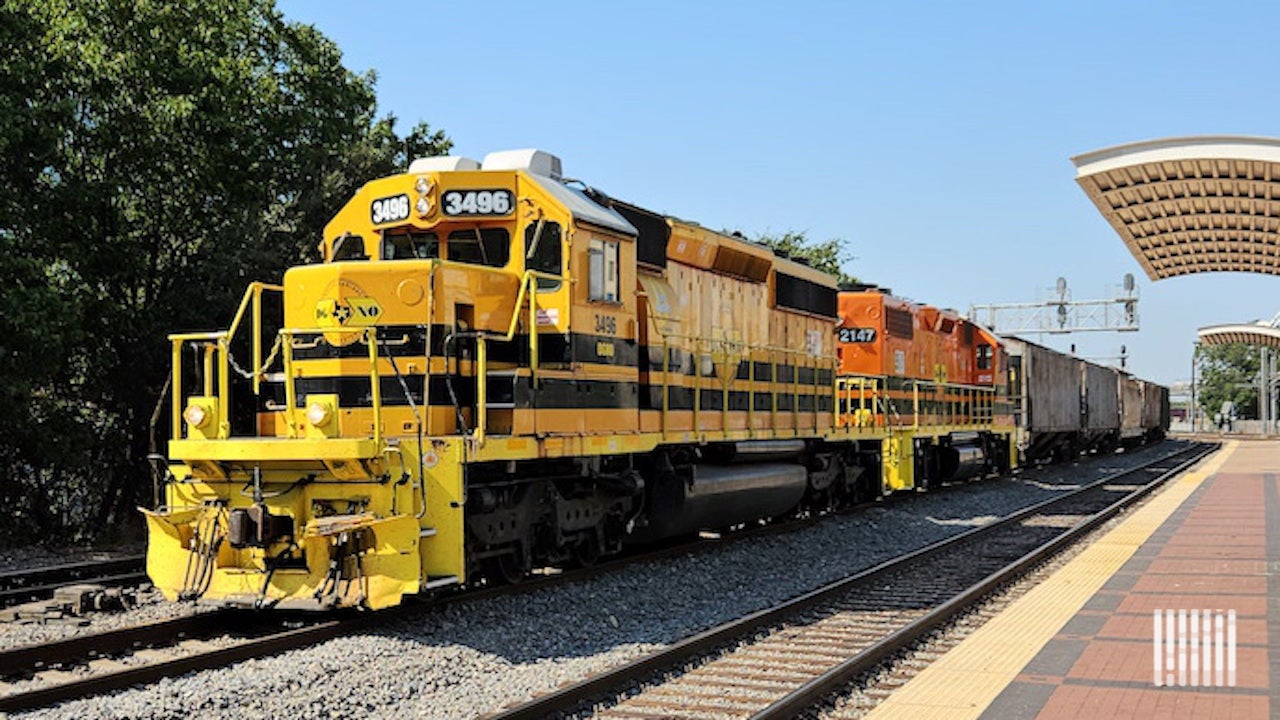
Short line CEO says railroads must embrace Uber-like technology to secure future

NEW YORK — The largest operator of shortline railroads has a clear message about the future of the industry.

“It’s time to get off our asses,” declared Michael Miller, chief executive of Genesee & Wyoming, at the annual RailTrends conference last week.

While G&W is celebrating its 125th anniversary, Miller said in a presentation to executives, suppliers and investors, “[W]hat got us here won’t get us there,” meaning a profitable future. He warned railroads must commit to their core principles while embracing technology that’s reshaping transportation.

Shortline and regional railroads are considered the scrappy, hustling entrepreneurs of railroading. Their networks range in scope from a few to hundreds of miles of track handling dozens to tens of thousands of carloads annually. Short lines account for the “first mile-final mile” car movements that the Class 1 linehaul railroads depend on for carload traffic but have winnowed from their operating models.

A shortline operator with the corporate profile of a Class 1, Genesee & Wyoming began its North American operations in 1899 serving a single customer over 14 miles of track in western New York state. Today, the company operates 110 railroads with 4,000 employees, running over 13,000 track-miles serving more than 2,500 customers with volume of 1.5 million diversified carloads per year in the United States, Canada and Mexico.

But all that history doesn’t count for much, said Miller, if an organization isn’t able to adapt and change.

He showed the results of a survey presented earlier this year by consultant Accenture at the World Economic Forum in Davos, Switzerland, that found around 23% of organizations are reinventing themselves every year or less — the fastest rate of change ever recorded. Moreover, the study found only 34% of change initiatives are considered successful.

Those are sobering statistics for a hidebound industry as tied to its history as railroading. 

“Technology is the most significant source of change and disruption, and key to structural change,” Miller said, quoting the study, adding that in the next decade companies that succeed will be the ones that embrace a strategy of continuously reinventing every part of their business with technology.

Miller held up Uber as a paradigm of the evolving technology company.  

From 2018-2021, the ride-hailing provider posted billions in losses before turning a profit in 2022. In that time, Miller said, Uber expanded the business to include delivery of food, groceries and parcels, and started brokerage Uber Freight, all at the touch of a mobile app. Uber provides a staggering 28 million rides per day, backed by 10 million peak pricing predictions per second, with 20,000 AI models trained per month. The result: Adjusted operating profit soared to $6 billion in those five years. 

Miller warned Uber has far grander ambitions that should get the attention of railroads that talk a good growth game but return uneven results. He quoted Uber Chief Executive Dara Khosrowshahi, who said, “If it moves, and it carries people and things, we’re going to wire it up and make it available on demand.”

(Concurrently, Bloomberg this week reported that the incoming Trump administration is seeking to ease rules for self-driving vehicles. That could accelerate the deployment of autonomous trucks and put even more pressure on railroads to compete for freight.)

Embracing change to accelerate application is the principle “that will propel [G&W] into the next 125 years,” Miller said.

At the same time, Miller told the conference that short lines and their Class 1 partners should embrace their fundamental characteristics that enable them to interconnect so well in the rail ecosystem.

The best fit for short lines, he said, is “white glove” service for customers and removal of higher-cost activities, such as switching, to help Class 1 margins. The best fit for Class 1s are economies of scale with high-volume terminal-to-terminal freight flows with operating plans that balance and optimize network, assets and cost structure.   

This was illustrated in October, when the Surface Transportation Board approved the acquisition by CSX and CPKC of G&W’s Meridian & Bigbee Railroad in Alabama. The deal created a linehaul through route from the Southeast to Texas and Mexico; MNBR will continue to provide local service on a portion of the route.

The must-do takeaways going forward for G&W and the rail industry, according to MIller:

  • Maintain timeless principles of being the safest and most respected transportation service provider in the world.
  • Do more than provide safe and reliable service — “that’s table stakes today.”
  • Tailor service in the form of a partnership, not a transaction (customers not shippers).
  • Have the courage to embrace change, but more importantly the will to enact change at a much faster pace.
  • Focus more on [railroadings’] ecosystem creating more value for all participants, so the ecosystem grows, thrives and becomes more resilient.

Find more articles by Stuart Chirls here.

Related coverage:

Port of Virginia gets new cranes, chassis pool upgrade

Unions returning to work at Canada ports 

Kuehne+Nagel acquires majority share of US-based IMC Logistics

Flexibility crucial for warehouse management tech, expert says

Global e-commerce sales are projected to reach $6.09 trillion in 2024, an 8.4% increase from $5.62 trillion in 2023, according to Shopify. This marks a transformative shift, as businesses and consumers adopted digital-first behaviors rapidly during the pandemic, compressing a decade of digital adoption into just a few years.

Smitha Raphael, chief product and delivery officer at warehouse management platform SnapFulfil, said in an interview that 2024 has seen a major influx of requests from business-to-consumer and 3PL clients looking to rapidly expand online operations.

One key trend is the need for greater flexibility and integration capabilities in warehouse management systems (WMS). Customers are no longer satisfied with a one-size-fits-all approach and are seeking WMS solutions that can seamlessly connect to their existing enterprise resource planning systems, order management systems, and a variety of sales channels and carrier integrations.

“When these companies look into automating their system, they want to make sure they’re selecting a WMS that has no restrictions,” Raphael explained.

She noted that this agnostic approach to integration has been a major selling point, as customers look for a system that can be easily and quickly integrated. Flexibility is especially crucial for 3PLs, which need to onboard new clients with diverse technology stacks.

“This flexibility is becoming very important for third-party logistics companies because anytime they bring on a new customer, they need integrations to happen overnight to win that business,” she said.

The rapid expansion of e-commerce operations has also led to the need for scalable, multisite warehouse management. Customers are no longer content with a single fulfillment center and are instead looking to quickly spin up new locations to meet growing demand. WMS providers that can facilitate this type of rapid growth and seamless integration across multiple sites are in high demand.

Finally, Raphael told FreightWaves that customers are increasingly seeking WMS providers that can not only deliver a robust platform but also serve as a hub for integrating complementary solutions, such as transportation management systems, order source integrations and carrier services.

She said it is important for B2C companies and 3PLs to have an open dialogue with system providers about future integrations they hope to implement or what current partners they are working with in order to get the most out of their solutions.

These conversations are especially critical, Raphael emphasized, as more sophisticated technologies become available in the near future.

“We are seeing more interest in picking automation like [autonomous mobile robots] … and packing solutions for those that want custom boxing but can’t afford a whole custom box building machine. … Interest is growing for automation, not just for the sake of labor, but for where it adds value,” she said.


Consultant bullish on Trump’s impact on retail, e-commerce, FreightTech M&A

How global trade actors are turning to fintech to tackle fraud

AI will have huge impact on freight but also overhyped, says Transflo exec

Etihad Airways to order 3 additional A350 freighters from Airbus

An Etihad Cargo jet with multicolored tail takes off with hangar buildings in the background.

MIAMI BEACH, Fla. – Etihad Airways has decided to exercise an option for three Airbus A350 next-generation freighters, bringing its total order to 10 aircraft, said Stanislas Brun, vice president of cargo, in an interview with FreightWaves.

The Middle East carrier in 2022 committed to buy seven A350 future model cargo jets but is motivated to take more aircraft amid the relentless growth of e-commerce shipments from Asia to global consumers.

More than 20% of general air cargo volumes worldwide are now considered to come from e-commerce platforms, and upwards of 60% of air shipments out of the greater Hong Kong region originate with online marketplaces in China, according to local airlines and industry experts.

Etihad Cargo operates five Boeing 777 freighters and manages cargo carried in the belly of the airline’s widebody passenger fleet. The airline operated more freighter aircraft in the past but returned some to lessors or sold them because the different types no longer fit with the fleet strategy.

The company board authorized the new purchase of A350Fs earlier this month and management is negotiating the final terms and delivery with Airbus. “In the next five years, we should go from five to 15 freighter aircraft,” said Brun in the carrier’s hospitality suite at The International Air Cargo Association trade show here. 

The Etihad contract would put Airbus at 58 orders for the A350 from nine airlines and leasing companies.

Airbus says it expects to begin commercial deliveries of the new plane, which is still in final development and testing, in 2026. Air Lease Corp. is the launch customer. Etihad could receive its first A350F in 2026 or 2027. Entry into service was delayed from the previous target of late 2025 so that Airbus could certify the new cargo door configuration and its impact on the aircraft’s structure. 

The A350F will be able to carry a payload of up to 122 tons and fly up to 4,700 nautical miles, according to Airbus. It will feature the industry’s largest main deck cargo door. More than 70% of the airframe is made of advanced materials. Airbus claims the lighter airframe and efficient Rolls Royce engines produce a 20% advantage in fuel burn and carbon dioxide emissions over the legacy Boeing 777 currently in production, as well as the older Boeing 747-400. Boeing’s next evolution in freighter technology is the 777X, which is going head-to-head with the A350 in the large freighter category.

Peak season response

Etihad Airways said in a financial news release last week that it had achieved cargo revenue of $808 million during the first nine months of the year, a gain of 21% from the same period in 2023, which it attributed to improved capacity, volumes and pricing power.

Brun, who joined Etihad in March after heading global airfreight for France-based logistics provider Geodis, said the air capacity crunch in China has forced logistics providers to arrange unusual routings for shipments to Europe and North America.

The air cargo market has shown consistent strength all year without seasonal ebbs, resulting in what appears to be a strong high season without the traditional spike in volumes ahead of holiday shopping events.

Air cargo volumes have increased more than 10% this year from 2023. Red Sea shipping disruptions and the threat of U.S. dockworker strikes has pushed more cargo to airlines. Many shippers procured inventory from overseas months earlier than usual to avoid potential transport delays and give themselves time to find limited aircraft capacity as e-commerce platforms reserve large swaths of supply under long-term contracts. 

Airfreight volumes out of China and surrounding countries are so heavy this year, Brun noted, that freight forwarders are even routing cargo by road and sea to leisure destinations such as Phuket, Thailand, and Bali, Indonesia, to catch a ride to Europe and North America on passenger aircraft.

Etihad Airways, for example, operates three flights per day from Phuket, and they are full with cargo, he said.

“The load factor is 100% out of China. Cargo is also coming from Cambodia and Vietnam because there is no other exit,” Brun explained. “Everyone is looking for alternatives to get out of China.”

His comments echo those of air logistics companies that previously described how  soaring e-commerce volumes and high yields have pushed lower-value general cargo by truck  to airports in Vietnam, Thailand and Malaysia.

“The peak season is passing, more or less, with no big bang. And the creativity of the freight forwarders, plus the airlines, is generating some solutions which are definitely surprising,” said Brun.

China focus

In September, Etihad Cargo and China-based express carrier SF Express signed a memorandum of understanding to take their 18-month collaboration to the next level with the establishment of a joint venture that offers a unified logistics product to customers.

Under the existing capacity-sharing arrangement, Etihad Cargo and SF Airlines conduct freighter flights to their respective home bases in Abu Dhabi and Ezhou to increase connectivity for their respective customers. This year the parties increased freighter frequency on that route and launched a new service between Shenzhen and Abu Dhabi. Etihad helps SF Airlines, the in-house airline of SF Express, reach Europe by transferring parcels in Abu Dhabi to passenger aircraft and freighters servicing the continent.

The joint venture isn’t intended to create a new airline or mesh their global networks, but rather to create a joint product focused on the trade lane between China, Hong Kong and Taiwan on one end and Abu Dhabi on the other, Brun explained. Etihad benefits because SF has more traffic rights out of the China region than Etihad, whereas Etihad can reach more destinations in Europe, India and the Middle East for SF.

Etihad no longer has any freighters operating to the United States after the company pulled the last service to Chicago in July and redeployed it to more lucrative lanes out of Asia.

Etihad Cargo also has a capacity partnership with Malaysia-based Teleport, which uses a small fleet of standard-size A321 converted freighters to ferry goods around Southeast Asia.

Etihad Airways flies out of four U.S. cities – Chicago, New York, Boston and Washington – and also has a daily flight out of Toronto. The airline went to daily service in Boston on Nov. 3, up from four times weekly after starting service there six months ago.

The cargo division in August began a geographical reorganization into four regions designed to improve customer interaction and allow for more tailored responses to specific requirements.

Abu Dhabi Airports and Etihad Cargo are collaborating on construction of a high-tech cargo facility to serve as Etihad’s new cargo home at Zayed International Airport. The modern terminal, which will include a large temperature-controlled area for pharmaceuticals and perishable products, is scheduled to open for business in the first half of 2027.

(Clarification: The story has been updated to make clear that Etihad has decided to place an order for three A350Fs, but has not finalized terms with Airbus.)

Click here for more FreightWaves/American Shipper stories by Eric Kulisch.

Lufthansa Cargo bolsters China partnerships as trade grows

Emirates to nearly double 777 freighter fleet by late 2026

Nyshex closes latest funding round, launches shipping rate indexes

A loaded containership at port

The New York Shipping Exchange (Nyshex) announced Tuesday it has closed on its latest funding round and that it’s working with Intercontinental Exchange Inc. (ICE) to launch new shipping rate indexes.

Founded in 2015, Nyshex is a facilitator of two-way committed ocean container shipping contracts, ensuring contract performance between carriers and shippers on a shared digital platform. The exchange works to establish clear contract terms, providing an exception resolution process by a neutral third party.

The Series C funding round was led by Collate Capital with participation from all of Nyshex’s other major investors, which include Goldman Sachs Alternatives, NewRoad Capital and Blumberg Capital. Details on the funding round were not disclosed. As of May, it had raised $68.8 million since inception, according to PitchBook.

“We are delighted to have completed the first close of our Series C and to welcome ICE as a shareholder,” said Gordon Downes, CEO and co-founder of Nyshex, in a news release. “Our collaboration with ICE and the additional capital allows us to expand upon our services.”

The rate indexes will be transparently monitored, capturing “actual cargo moving rates.” Free access will be provided to all carriers, shippers and non-vessel-operating common carriers for contract indexing regardless of the index their contracts are linked to.

Exchange operator ICE (NYSE: ICE) will act as the calculation agent for the freight rate indexes starting next year. ICE operates several futures, equity and options exchanges, including the New York Stock Exchange.

ICE also participated in the latest funding round.

“The container shipping industry is vital for global trade, yet it remains an inefficient and volatile market,” said Stuart Williams, chief operating officer at ICE. “For over two decades, ICE has worked with our customers to develop a network of liquid and interconnected markets that provide the price transparency and risk management tools needed to manage evolving supply chain and geopolitical risks.”

Nyshex is designed to allow supply chain managers to better manage costs, avoid blanked sailings and keep their freight from being rolled to future sailings. The platform helps carriers realize better asset utilization giving them more predictable revenue streams.

“As we see the container shipping industry moving toward index linked contracts, there is a growing need for ways to hedge the volatility of container spot rates,” said Zach Fields, an investor on Goldman Sachs Alternatives’ growth equity team. “As we help our clients to manage their freight risk, we fully support NYSHEX in developing more robust indices that will benefit all shippers, carriers and NVOCCs.”

More FreightWaves articles by Todd Maiden