Hurricane Milton deals estimated $160B blow in damage, economic loss
Hurricane Milton caused at least $160 billion in damage and economic loss, according to a preliminary estimate from AccuWeather.
The Category 3 hurricane hit Florida Wednesday night, leaving a trail of devastation in its wake. Total losses could be up to $180 billion, making it one of the most damaging storms in Florida history, AccuWeather said.
Milton came on the heels of Hurricane Helene, which AccuWeather projected caused at least $225 billion in damage and economic loss.
“With Hurricane Milton’s total damage and economic losses of $160-180 billion, the sum of two hurricanes in just three weeks elapsed time has a total damage and economic loss of near 2% of the country’s GDP,” AccuWeather founder and Executive Chairman Joel N. Myers said in a statement.
Destructive winds over Florida led to millions of homes and businesses losing power. As of Friday, 2.4 million customers were without power, according to PowerOutage.us.
Dwindling fuel supply, possible agricultural damage
Fuel supplies that had dwindled ahead of the storm remained low Friday. Over a quarter of gas stations across the state were out of fuel, according to Gas Buddy. The Tampa and St. Petersburg areas were the most impacted: Nearly 75% of gas stations had no fuel.
Milton’s damage to the agricultural industry in Florida could exacerbate problems farmers are already facing post-Helene. Significant agricultural damage was reported after Helene hit the state, the Florida Farm Bureau said.
Damage from Helene included to poultry, bees, beef cattle, dairy, cotton, peanuts and citrus, the Farm Bureau reported. Prices for fruits and vegetables could increase in stores in the coming weeks, AccuWeather said.
The full extent of Milton’s damage has not yet been realized, David Spencer, market intelligence vice president at Arrive Logistics, told FreightWaves.
“I believe the bulk of the impact is definitely going to be felt in the immediate post-storm needs,” he said.
Pointing to Helene, Spencer said he is seeing the greatest impact on open-deck and flatbed equipment in terms of nationwide rate movements. Any lasting impact will likely occur on this equipment type, he said.
“Yes, there is surging regional demand for relief needs, but we expect excess supply in the market to be able to absorb the short-lived demand surge and normal seasonal volatility to resume as the main freight market narrative for van and reefer equipment,” he said.
The current market fundamentals, including a large contract-to-spot rate spread, should not cause more than a brief surge in spot demand, he said.
Florida ports shuttered ahead of Milton and some lacked power on Thursday. Port Tampa Bay, which handles 43% of the fuel used by jets, airplanes, tractor-trailers and passenger vehicles in the state, still had power issues on Friday.
The port’s fuel terminal partners have fuel ready to deploy to the region but lack power, the port said in an update Friday morning. Officials hope the fuel terminals can begin operations again Friday and are working with energy supplier Teco to expedite the process.
Port President and CEO Paul Anderson has met with Gov. Ron DeSantis’ office about the fuel status to determine whether additional resources need to be dispatched to Florida.
SeaPort Manatee, one of the largest U.S. gateways for imports of fresh fruits and vegetables, was without power Thursday night.
Carrier disruptions
Milton could impact FedEx deliveries in Florida and across the Southeast, the company said in a statement on Friday. The company said it had activated contingency plans.
The U.S. Postal Service had suspended operations in several Florida ZIP codes but resumed business on Friday. Some Florida post offices in Milton’s path were closed indefinitely.
Southeastern Freight Lines and Estes both had facility closures and limited operations in the state.
Schneider National was assessing its Winter Haven facility but said no other facilities were damaged. Service was interrupted for ArcBest across Florida. Service centers were closed in Fort Myers, Sarasota and Tampa.
CSX, short lines in recovery mode after Hurricane Milton
TAMPA, Fla. — Freight railroads from the Gulf Coast to Miami are still assessing damage and making repairs after Milton made landfall near St. Petersburg late Wednesday as a Category 3 hurricane. According to CSX’s most recent customer advisory, all routes north of Jacksonville are open with no anticipated issues, as is the railroad’s mainline to Callahan and south to near Anthony on the railroad’s Wildwood Subdivision. Washout repairs are still ongoing in central Florida on the railroad’s Carters Subdivision between Lakeland and Auburndale, as well as its Vitis Subdivision between Lakeland and Vitis Junction, near Richland. CSX anticipates the 49-mile Central Florida Commuter Rail line, operated by Orlando’s SunRail and accessed by CSX via trackage rights, will reopen Friday night, providing a route into Winter Haven. CSX has contingency plans in place for potential service issues caused by a gas pipe washout in the Miami region. Florida East Coast Railway says its officials have thoroughly inspected the full length of the railroad and are making necessary repairs along Florida’s Atlantic coast. FEC’s intermodal terminals have reopened and are accepting incoming and outgoing traffic. Through freight and local carload service is still annulled until all repairs are completed, according to a customer update on Friday. Short-line railroads in the area continue to inspect track and assess damage. Regional Rail, which operates four short-line railroads across central Florida, spent much of Thursday inspecting track and assessing damage, and the Seminole Gulf Railway in Sarasota is conducting a final inspection Friday, with more information expected Monday.
Milton makes landfall on freight market
Chart of the Week: National Outbound Tender Rejection Index – USA SONAR: OTRI.USA
National outbound tender rejection rates (OTRI), the rate at which carriers turn down requests from their customer for truckload capacity, jumped from 5.13% to 5.62% from Oct. 8 to Oct. 9 as Hurricane Milton closed in on Florida’s west coast. This was the largest single-day jump of the past two years. What are the takeaways for transportation providers and managers in the wake of the third major transportation market disruption to hit in less than a month?
Hurricanes can be the catalysts for dramatic shifts in North American transportation markets, traditionally making sourcing truckload capacity much more challenging. Shipping activity stalls for days, infrastructure like roads and warehouses are damaged, and then comes the disaster relief draw for carriers.
Hurricane Harvey in 2017 was the primary catalyst for one of the longest stretches of trucking market tightening of the past 20 years outside of COVID.
In the days leading into a hurricane, carriers avoid driving into danger — as they should. Shippers may send out increased orders as they try to move their goods out of harm’s way.
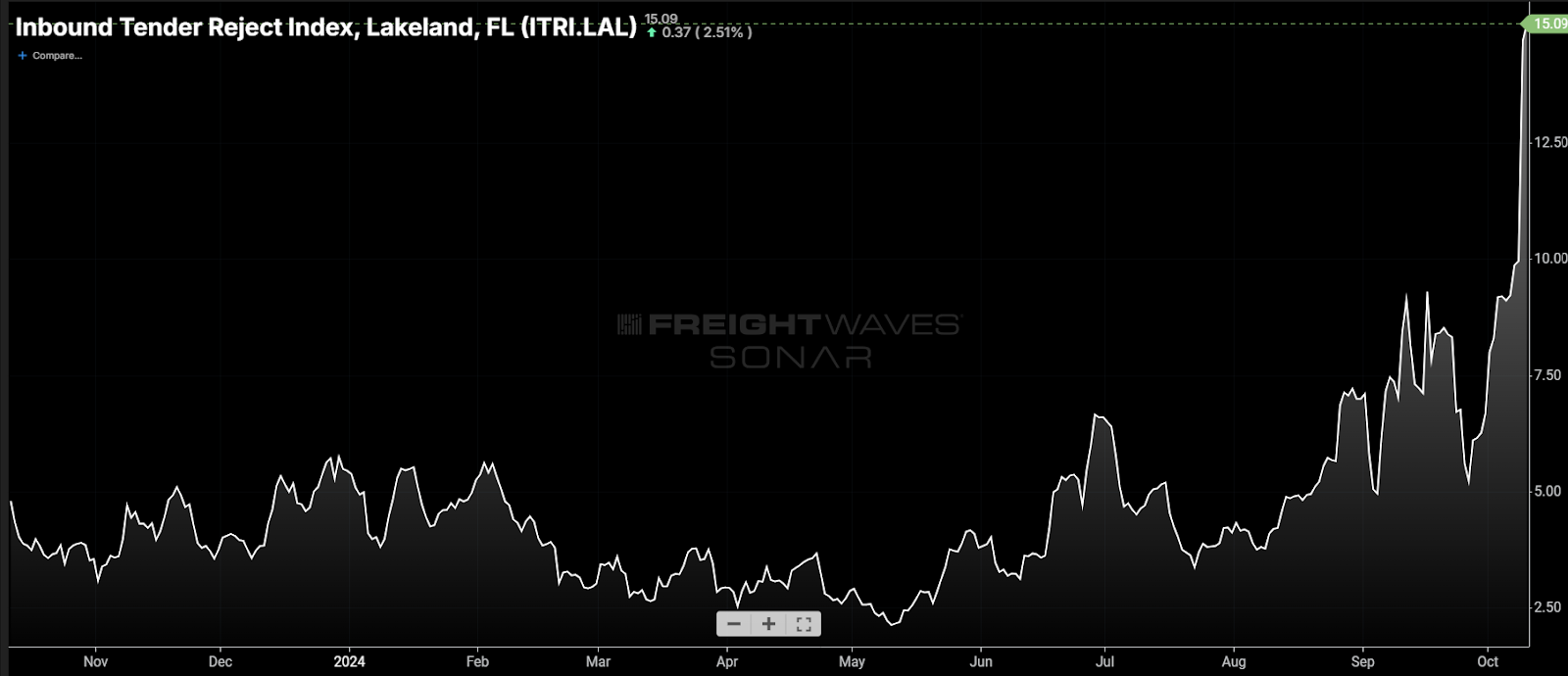
Inbound tender rejection rates for the Lakeland market in central Florida spiked to over 15%, the highest value since the pandemic era ended in early 2022.
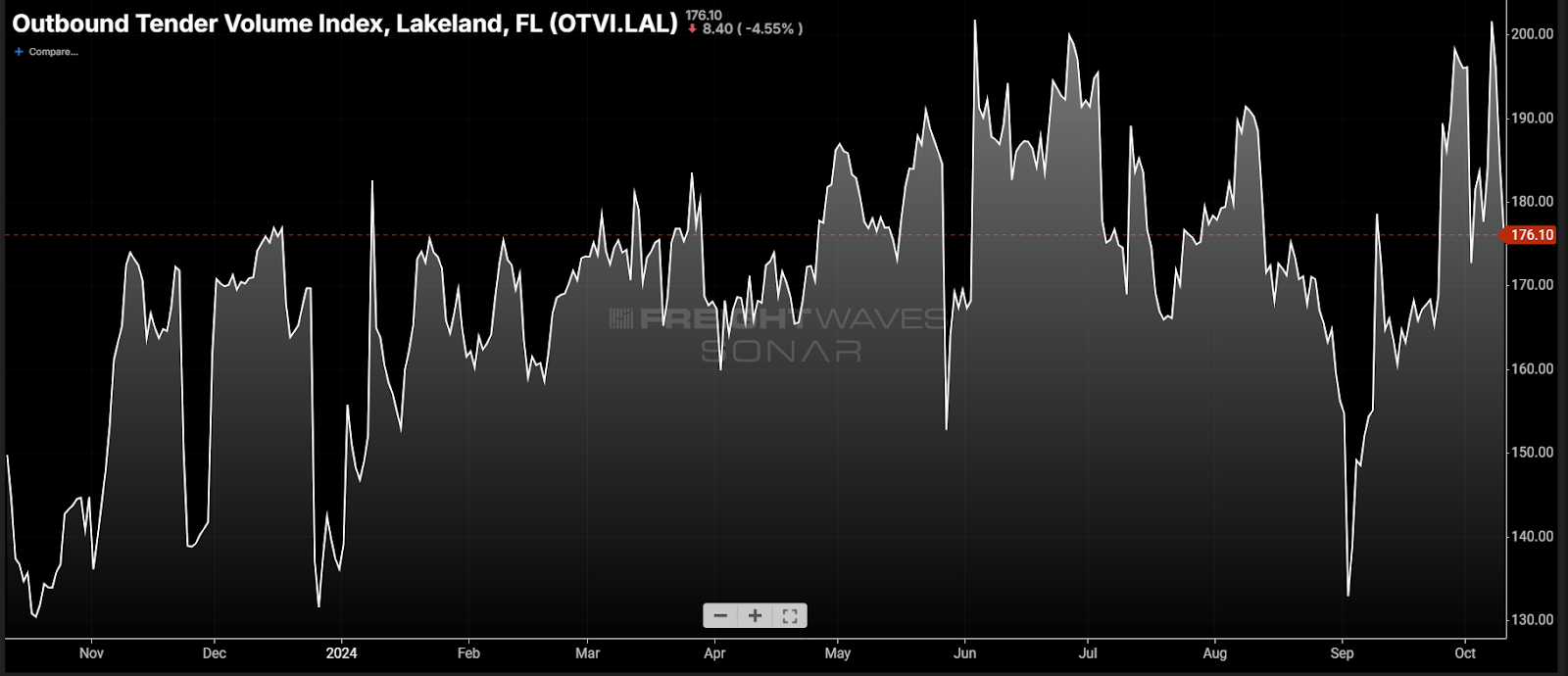
Outbound tender volumes also increased ahead of the storm, before dropping quickly as it made landfall.
This type of activity creates bottlenecks in transportation shipping for a period of time after the storm passes. The national freight market has been a well-oiled machine since early 2022, as there has been more than enough trucking capacity to fill in the gaps when disruptions have occurred.
Back to back … to back
Milton is the third major disruption to hit national transportation networks over the past three weeks. Hurricane Helene landed in the Big Bend area of the Florida Gulf Coast on Sept. 26 as a major Category 4 storm. The bulk of the damage occurred inland as the system quickly tracked into north Georgia and the western Carolinas. The storm caused catastrophic damage to the area but was not a major immediate disruption to transportation due to the lack of a major outbound shipping presence being impacted.
The following week, the International Longshoremen’s Association (ILA) went on strike for three days, resulting in several days of lost container clearing and shipping activity around the East Coast ports. While many shippers were prepared for this, some slight deterioration was detected in the form of slightly increasing rejection and spot rates.
While shippers could prepare, there was little carriers could do besides attempt to find other freight to haul. This put them out of position when the strike ended. With shippers being relatively prepared and the strike lasting only a few days, there was not a strong sense of urgency to recover.
Milton has by far been the most impactful, at least on the surface. The timing of the system hitting on the heels of two other network-altering events has potentially exacerbated its influence.
See spot sit
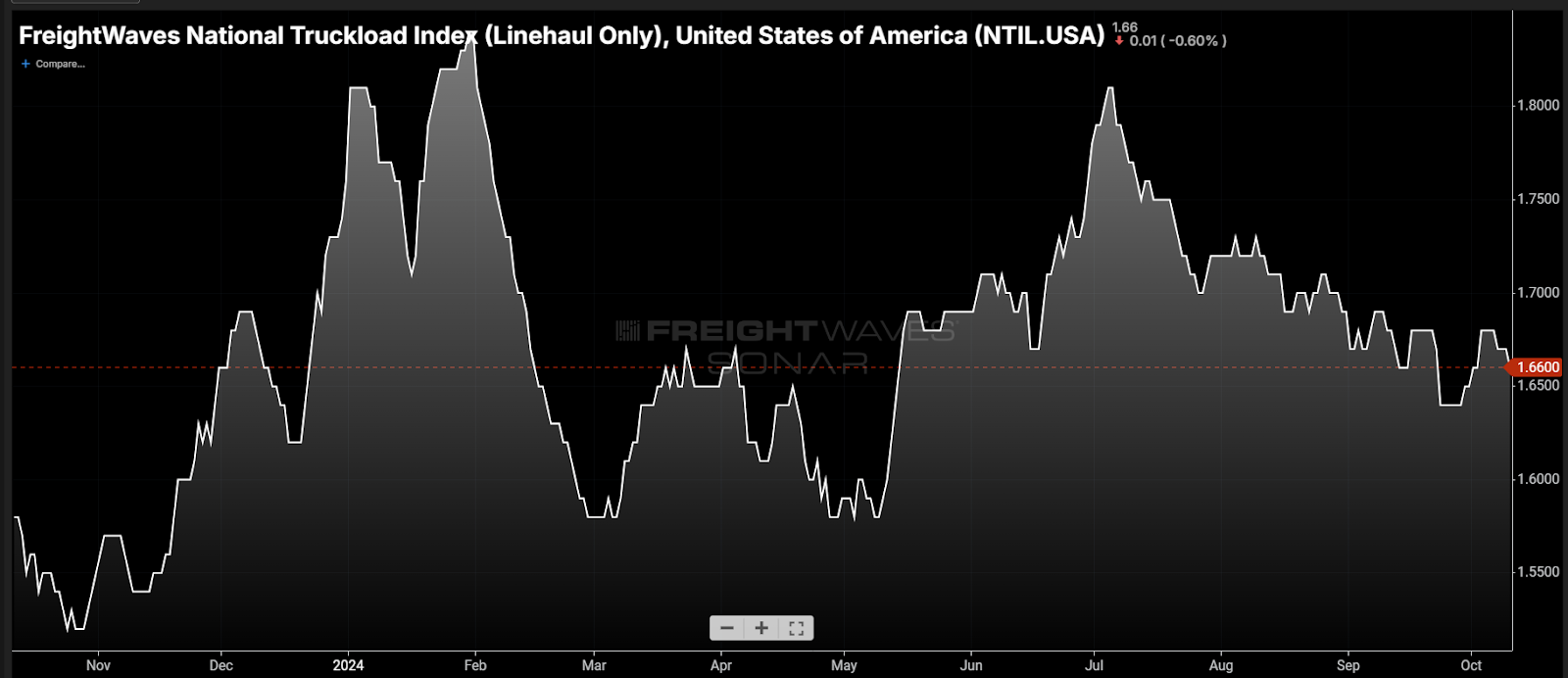
The spot market was not quick to respond to Milton. As of Thursday, there was not a large-scale shift in direction of spot rates. The National Truckload Index excluding the influence of fuel (NTIL) was trending downward as of Thursday. Spot and rejection rates normally have a strong correlation, so why are spot rates less responsive than rejections in this situation?
With carriers avoiding the area in front of the storm, there was plenty of available capacity outside the most affected region and not enough accepted freight to drive rates higher significantly on a national level out of the region. In other words, give it a minute.
As shippers get back to work in the coming week and disaster relief efforts begin in earnest, there will be an upward push on spot rates as capacity will inevitably get drawn into the region.
The Federal Emergency Management Agency will need assistance from the nation’s carriers, and yes, some of these loads will pay well above what they are getting from existing customers, forcing them to make the decision between a FEMA load and a customer load. The jury is out on the scale of this influence.
Contract rates are showing signs of bouncing off the floor in an environment that they could still be moving lower. National truckload dry van contract rates are down roughly 2% y/y but flat over the past six months and up 1% over the past quarter.
This means carriers have largely hit the threshold of where they are willing to price lower to get business in an environment where supply remains abundant. In other words, rates are low, and it will not take a lot of financial incentive to get carriers to move freight outside of their existing customer base.
The initial wave of rejections is just the reflection of physical inability to move freight. The next phase will tell us exactly how vulnerable the market is in terms of how much slack is available to swoop in and handle the recovery.
October is traditionally a slower month for trucking, making the rejection rate jump that much more significant. The transportation market appeared to still have enough resiliency to handle two major events, but the jury is still out on the third. A lot will be learned about where we are in the current oversupplied freight cycle in the coming weeks, leading into retail peak shipping season.
About the Chart of the Week
The FreightWaves Chart of the Week is a chart selection from SONAR that provides an interesting data point to describe the state of the freight markets. A chart is chosen from thousands of potential charts on SONAR to help participants visualize the freight market in real time. Each week a Market Expert will post a chart, along with commentary, live on the front page. After that, the Chart of the Week will be archived on FreightWaves.com for future reference.
SONAR aggregates data from hundreds of sources, presenting the data in charts and maps and providing commentary on what freight market experts want to know about the industry in real time.
The FreightWaves data science and product teams are releasing new datasets each week and enhancing the client experience.
Three numbers tell the desperate state of fuel cell truck maker and hydrogen fuel provider Nikola. Dozens of others apply, but these three suggest the clock is ticking faster on whether the company can survive.
Was this newsletter forwarded to you? Click here to subscribe and get Truck Tech delivered to your email on Fridays. And catch the latest episodes of the Truck Tech podcast and video shorts on the FreightWaves YouTube channel.
By the numbers …
Nikola’s notable numbers: 135, 29.07% and 88.
135
The Phoenix-based company on Wednesday laid off about 135 employees, roughly 15% of its workforce, amid a persistent cash crunch with little room to sell more stock as its price slides. Nikola laid off 270 employees in June 2023 and 100 in November 2022.
“To extend our runway, we are adjusting and rescaling our staffing needs,” CEO Steve Girsky said in a statement. “This is a difficult, but necessary, decision and we thank those team members who helped build Nikola and wish them the best moving forward.”
29.07%
At 29.07%, Nikola has the third-highest percentage short interest – investors betting the share price will fall as it has consistently since Nikola executed a 1:30 reverse stock split on June 25. The cosmetic move to artificially boost the share price fended off delisting from the Nasdaq, which requires a price of $1 or higher for 30 consecutive days.
Such moves rarely succeed. Before the reverse split, Nikola traded at around 30 cents a share. On a split-adjusted basis, it sells for about half that.
Short selling occurs when an investor borrows a security and sells it on the open market, planning to repurchase later for less money. It is a high-risk, high-reward strategy that has plagued Nikola almost since it went public in June 2020 during the SPAC frenzy. Girsky led the special purpose acquisition company that brought Nikola public.
88
The one number that could be considered a positive – at least in isolation – is that Nikola delivered 88 fuel cell electric trucks at wholesale in the third quarter. No one else delivered any.
The number fell within the company’s predicted range of 80 to 100 sales. It gave a shot of adrenaline to the stock price, which jumped nearly 20%. The next day, it dropped 6.5% and has been mostly declining since.
Nikola sold 88 fuel cell electric trucks at wholesale in the third quarter, bringing to 235 the total of the alternative fuel vehicles sold since production began in 2023. (Photo: Nikola)\
The company posted record revenue in the second quarter. Generous purchase incentives for zero-emission trucks – mostly from California’s Hybrid and Zero-Emission Truck and Bus Voucher Incentive Project – juiced interest in the only hydrogen-powered fuel cell truck currently for sale.
But Nikola’s costs of making and selling the Class 8 Tre cabover trucks – estimated at more than $1 million each – far outstripped the $380,000 in revenue per copy.
“Nikola needs around $500 million per year to fund its operations. Every year it needs to find new investors to finance its operations. So far, either through share issuance or private investors, the company has been able to cope and survive,” long-term and dividend growth investor Luca Socci wrote on the investor site Seeking Alpha.
Ongoing dilution and burning the furniture for warmth
Dilution of shareholders, most recently through the reverse split they approved in June, has left Nikola bereft of options to raise capital. Banks are not an option. Citibank collects a 2.5% commission for backing at-the-market stock sales. With only its Coolidge, Arizona, plant property, machinery and equipment as assets, insufficient collateral exists to borrow against.
Nikola sold its Phoenix headquarters building and leased back the property. (Photo: Nikola)
Nikola sold and leased back its plant and Phoenix headquarters in earlier cash-raising moves. Nikola has some intellectual property. But it mostly assembles key components purchased elsewhere. The Iveco S-Way is the basis of the truck. Robert Bosch makes the fuel cells. Batteries come from Proterra, now part of Volvo Group following Proterra’s bankruptcy.
That makes an acquisition of Nikola on favorable terms unlikely because so little is unique from a technology perspective.
Girsky’s comment when Nikola announced Q3 unit sales on Oct. 2 was intended as a positive. But it pointed to Nikola’s greatest challenge. It cannot sell enough trucks at prices to support a viable business.
“Despite overall market headwinds, Nikola remains focused on our mission to pioneer solutions for a zero-emission world, and we’re doing it one truck at a time,” Girsky said.
Rolling tech lab Shell Starship may have run its course
BIRMINGHAM, Ala. – The Shell Starship 3.0, the pointy-nosed, sleekly styled technology test bed built on a Navistar International chassis in 2018, took trucking media for ride-and-drives on Tuesday at Barber Motorsports Park, demonstrating at slow speeds its latest powertrain advance – the Cummins X15N natural gas engine.
The Shell Starship 3.0 test truck has a Cummins X15N natural gas engine. (Photo: Shell)
“Going to the natural gas engine, fuel economy went down just a little bit, but natural gas is cheaper and it burns cleaner so that’s a huge benefit,” Starship driver Brian Rector told me during a couple laps. “It didn’t lose any power, switching between the natural gas and the diesel.”
Cummins thinks the 15-liter big bore X15N could create a breakthrough in natural gas adoption following tepid adoption of its 9- and 12-liter natural gas offerings criticized for lacking the power and torque needed for long haul. The engine runs on petroleum-based compressed natural gas or renewable natural gas made from landfill gasses and dairy waste.
Off-the-shelf technologies push efficiency
The Starship 3.0 NG achieved 9 miles per gallon during an 840-mile loop of California under a full-80,000-pound load. Aggressive aerodynamic enhancement including tire-covering body skirts, automated gap-closing wings between cab and trailer, and video mirror cameras in place of bulky side mirrors all contributed. A typical diesel truck averages 6.4 mpg.
More importantly, the third – and possibly final – version of the Starship continued to improve freight ton efficiency, a measure of how many tons of freight have been moved from one spot to another against how much fuel was used.
“From the second-generation truck to the third-generation truck, it was a little bit of improvement but not as huge as the previous ones,” Kevin Otto of the North American Council for Freight Efficiency told me. NACFE has analyzed runs on each of the Starship iterations.
The Shell Starship 3.0 NG achieved 9 miles per gallon fuel economy during an 840-mile run in California using compressed natural gas and renewable natural gas. (Photo: Shell)
Otto pointed to the use of lightweight materials and low-rolling resistance tires for the most recent gains.
Shell not competing with SuperTruck
Unlike the SuperTruck programs sponsored by the Department of Energy in cost-sharing arrangements with truck makers, Shell uses combinations of off-the-shelf technologies to improve truck performance, which translates to lower total cost of ownership.
But its interest is not completely selfless. With each update of the Starship, Shell assesses the effectiveness of its latest oils and fluids such as its Rotella natural gas engine oil and Spirax transmission and axle oils.
With the more modest gains from Starship 3.0, Shell is noncommittal to a fourth generation. The path to big efficiency gains would come through an alternative powertrain, either a battery-electric or a hydrogen fuel cell. Truck OEMs participating in SuperTruck 3.0 are testing fuel cells to reach 75% reduction in greenhouse gas emissions.
Among the Shell Starship’s aerodynamic innovations are jet-style foldable steps for entry and egress. (Photo: Alan Adler/FreightWaves)
Since Shell has no intention of making trucks, has the Starship run its course?
“That’s one of the questions we ask ourselves with every iteration of the Starship,” Heather Duffy, a Shell marketing specialist, told me. “I think we’ve learned a lot over the six years of the program. There’s a lot more to learn. One of the things we’re learning is that some of that technology is just not there yet.”
Truck Tech Episode No. 86: Daimler Truck creates a full-scale hydrogen station for pilot versions of GenH2 fuel cell trucks
That’s it for this week. Thanks for reading and watching. Send your feedback on Truck Tech to Alan Adler at aadler@firecrown.com.
Editor’s note: An item about autonomous trucks in the Oct. 2 Truck Tech should have mentioned that Plus spun off its China operations into a separate entity in 2023.
FreightWaves Infographics: Texas trucking company owner gets 25 years for Mexico-Chicago drug pipeline
To view more FreightWaves infographics, click here
Georgia’s Brunswick port expands ro/ro capacity
So what’s a port to do after it adds 120 paved acres to support its growing roll-on/roll-off (ro/ro) vehicle business?
That’s easy. If you’re the Port of Brunswick, Georgia, you add 50 more acres.
The Georgia Ports Authority Board approved the measure for expansion of more vehicle storage at Brunswick, a move that will enable the authority to more efficiently accommodate increased trade crossing the docks at Colonel’s Island Terminal.
“The combination of space to grow, global and domestic reach, and quality of service make the Port of Brunswick the nation’s premier gateway for ro/ro trade,” said Griff Lynch, Georgia Ports Authority president and chief executive, in a release. “With the significant infrastructure investments we’re making at the nation’s largest auto port, GPA is prepared to handle future growth from new and existing customers. This move comes in response to requests from auto manufacturers seeking to expand their cargo volumes through Georgia.”
Hyundai, Kia, Mercedes-Benz and a number of automotive components makers have production facilities in Georgia. Mercedes-Benz operates an auto processing terminal at Brunswick.
The expanded auto processing capacity approved at the GPA’s meeting Sept. 24 will go online in the summer of 2025 and follows the recent addition of more than 120 like acres, part of $262 million in capacity enhancements for auto storage and warehousing recently added at Colonel’s Island.
Brunswick has more than 200 additional acres for expansion when the time comes to scale up.
Colonel’s Island Terminal handled more than 870,000 units of ro/ro cargo in fiscal 2024, which ended in June. That would put it ahead of the Port of Baltimore, which handled 847,000 cars and trucks on 710 acres in 2023.
At the same time, Brunswick will receive nearly $38 million in federal funding for maintenance dredging and harbor improvements in legislation passed by Congress earlier this year. That includes $26.6 million to return the federal waterway to its full authorized depth. Dredging work by the U.S. Army Corps of Engineers is expected to start in late 2024.
An additional $11.35 million in federal funding and $6 million in state money have been allocated to the Corps’ Brunswick Harbor Improvements project. The plan includes an expanded area for vessels to pass, a bend widener and an expanded turning basin for ships docking at Colonel’s Island.
In August, Georgia’s Brunswick and Savannah handled 74,630 units of ro/ro cargo, an increase of 21.4%, or 13,175 units, compared to the same month a year ago.
Welcome to the WHAT THE TRUCK?!? Newsletter presented by Nikola. In this issue, “Lt Dan” becomes Milton’s main character; Elon Musk’s bold prediction; logistics companies deliver hurricane relief; more.
Sponsored by Nikola: Clean. Quiet. Smart. Sustainability delivered today. Nikola’s Class 8 battery-electric and hydrogen fuel cell electric trucks are available now. Learn more about incentives in your area.
Riders on the storm — Just as Tampa Mayor Jane Castor was telling viewers on CNN that, “I can say this without any dramatization whatsoever: If you choose to stay in one of those evacuation areas, you are going to die,” an unlikely star emerged from the storm coverage who has captivated social media for the past few days.
GCaptain’s John Konrad reports, “Joseph Malinowski, nicknamed “Lieutenant Dan” went viral after defying both a massive hurricane and authorities’ pleas to evacuate, choosing to stay aboard his tiny 22-foot sailboat SeaShell as Hurricane Milton battered Florida’s Gulf Coast.” Lt Dan also rode out Helene on his ship.
“If we can get Lieutenant Dan to go to a shelter we can get anybody to do that.” – Tampa Mayor Jane Castor
Yesterday, concerns grew that Lt Dan would die in the storm and was just remaining in his boat as a stunt for online clout and clicks. The mayor even said he was taken to a shelter. That proved to be false as NewsNation uncovered.
In fact, not only did he not go to a shelter but he completed his goal of channeling his inner Noah by riding out Hurricane Milton in his boat.
Konrad says, “We hope that when the next major hurricane hits, other boaters won’t ignore warnings and follow his dangerous example.” Read his incredible breakdown of the whole series of events here.
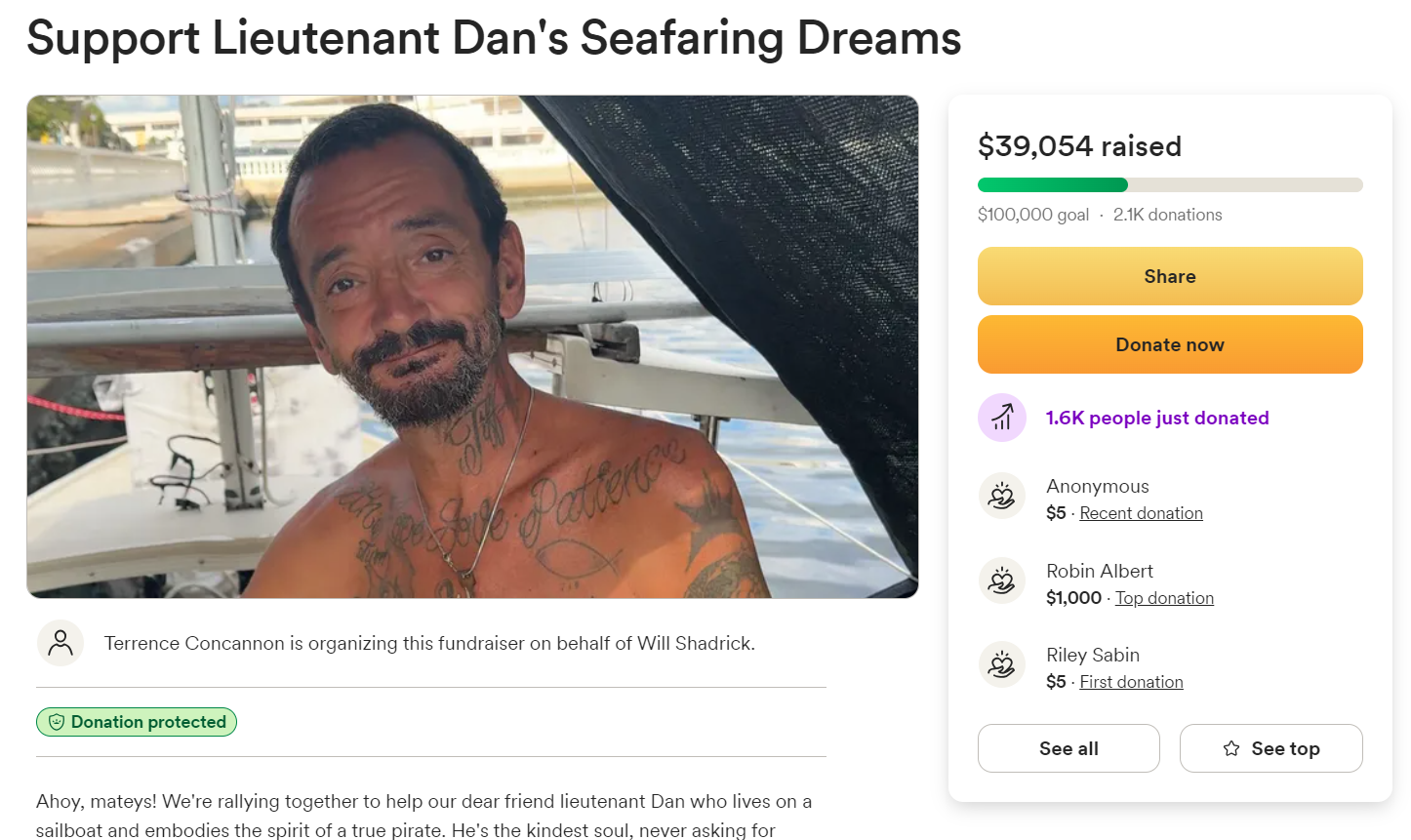
Not all fans – Not everyone was cheering on Lt Dan. Mena Ganey posted a video on X with over 6.4 million views calling him a grifter. The problem is, he did actually ride out the storm. As for his GoFundMe and TikToks, those were set up by content creator Tampa Terrance. That said, his problematic past has also surfaced.
An article published by WUFT claims that Lt Dan punched a police officer and urinated in his cruiser back in 2022. He served a one-year prison sentence over that incident.
Last year he was arrested for setting a park bench on fire. During the incident, a woman claimed she was splashed with some of the gasoline that he used to ignite the bench. That case was dropped.
Sound off – What do you think? Was Lt Dan an inspiration, a menace, crazy or the smartest guy in Tampa? Email me.
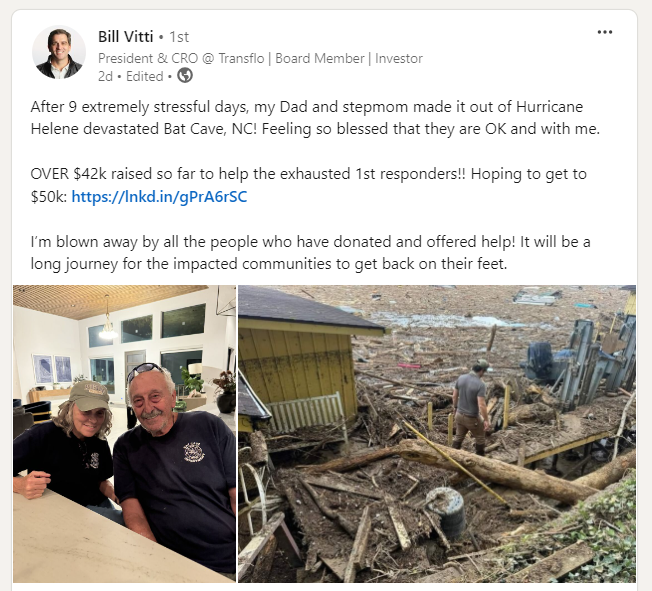
Bat Cave – While Taylor Swift and Dolly Parton may get the press for multimillion-dollar donations, they’re not the only ones stepping up. The devastation from Helene hit especially close to home for Transflo’s Bill Vitti as his parents live there. Vitti has worked tirelessly for the past nine days.
The Transflo president assembled a crew and heavy equipment, and has raised over $47,000 via a GoFundMe.
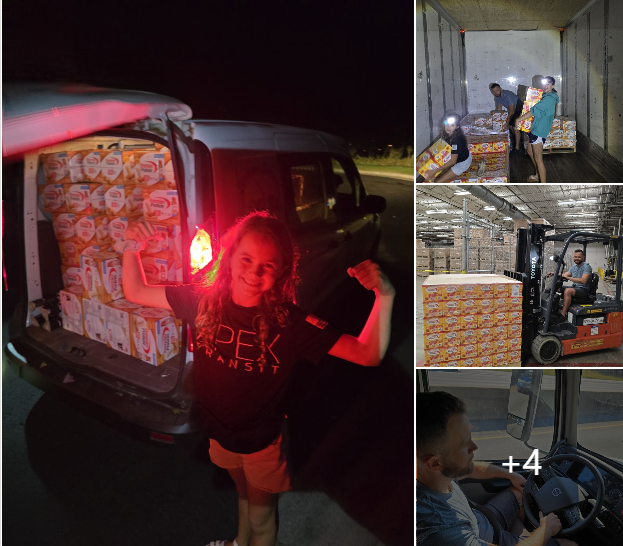
Apex delivers the macros –Marina Ivanov and her team at Apex Transit & Logistics brought in a truckload of protein shakes and delivered 46,000 meals to Hendersonville, North Carolina.
Learning while giving – Trucksafe’s Rob Carpenter says his “Daughter, Gracyn, and son Gavin have been with me on the relief trail in Virginia, Tennessee and North Carolina the past couple days.” He took the opportunity to show his kids what giving back means. He was concerned about receiving flack for keeping the kids out of school for two days but says the experience was more than worth it.
Walmart sends the convoy – Walmart’s Mike Keller and his team have spent the past week and a half organizing and sending a relief convoy to the Asheville area.
In addition, he says, “Looking to help? Walmart is matching donations to the American Red Cross 1:1, up to $2.5 million, when donations to support hurricane relief are made at the registers in stores and clubs and on Walmart.com until Oct. 13.”
To read about more logistics companies that have answered the call, go here.
No license – Tesla’s Elon Musk predicted today that all transport will be fully autonomous within 50 years.
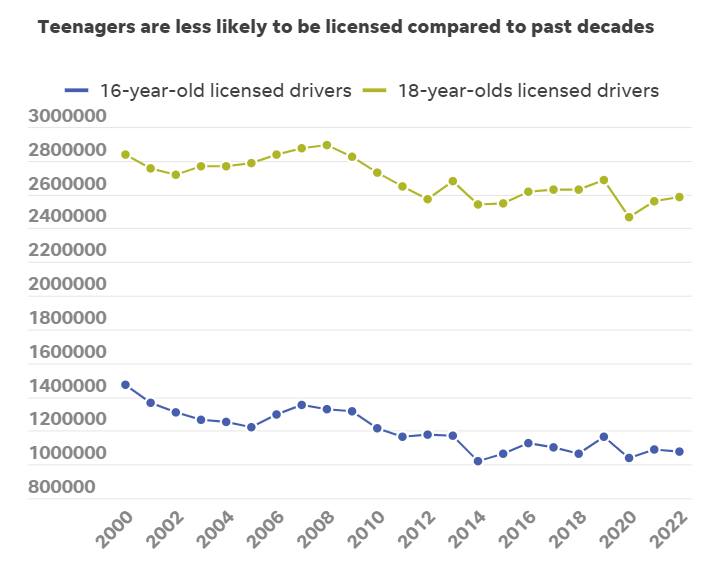
It may have to be with the rapidly growing rate of young people forgoing the ritual of getting a license when they come of age.
Within 50 years, the pool of people who even know how to drive may be incredibly small. While this prediction may be much harder to achieve with trucks, I have little doubt a lot of passenger vehicles will be fully self-drive (and not just the kinda sorta FSD Tesla has now.)
Not everyone is buying it, and Katya brings up a great point. Who wants autonomous trucks in a situation like we have in North Carolina? One thing to also keep in mind is that Musk’s timelines for nearly everything tend to be overestimated.
Our first documentary looks at WHAT THE TRUCK?!? is up with the SoCal ports
Now playing – The ports of Los Angeles and Long Beach. Just a few short years ago they were ground zero for the supply chain crisis. Today, the ports of Los Angeles and Long Beach are seeing record import levels.
Those will only grow as ports from Maine to Texas could go on strike again, leaving Los Angeles and Long Beach as two of few major ports in the country open for business.
Along with that, the ports as well as the drayage community are tasked with hitting some very real zero-emissions goals by 2030. Are we seeing an end to the freight recession in real time? Can the shipping community meet its environmental goals? Who are the players and what is the tech paving the way for this future?
We had to jump a plane from Chattanooga, Tennessee, to LAX to see what the truck is up with the gateway to the USA: the Southern California ports.
Featuring Port of Long Beach’s Noel Hacegaba; Talon’s Emmanuel Carrillo and Isaac Castaneda; Harbor Trucking Association’s Matt Schrap; Swire’s Iain Stewart; Braid Theory’s Ann Carpenter; Forum Mobility’s Ron Hunt; Long Beach Container Terminal’s Charlie Doucette and Bonnie Nixon; PortPro’s Walker Banks; Vendorflow’s Eric Rodriguez; and WHAT THE TRUCK?!?’s Dooner (aka me).
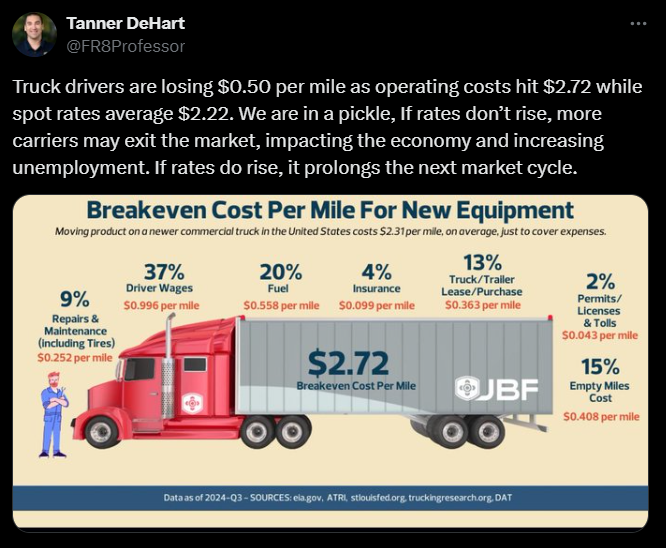
Truck costs, paid parking debate, AI for operations – Friday live on WHAT THE TRUCK?!?, I’m joined by freight analyst Tanner DeHart. We’re breaking down the market and how it impacts truck cost. We’ll also look at how breakeven can vary wildly between carriers.
Truck Parking Club’s Reed Loustalot gets into the paid versus free parking debate and how they’re expanding their services across the nation.
Lexmark’s Brant Nystrom shares the latest on their deployment of AI in truck operations. What are they doing with it? We’ll find out.
Plus, the latest headlines and weirdness going down in this wild industry.
Catch new shows live at noon EDT Mondays, Wednesdays and Fridays on FreightWaves LinkedIn, Facebook, X or YouTube, or on demand by looking up WHAT THE TRUCK?!? on your favorite podcast player and at 5 p.m. Eastern on SiriusXM’s Road Dog Trucking Channel 146.
Forget ‘Founder Mode’
FBM – Founder Mode has nothing on Freight Broker Mode. Wear the shirt that lets them know you grind. Head on over toWTTGear.com to get our latest merch! Use code WTTFans for 10% off.
STP x F3
Get your tickets to the logistics event of the year, F3 right here. (That’s my discount link.)
Or simply look up WHAT THE TRUCK?!? on your favorite podcast player. Or, if you have SiriusXM, tune in to the show Monday, Wednesday and Friday at 5 p.m. Eastern time on Road Dog Trucking Channel 146.
Levi Strauss & Co. is outsourcing operation of a huge omnichannel fulfillment center in Ohio to logistics giant Maersk, part of the retailer’s transition to a hybrid distribution strategy.
Maersk announced Wednesday that its warehouse and distribution services unit in August began operating a 1.2 million-square-foot distribution center in Groveport, Ohio, for the apparel company. Maersk recently leased the building and took over processing wholesale, retail and e-commerce shipments that were previously handled at another location by Levi’s (NYSE: LEVI) itself, according to a Maersk spokesperson.
The facility is a key cog in Levi Strauss’ push to make direct-to-consumer its primary sales channel and modernize supply chain operations. It is the 10th global facility operated by Maersk for the retailer. Maersk, one of the world’s largest ocean shipping companies, has expanded to become an integrated logistics provider to multinational businesses like Levi’s. Among the services it provides Levi’s is consolidating orders at overseas points of origin for air and ocean transport.
D2C, both through its own stores and e-commerce site, is Levi’s fastest growing segment as the company deemphasizes its wholesale business.
Management said on the second-quarter earnings call that it has decided to move from a primarily self-owned and -operated distribution and logistics network in the United States and Europe to one that is more balanced between company facilities and those of 3PLs. The D2C strategy also requires investments to upgrade existing capacity with omnichannel capabilities. Outsourcing fulfillment activity will reduce per-unit costs and deliver more than $90 million in savings this year, primarily by not having to build a planned distribution center in Germany, said Harmit Singh, the retailer’s chief financial and growth officer.
In Europe, Levi’s has contracted with GXO Logistics as a 3PL.
“We are in the process of re-aligning our network to better position LS&Co. to meet customer demands, drive our DTC-first ambitions and sustain future growth,” said Craig Jones, the company’s senior vice president of global distribution and logistics operations, in a news release. “This Maersk-designed and operated facility is an important step in our strategy to transition to a hybrid distribution and logistics network that balances omni-capable owned-and-operated facilities with technologically advanced 3PL facilities like this one. Collectively, this will improve customer experience, capacity, on-time performance, and efficiency across our business.”
The new facility will help lower Levi’s costs while reducing container handling time and enhancing speed and efficiency, according to the announcement. Groveport is near Columbus, Ohio, an area with a heavy concentration of retail distribution centers and good access to highway networks that allows the company to reach more U.S. consumers faster.
During the next several months, Maersk will install high-speed sortation systems from EuroSort capable of processing 100 million outbound units annually. The facility will feature the latest implementation of Maersk’s proprietary warehouse management system to improve efficiency.
Maersk operates more than 85 warehousing facilities across North America.
Air Canada pilots voted in favor of a new collective bargaining agreement Thursday that includes several pay increases and quality-of-life improvements. Described as the airline’s largest-ever labor contract, the deal moves pilot compensation more in line with that of their U.S. peers.
The agreement, which was reached between Air Canada and the Air Line Pilots Association, International (ALPA), representing over 5,200 pilots, was ratified by 99% of the workforce. According to the union, 67% of Air Canada’s pilots voted in favor of the agreement.
Pilots are set to receive a 26% retroactive pay increase to September 2023, followed by additional 4% raises each year through 2026. This adjustment aims to bring their compensation closer in line with what their counterparts earn at U.S. airlines, addressing long-standing concerns over wage disparity.
“This contract is the largest labour agreement in Air Canada’s history and reflects contributions that our pilots bring to the success of our airline. This agreement helps restore what Air Canada pilots have lost over the past two decades and creates a strong foundation from which to build on,” said First Officer Charlene Hudy, chair of the Air Canada ALPA Master Executive Council, in a news release. “We look forward to working under these improved pay rates and working conditions while continuing to connect our passengers to Canada, North America, and the world.”
According to The Globe and Mail, the contract is valued at approximately $1.9 billion.
“We are very pleased this new collective agreement has been approved by our pilot group. The agreement is mutually beneficial and it will keep our pilots the best compensated in Canada and provide the work-life balance improvements they were seeking. At the same time, the agreement gives our company flexibility and creates a framework for future growth of the airline and its network. We look forward to working with our pilots under this renewed partnership,” said Michael Rousseau, president and chief executive of Air Canada, in a news release from the airline.
In September, the airline and its pilots averted a potential strike, reaching the last-minute deal just hours before scaling down the carrier’s operations.
Nonprofits in logistics space speed medical supplies, other aid to Florida
Nonprofit groups loaded with crucial disaster-relief and medical supplies are parked at staging areas in Florida after Hurricane Milton, which was a Category 3 storm when it struck Florida’s Gulf Coast Wednesday night, spread destruction across the state.
Kelby Marlin, transportation director at Convoy of Hope, said the faith-based organization has two tractor-trailer loads of supplies at its staging area in Perry, Florida. That location could change depending on the hurricane’s trajectory.
FedEx driver Scott Osborne is delivering a truckload of relief supplies in Florida for Convoy of Hope. (Photo credit: COH)
Springfield, Missouri-based Convoy of Hope has been partnering with FedEx Corp.(FDX), for the past three years. Marlin said Memphis, Tennessee-headquartered FedEx flew two of its top truck drivers to Springfield to drive Convoy of Hope’s disaster-relief supplies to Florida. Scott Osborne, a 31-year trucking veteran who works out of the FedEx Freight terminal in Jackson, Mississippi, was behind the wheel of one of Convoy of Hope’s red Kenworths as he made his way to Florida.
FedEx Freight previously sent three drivers to haul provided hygiene kits, food, water and tarps to staging areas to help survivors in six Southeastern states that were devastated by Hurricane Helene. The Category 4 storm made landfall on Sept. 26, pounding Florida’s Gulf Coast, before churning its way inland, leaving a 500-mile path of devastation.
“Volunteer drivers are the backbone of our driving team. Especially during high-volume times like these,” Marlin told FreightWaves. “We are always in need of volunteers who believe in the mission of Convoy of Hope and have a passion and a skill for driving.”
The organization, founded in 1994, has delivered relief supplies to more than 250 million people over the past 30 years.
So far, Convoy of Hope has sent over 100 truckloads, and its volunteer drivers have delivered approximately 2.5 million pounds of supplies to Florida, Georgia, North Carolina, South Carolina, Tennessee and Virginia. In its daily briefing Thursday, the Federal Emergency Management Agency reported that 210 people have been confirmed dead in those states, with the number expected to rise in the coming days and weeks.
Global logistics giant FedEx has offered to send seven more drivers over the next few weeks to haul Convoy of Hope supplies, Marlin said, after the nonprofit group assesses the areas where relief supplies are most needed.
The organization is looking for volunteer truck drivers to haul relief supplies from its locations in Springfield as well as Sacramento, California, and a future location in Atlanta.
“Our team will remain out of harm’s way until the storm passes, then we will move in as quickly as possible to get relief supplies to people in need,” Marlin told FreightWaves. “Most of our volunteer drivers have responded to these kinds of natural disasters before, and like most truck drivers, who spend long periods in their trucks, are capable and prepared for these types of situations.”
Medical mobile units head to Florida
In the wake of the second major hurricane to strike Florida in less than two weeks, Lenexa, Kansas-based Heart to Heart International, a nonprofit medical and logistics organization, is preparing to send its advance teams to the state to coordinate with local, county, state and federal entities.
Hurricane Milton is blamed for six deaths in St. Lucie County and two in St. Petersburg, Florida. (Photo credit: Convoy of Hope)
As of publication Thursday, Milton has been blamed for six deaths so far in Florida, including four in St. Lucie County and two in St. Petersburg.
Dan Neal, senior vice president of HHI, said its volunteer roster includes around 150 physicians, nurses and logistics professionals from across the country. He said HHI has enough medical personnel to operate multiple teams in different areas that are devastated by natural disasters.
“We’re just sort of on standby to see what’s happening with Milton. We don’t know where we will deploy yet,” Neal said.
While not all of its medical and logistics volunteers deploy at the same time, doctors and nurses typically work in teams of 10. For the past 13 days, HHI teams have been treating up to 30 victims of Helene each day in the hardest-hit parts of North Carolina using the organization’s 45-foot RV, which has been converted into a mobile doctor’s office. The medical vehicle comes equipped with two exam rooms, a pharmacy and bathroom facilities.
After Helene, HHI partnered with the Haywood County Department of Health and staged its mobile clinic just south of Asheville, North Carolina.
“We can take it anywhere around the country and pull it into a parking lot, open up the door, and treat those with non-life-threatening medical conditions or those in need of their blood pressure medication, insulin, or treat cuts, minor injuries, even poison ivy, to ease some of the pressure from hospitals’ emergency rooms,” Neal told FreightWaves.
The mobile clinic doesn’t have an X-ray machine, and those needing oxygen are referred to a nearby hospital. Neal said HHI medical volunteers can fill patients’ daily medications for a short term or around 30 days as most of the pharmacies in the hardest-hit areas of some states are still closed or gone.
Many Helene survivors lost their medications as they rushed to evacuate during the devastating flooding and mudslides that left 88 people dead in western North Carolina, according to FEMA. That number is expected to rise. Some rural communities are still cut off from emergency personnel getting to them as hundreds of roads and bridges were wiped out after Helene dumped 17 to 31 inches of rain in some communities in the Appalachian Mountains, according to the National Weather Service.
Hurricane aftermath
Respiratory illnesses are on the rise in western North Carolina as Helene survivors return to formerly flooded homes that are now filled with mud because they have nowhere else to stay, Neal said.
“Now, it’s October and it’s getting cool at night in the Smoky Mountains and there’s mold developing in their homes, and folks are also lighting fires to stay warm at night,” Neal said. “With the smoke and mold, we’re seeing a lot of respiratory illnesses.”
Ingrid Brown, a 45-year trucking veteran, lives in Zionville, North Carolina, which borders Tennessee. As Helene headed toward Florida on Sept. 26, Brown said she was delivering freight near Tampa and was picking up another load of refrigerated produce near Plant City, Florida, to deliver near Memphis.
Helene’s torrential rain and mudslides washed away a building near Ingrid Brown’s farm in Zionville, North Carolina. (Photo credit: Ingrid Brown)
Despite receiving news reports from family members who live near her farm in Zionville that the area was getting slammed by torrential rainfall, mudslides and flooding, Brown said she had to force herself to focus on delivering her load and navigate traffic jams as Florida residents scrambled to flee Helene before she could think about the damage to her farm.
“Working and driving is a completely different world than being at home and seeing this devastation happening and not being able to do anything about it,” Brown told FreightWaves. “I haven’t really been able to talk about this before. It’s just so sad. I have to stay busy.”
Brown said she wasn’t able to see the storm damage to her farm until days later because all the main and back roads to her home were washed out. She and five other families on Rich Mountain still don’t have electricity.
While her roof sustained damage from fallen trees and a bedroom on the first floor of her house flooded, Brown said things could have been much worse. Brown, who is 63, said her family has lived on Rich Mountain their entire lives.
“I am lucky that I have my life and a place to go home to because many people here do not,” she told FreightWaves. “I can’t imagine losing my life because I was trapped by water with no way out. All of the roads around here follow the creeks and rivers. Bridges that have been here forever are completely gone.”
She also volunteered and delivered pallets of water and bags of ice to neighboring communities in western North Carolina.
After meeting with her insurance adjuster on Monday to survey the damage to her roof and property, Brown said she couldn’t sit still long because one of her customers was in the crosshairs of Milton’s path and asked if she could drive down and pick up a final load of produce before the hurricane hit.
A former owner-operator, Brown now drives for Blackjack Express of Proctor, Arkansas. She runs its only refrigerated trailer while the carrier’s remaining fleet of around 25 drivers haul heavy equipment and oversize loads.
“I asked the owners if I could deadhead about 750 miles to take care of this customer before Hurricane Milton hit and potentially wiped them out of business and off the map and they said, ‘Of course. Do what you need to do,’” Brown said. “It’s just not in my nature to sit still and not try to help and take care of people and my customers if I can.”
Steve Brown of Zionville, North Carolina, attempts to cut down a fallen tree from his cousin Ingrid Brown’s roof after it was heavily damaged in Hurricane Helene. (Photo Credit: Ingrid Brown)
Ingrid Brown’s cousin, Steve Brown, who also lives in Zionville, is using his own backhoe and excavating equipment to build culverts on roads washed out by massive flooding so that emergency vehicles can get to some residents previously surrounded by water.
“Steve, who is more like my brother to me and takes care of my property when I’m on the road, is using his own money to buy the supplies and fuel for his equipment to build these culverts and open these roads for some of these people,” Brown said.
After picking up her load of produce near Tampa, Brown said it took her eight hours to go 200 miles as thousands of motorists and their families attempted to evacuate before Milton struck.
Brown said families in her area were being stung by yellowjacks after their underground nests were flooded during Helene, which was confirmed by The Associated Press.
“Folks back home are having a heck of a time finding EpiPens or allergy medication because the stores and pharmacies are closed.”
Neal confirmed that HHI’s mobile medical clinic carries EpiPens after a situation years earlier when a man who was repairing power lines in another disaster area was stung and had a severe allergic reaction.
“Our team was able to save this man’s life because we had EpiPens on site,” Neal said.
While HHI is shifting some of its resources to Hurricane Milton as it coordinates with more than 70 partners in Florida, Neal said the organization plans to continue dividing its resources and assets between North Carolina and Florida.
He said FedEx is a huge supporter of HHI’s relief efforts and that the organization has a charitable account with FedEx that allows it access to the shipping giant’s entire network to ship critical medical supplies overnight, if needed, from its warehouse in Lenexa.
“We just shipped out a resupply order today of asthma-related drugs, including inhalers and similar types of medications, for some patients in North Carolina,” Neal said.
While most of the medication that HHI dispenses is donated by large pharmaceutical companies, including free flu shots, tetanus vaccines and insulin, along with blood pressure and cholesterol medications for hurricane victims, Neal said the group had to use its own funds to buy more asthma medications.
Former truck drivers with active Class A CDLs as well as retired school bus drivers often volunteer to drive HHI’s mobile RV and some of organization’s other equipment.
“We have some volunteers who retired from other professions who decided it would be cool to get their CDLs, and we pay for them to do that in exchange for volunteering their services,” Neal said.
HHI also has a Mercedes Sprinter van, which Neal describes as a one-room doctor’s office that is equipped with an exam table and refrigerator to store medication like flu and Tdap vaccines. The smaller vehicle allows the medical teams to navigate traffic much more easily than the 45-foot RV in disaster areas.
HHI, which began in 1992, has delivered over $3 billion of medical supplies and aid to more than 130 countries.
The nonprofit medical organization also partners with Clinic in a Can (CIAC), which is headquartered in Bel Aire, Kansas. CIAC turns 20-foot intermodal containers into one-room medical clinics equipped with solar panels for power and diesel generators. Neal said HHI tested out one of CIAC’s first prototypes during Hurricane Katrina in 2005.
Michael Wawrzewski founded CIAC in 2002 after volunteering with an international organization that provided medical services in impoverished countries around the world. Besides serving as CIAC’s CEO, Wawrzewski has worked as a nurse practitioner for over 27 years, according to the organization’s website.
HHI can order more CIAC containers as needed, Neal said. They are placed on flatbed trailers and delivered to staging areas during natural disasters.
As of Thursday, Neal said HHI plans to stage its mobile clinic at Florida’s Emergency Operations Center in Tallahassee, then the organization’s teams will deploy to that location and set up health care operations.
As for Brown, she’s back on the road and won’t be home for a few weeks. Her rig was one of 50 custom Peterbilt trucks chosen in the U.S. and Canada to participate in Peterbilt’s annual Pride and Class Parade on Oct. 18 in Denton, Texas, to raise money for the United Way.
“Some people pulled their trucks off the road weeks ago to paint and polish their Peterbilts before the event,” Brown said. “I’ve got to get my stuff together. I am dealing with all of this mess and trying to drive, but I will pull it together before the event and get the truck looking pretty. This is something good to look forward to after this massive tragedy.”
Do you have a news tip or story to share? Send me an email or message @cage_writer on X, formerly known as Twitter. Your name will not be used without your permission.