Mexico’s heavy-truck exports plunges 22% as light-vehicle demand also dips
Mexico’s automotive industry posted sharp declines across cars, light trucks and heavy-duty commercial vehicles in November, as road blockades, labor stoppages and softer global demand disrupted factory operations and slowed exports.
The 16 members of Anpact in Mexico are Freightliner, Kenworth, Navistar, Hino, International, DINA, MAN SE, Mercedes-Benz, Isuzu, Scania, Shacman Trucks, Foton, Cummins, Detroit Diesel, Daimler Buses Mexico and Volkswagen Buses.
Freightliner was the top truck producer and exporter in Mexico in November, producing 7,545 trucks, a 24.7% year-over-year decline. The truck maker exported 7,099 units during April, a 19.1% year-over-year decrease.
International Trucks Inc. was the No. 2 producer and exporter during the month, manufacturing 4,044 trucks, a 25.3% year-over-year decrease. The truck maker’s exports fell 23.3% year-over-year to 2,949 units during the month.
Rogelio Arzate, president of Mexico City-based Anpact, said the declines in year-over-year exports and production in November was caused by tariffs and supply chain uncertainty created by the U.S., the main export market for Mexico’s heavy-duty truck market (94.4%).
“The uncertainty is what caused what has been expressed in the reports every month, not knowing where the trade policies and tariffs in the United States will end up, and the fact that we are currently paying 25 percent on non-American content, and that has had an impact,” Arzate said during a news conference on Tuesday.
Rolling protests and road blockades by farmers and truckers across Mexico have also impacted major border crossings over the past several weeks, stranding thousands of freight trucks carrying goods to the U.S.
Mexico assembled 322,205 cars and light trucks in November, down 8.4% year-over-year. Exports totaled 279,342 units, a 3.4% decline from November 2024.
Exports continued to skew heavily toward the U.S., which absorbed 78.6% of shipments from January to November (2.48 million vehicles). Canada followed with an 11% share and Germany with 3%.
Light trucks continued to dominate assembly lines, accounting for 77.2% of national production, underscoring their importance in Mexico’s export mix.
Top light-vehicle exporters – November 2025
General Motors: 78,257 units (+3.9% year-over-year)
Ford: 33,709 (+89%)
Volkswagen: 27,794 (+9.2%)
Stellantis: 27,653 (-10.1%)
Nissan: 23,008 (-38.5%)
Automotive officials said weak demand in the U.S. slowed down auto factories across the country.
“Among the factors contributing to the uncertainty affecting the sector’s performance in the international context is the ongoing adjustment of U.S. trade policy within the framework of the review and renegotiation of the United States-Mexico-Canada-Agreement,” Guillermo Rosales, president of the Mexican Association of Automobile Dealers, said during the news conference.
Peterbilt, Kenworth expand EV lineup with new medium-duty models
Peterbilt and Kenworth, both subsidiaries of global original equipment manufacturer PACCAR Inc., have announced expansions of their zero-emission vehicle portfolios with the introduction of multiple medium-duty electric truck models.
The simultaneous announcements Tuesday are part of a larger commitment by both companies to provide zero-emission solutions across various applications, from regional delivery to vocational configurations.
Denton, Texas-based Peterbilt unveiled three new electric vehicle models — the 536EV, 537EV and 548EV — designed to address specific customer needs in the medium-duty segment. These new offerings feature zero tailpipe emissions while incorporating the latest safety technologies.
The 536EV and 537EV target regional delivery and service applications, while the Class 8 548EV supports 4×2 tractors and vocational configurations with power takeoffs, such as dump trucks. These models feature distinctive exterior styling with blue-accented crown and grille elements, alongside EV-exclusive panels on the hood sides.
“Optimized for the demands of the medium-duty segment, the next generation of Peterbilt electric vehicles deliver excellent efficiency, rapid charging and versatile configurations elevating customer productivity across a wide range of applications,” said Erik Johnson, Peterbilt’s assistant general manager for sales and marketing.
The Peterbilt models feature an EV-specific 15-inch digital driver display, SmartLINQ integration, configurable powertrain settings and cabin preconditioning.
Kirkland, Washington-based Kenworth simultaneously announced its own medium-duty battery-electric trucks: the T280E, T380E and T480E. These Class 6-8 models are designed for pickup and delivery, utility, regional haul and vocational applications. Drivers will find the latest technology inside the Kenworth models, including the Kenworth SmartWheel and a 15-inch digital display.
“Kenworth builds a truck and a powertrain for every job and is proud to expand our comprehensive range of battery-electric models across both vocational and on-highway markets,” said Kevin Haygood, Kenworth’s assistant general manager for sales and marketing. “With the addition of the T280E, T380E and T480E, customers now have even more options to spec trucks that align with their business needs and sustainability goals.”
Both manufacturers’ power options scale to accommodate different applications, with configurations offering up to 605 horsepower and 1,850 pound-feet of torque. The system utilizes lithium iron phosphate battery chemistry and includes selectable three-stage regenerative braking to maximize range and efficiency.
Beyond the vehicles themselves, both brands are supporting the electric vehicle transition with comprehensive charging infrastructure solutions. Peterbilt offers a complete lineup of chargers through PACCAR Parts, with options including both AC and DC chargers with up to 400 kilowatts capacity. The company also provides charging infrastructure planning and installation services through partnerships with Qmerit and Schneider Electric. Kenworth supports DC fast charging with peak rates up to 350 kilowatts, backed by a full suite of charging solutions available through PACCAR Parts.
Three Teamsters locals come together to set new deal with Sysco
Three separate West Coast Teamsters locals have teamed up to secure a new contract with food distributor Sysco in an unusual arrangement.
The union announced this week that more than 1,000 Sysco drivers and warehouse workers in northern California and Nevada ratified what the union called the “first-ever regional collective bargaining agreement negotiated by the Teamsters at Sysco.”
The deal is for four years. The union, in a prepared statement, said the contract provides for a 34% increase in wages, “substantial improvements” in Sysco’s (NYSE: SYY) pension contributions, “top-tier” health benefits and “robust protections against unsafe conditions and harmful automation practices.”
The locals in the contract are 137, based in Redding, California; 853, in Oakland, California; and 533, in Reno, Nevada.
A spokeswoman for the Teamsters said about 60% of the workers covered under the deal are drivers.
Separate deals come together
“All three locals had previously negotiated their collective bargaining agreements and then came together to jointly bargain the first-ever Teamsters regional contract at Sysco,” the spokeswoman said in an email to FreightWaves. “In order to make this happen, the locals voted to authorize and were prepared to strike unless a deal was reached. The regional agreement will serve as a model of how we plan to restructure bargaining with the company moving forward.”
“Our members made it clear the clock was ticking and were fully prepared to strike if Sysco failed to deliver,” Tom Erickson, director of the union’s warehouse division, said in the Teamsters statement. “That readiness paid off and delivered a major victory.”
In a statement supplied to FreightWaves, Sysco said the contracts covering the workers “are just another example of our commitment to providing colleagues with a great place to work with opportunities for professional growth. We will continue to reward our colleagues for their important contributions to Sysco’s success.”
Joe Silva, a Sysco warehouse worker who also is a steward with Local 853, said in the Teamsters statement that the contract is “the strongest we have ever negotiated.”
Sysco, in its most recent 10-K filing with the Securities and Exchange Commission, said about about 14% of its approximately 75,000 employees that are represented by unions, “primarily” the Teamsters.That 14% figure is coincidentally the number of union workers that the company said earlier in the year were subject to renegotiation of a contract in fiscal 2026, which ends June 30.
NLRB action
That was not the only recent interaction between the Teamsters and Sysco in recent weeks.
Matt Bruenig, an independent journalist who covers the NLRB and publishes a Substack called NLRB Edge, reported this week that the Region 04 Director of the NLRB had ordered a “mixed manual-mail ballot” for drivers in a representation vote in the Lehigh Valley.
According to the NLRB Edge, the finding by regional director Kimberly Andrews was that “the company’s scattered workforce and varied shift schedules make a traditional in-person vote impractical.”
In her decision, Andrews said that she “(concluded) that a mixed manual-mail ballot election is more appropriate than a manual election to enfranchise the greatest number of eligible voters and because it is the most efficient use of Board resources.”
She acknowledged in her decision that the preference of the NLRB is for in-person voting. But given the geographic spread of the workers in the representation vote, Andrews wrote, a mixed manual-mail ballot election would “ensure the broadest possible participation of eligible voters that are scattered.”
The Sysco workers who are voting on the representation are spread out in the northeast Pennsylvania area, with Allentown as the key location.
Codifying the Interim Rule or Locking in Ambiguity? Inside the Real Debate Over HR 5688
The conversation around non-domiciled CDLs has become one of the loudest and most emotionally charged debates trucking has seen in years. Depending on where you get your information, HR 5688 is either a long-overdue fix to a broken system — or a Trojan horse that could reopen the very loopholes drivers believe flooded the industry in the first place.
That tension is exactly why the issue was brought to The Long Haul.
From the opening moments of the episode, host Adam Wingfield set the tone clearly: this was not about picking sides or telling drivers what to think. It was about hearing perspectives directly, in full context, and allowing listeners to decide for themselves.
“My goal… is to take different perspectives and hear different sides of stories, to formulate my own opinion,” Wingfield said. “Because at the end of the day, you can’t hear someone else’s opinion if you’re not listening.”
For this episode, that perspective came from Lewie Pugh, Executive Vice President of OOIDA — a former driver who has spent decades navigating both the cab of a truck and the halls of Washington.
What followed was not a clean endorsement, nor a defensive press tour. It was a candid, sometimes uncomfortable discussion about how HR 5688 came to be, what it actually does, and where its limits — and risks — may lie.
What HR 5688 Was Designed to Fix
At its core, Pugh explained, the original intent behind non-domiciled CDLs was operational, not ideological.
“The problem it was designed to solve was if a person living in Florida went to Utah to work for a motor carrier… they could train there, test there, and get their CDL even though they weren’t a resident,” Pugh said.
That structure allowed large carriers and military programs to train drivers centrally, issue a CDL, and then have the driver transfer it back to their home state later. On paper, it solved a logistical bottleneck.
But as Pugh acknowledged, what lawmakers and regulators failed to anticipate was how broadly the door would open.
“What we didn’t realize… was that we were opening the floodgates to not only allow people from other states, but other countries.”
He was blunt about where responsibility fell.
“There’s a lot of unscrupulous trucking schools out there… and these people should have never gotten behind the wheel in the first place.”
That acknowledgment matters, because it undercuts the narrative that industry groups were blindsided only recently. OOIDA, Pugh said, opposed the expansion early — sending cease-and-desist letters to more than 40 states issuing non-domiciled CDLs.
Key Takeaways
Future risk depends on interpretation, not volume
The eligibility rules are effectively the same
No new access is created by H.R. 5688
The main change is permanence, not policy
Secretary discretion exists in both versions
The “Driver Shortage” Narrative Under the Microscope
As the conversation widened, Pugh returned repeatedly to what he described as the industry’s original sin: legislating around a perpetual driver shortage narrative.
“For the last 40 years, we’ve been regulating and legislating from this whole bull crap driver shortage narrative,” he said. “We don’t have a shortage of drivers. We have a shortage of pay, training, and places to sleep.”
That framing shaped nearly every policy decision that followed — including fast-tracking CDL access, easing training requirements, and tolerating churn.
“We fast-track truck drivers, but we don’t fast-track electricians, doctors, or carpenters,” Pugh said. “Why wouldn’t we want the guy hauling freight to actually know what he’s doing?”
In his telling, non-domiciled CDLs became one more lever to keep seats filled rather than improve job quality — a decision whose downstream effects are now impossible to ignore.
The turning point of the discussion came when Wingfield pressed Pugh on HR 5688’s substance — not its intent.
Pugh’s core argument was straightforward: the bill does not expand access. It codifies existing restrictions already put in place through the Interim Final Rule issued under Secretary Sean Duffy.
“This bill is nothing but codifying the Interim Final Rule,” Pugh said. “It’s mirrored language. It’s the exact same thing.”
And codification, he argued, is critical because agency rules can be undone by the next administration with the stroke of a pen.
“If Congress makes this a law… then it will take Congress to change it.”
That explanation addressed one concern — permanence — but raised another.
The Loophole Question
Wingfield did not let the conversation stop there.
He read directly from the bill’s language, pointing to clauses allowing eligibility based on visas “determined by the Secretary” and record retention periods also “prescribed by the Secretary.”
The concern was clear: discretion today could become vulnerability tomorrow.
“Wouldn’t it be advantageous to amend the bill now,” Wingfield asked, “so we remove the potential for loopholes instead of dealing with this again down the road?”
Pugh did not dismiss the concern.
“I would love to see no non-domiciled CDLs. Period,” he said. “That would be perfect.”
But he framed HR 5688 as a choice between imperfect progress and regulatory whiplash.
“If we don’t get this codified… the next administration can just do away with the rule completely, and it’s back to the Wild West.”
Pressed further on whether discretion itself creates risk, Pugh conceded the uncertainty.
“Anything can happen,” he said. “But there are steps before it ever gets to that level — labor need, visas, funding. It’s still better than what we have now.”
That exchange marked one of the clearest moments where OOIDA’s position showed strain: supporting a bill it does not love, to prevent outcomes it fears more.
Why the Backlash Hit So Hard
Another recurring theme was social media’s role in amplifying distrust.
“Social media has become the new CB radio,” Pugh said. “Everybody has an opinion.”
Wingfield pushed further, noting that advocacy organizations are now judged not just by policy outcomes, but by how fast and clearly they communicate.
Pugh acknowledged OOIDA was slower than ideal to adapt — but emphasized the challenge of representing a diverse membership across generations.
“You’ve got drivers in their 20s and drivers in their 70s. They get information completely differently.”
That gap, he suggested, allows simplified narratives to fill the void — including the belief that OOIDA supports foreign non-domiciled CDLs.
“OOIDA does not support non-domiciled CDLs. Period,” Pugh said. “We were the only ones pushing back in 2019.”
The Core Tradeoff
As the episode closed, the disagreement crystallized into a single question:
Is HR 5688 a flawed safeguard — or a necessary line in the sand?
Pugh’s answer was pragmatic, not triumphant.
“Is it perfect? No. Is it the best chance we have right now? Yes.”
He warned that refusing to engage, or making the bill politically toxic, could leave the industry with nothing at all.
“Something is better than nothing — when nothing means going backward.”
Wingfield did not dispute that reality. But he left listeners with the unresolved tension at the heart of the debate: whether settling now risks reopening the door later.
What neither side disputed was this — the era of quiet policymaking is over. Social media has turned every bill into a public trial, and every advocacy group into a defendant.
In that environment, clarity matters more than alignment.
And for truckers trying to make sense of HR 5688, the takeaway was not who to trust — but what questions still deserve answers.
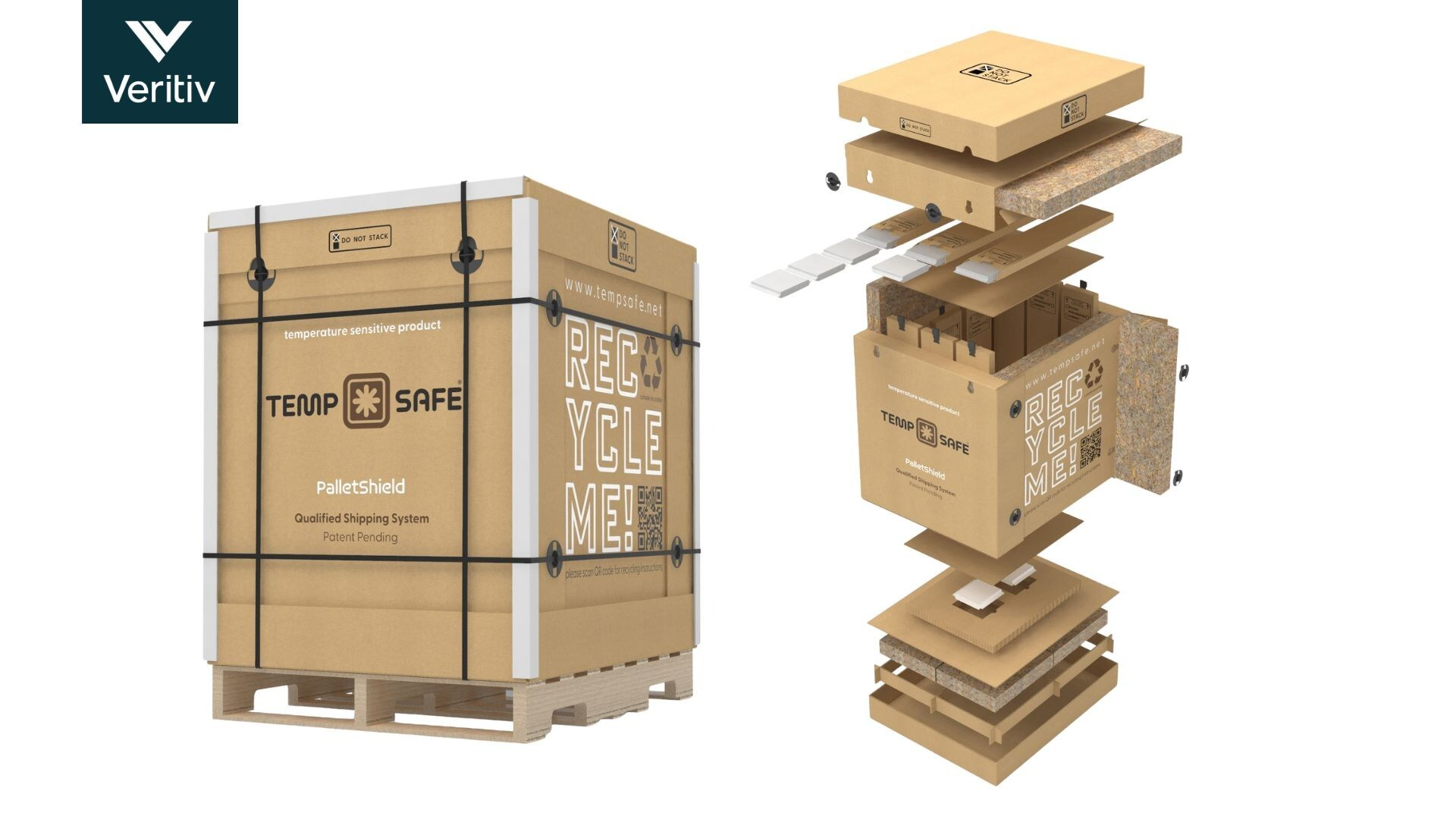
Veritiv expands its TempSafe portfolio with curbside-recyclable pallet shipper
Veritiv, a major player in specialty packaging distribution and supply chain solutions, has unveiled a groundbreaking addition to its cold chain logistics offerings: TempSafe PalletShield, the industry’s first pre-qualified pallet shipper constructed from curbside-recyclable components. This new product marks a significant advance in sustainable packaging for biopharmaceutical and temperature-sensitive shipments, reflecting growing industry demand for performance that doesn’t compromise environmental responsibility.
Cold chain logistics has long relied on materials such as expanded polystyrene (EPS) and polyurethane (PUR) foam to protect goods like vaccines, biologics, and other high-value therapeutics. While effective at preserving temperature, these traditional materials often end up in landfills and carry disposal costs that add to overall supply chain expenses.
TempSafe PalletShield aims to replace that paradigm by combining validated thermal performance with a fiber-based design that can be recycled curbside, where local facilities allow, significantly reducing waste from bulk shipments.
Designed to support the most demanding temperature-controlled distribution channels, the PalletShield system delivers more than five days of validated thermal protection, accommodates a payload volume between 558 and 596 liters, and holds more than 300 pounds of dry ice. Its patent-pending design includes interlocking panels that minimize edge loss and help maintain both structural integrity and consistent thermal performance across long distances and multiple stops. This makes it suitable for use in life sciences, healthcare, and specialized logistics operations where precision and compliance are essential.
From the outset of the project, Veritiv’s team aimed to meet or exceed the performance of traditional materials while making the system intuitive and scalable for operations teams on the floor. According to Frank Butch, Director of Cold Chain Solutions at Veritiv, the result is a shipper that not only performs well in real-world conditions but also scales with the complexity of modern cold chain networks. “Our goal from day one was to design a recyclable pallet shipper that performs at or above traditional materials while remaining intuitive for teams on the floor,” he said.
Chris Bradley, Veritiv’s Chief Marketing and Sustainability Officer, noted that the launch responds directly to market requests for solutions that bridge the gap between thermal assurance and environmental responsibility. He emphasized that PalletShield expands the company’s TempSafe portfolio, which already includes a range of curbside-recyclable solutions for different shipment sizes and temperature profiles. Bradley described the new shipper as built for “real operational pressures,” reinforcing Veritiv’s commitment to helping clients reduce waste, simplify pack-outs, and eliminate disposal costs traditionally associated with cold chain packaging.
Beyond its environmental benefits, the PalletShield system flows seamlessly into existing logistics and pallet workflows, supporting standard handling practices without requiring extensive retraining or infrastructure changes.
Intermodal traffic continues to hold down overall U.S. rail volume
Falling intermodal traffic has again led to a drop in weekly U.S. rail volume compared to 2024.
For the week ending Dec. 6, according to statistics from the Association of American Railroads, the overall volume of 508,999 carloads and intermodal units was down 2.3% from the same week a year ago. That overall figure included 228,823 carloads, up 1.7%, and 280,176 containers and trailers, down 5.4%.
It is the ninth consecutive week that total traffic has been down compared to the corresponding week a year earlier. The last time the overall figure was above 2024 levels was in the week ending Oct. 4.
Grain, 8.4%, coal, 5.4%, and nonmetallic minerals, 4.1%, led five commodity carload gainers. Forest products and chemicals were down 4,2% and 3.1%.
(Chart: AAR)
Through 49 weeks of 2025, total U.S. traffic was 24,166,363 carloads and intermodal units, an increase of 1.8% over the same period a year ago. The 10,889,132 carloads in that overall figure represent a 1.8% gain, while the 13,277,231 intermodal units are also a 1.8% increase.
North American volume for the week, as reported by nine U.S., Canadian, and Mexican railroads, was 697,896 carloads and intermodal units, a decline of 1.2%. The 335,803 carloads were a gain of 1.9% over the same week in 2024, while the 362,093 intermodal units were down 4%. The year-to-date total of 33,276,063 carloads and intermodal units is up 1.7% over the first 49 weeks of 2024.
In Canada, weekly traffic included 94,333 carloads, up 2.5%, and 67,966 intermodal units, down 1.8%. For the year to date, the cumulative volume of 7,943,671 carloads and intermodal units is up 2.3% from the first 49 weeks of 2024.
The week’s traffic in Mexico included 12,647 carloads, up 2.3%, and 13,931 intermodal units, up 18.4%. For the year, the total volume of 1,166,029 carloads and intermodal units is down 5% from the first 49 weeks of 2024.
WASHINGTON — The Trump administration is considering axing a Biden-era road safety initiative despite evidence that the ambitious program was successful at reducing passenger car and large-truck and fatalities.
After “crisis-level” truck and passenger car deaths in 2020 and 2021, the U.S. Department of Transportation’s National Roadway Safety Strategy (NRSS) was unveiled in January 2022. The initiative set aspirational goals for the Federal Motor Carrier Safety Administration and five other DOT operating agencies of zero fatalities and serious injuries.
A year into the initiative, FMCSA data showed fatalities resulting from crashes involving large trucks (weighing over 10,000 pounds) fell 14.4% — from 1,175 to 1,006 — in the first quarter of 2023 compared to the same period in 2022, dropping below the 10-year trend.
In an audit of the NRSS released on Thursday by DOT’s Office of Inspector General (OIG), the oversight office reported that as a result of the NRSS effort there have been 10 consecutive quarters of declines in traffic fatalities since 2022 (with an April 2025 early estimated showing the trend continuing for an 11th quarter), according to data supplied by DOT.
Noting that the NRSS was initiated by the previous administration, DOT “is still determining next steps on any future roadway safety initiative,” Loren Smith, DOT’s deputy assistant secretary for Transportation Policy, told auditors in responding to the report, with a decision by DOT on whether to continue the NRSS by January 2026.
“We are committed to advancing safety, moving people and goods, and building big and beautiful infrastructure,” Smith told OIG. “DOT will continue to diligently implement critical roadway safety programs to save lives in accordance with the law and Administration priorities.”
FreightWaves has contacted DOT for further comment.
OIG’s audit reviewed 11 priority actions within the NRSS to be implemented by FMCSA or the National Highway Traffic Safety Administration that relate specifically to large truck and bus fatalities, with eight of the actions marked as complete.
“Based on its reporting, the department took an average of approximately 26 months and a median of approximately 28 months to complete” the eight action items, the report stated.
The three incomplete action items, to be implemented by FMCSA, include putting in place new processes to better identify truck safety risks, updating regulations related to truck technology advancements, and to consider a speed limiter rulemaking – which the Trump administration has since announced would not be happening.
The OIG recommended that Smith, in his policy role at DOT, work with FMCSA, NHTSA, and the Federal Highway Administration, and the NRSS Action Team “to develop requirements and procedures for measuring the success of individual priority actions in achieving program outcomes.”
Smith responded that DOT “concurs with the recommendation if it decides to continue the NRSS,” and if it does, will complete any actions addressing the recommendation by December 31, 2026.
Is Texas Quietly Downgrading Non-Domiciled CDLs? — Here’s What We Actually Know So Far
Over the past several days, screenshots like the one circulating below have spread rapidly across trucking social media. The letter, issued by the Texas Department of Public Safety (DPS), notifies a driver that their non-domiciled Commercial Learner’s Permit or CDL has been cancelled effective immediately, citing non-compliance with federal regulations.
Naturally, that has triggered a wave of speculation. Some are calling it a potential mass revocation. Others are framing it as a backdoor immigration enforcement move. The truth, as usual, sits somewhere in the middle — and it matters that we slow this down and get it right.
Let’s walk through what’s happening, what isn’t, and why Texas is suddenly at the center of this conversation.
An unconfirmed letter is circulating different social media platforms, apparently from the state of Texas advising a non-domiciled CDL holder, that their commercial driving privileges have been revoked.
What the Letter Actually Says
The notice itself is not subtle. It states that DPS conducted a review of the driver’s application and lawful status documentation and determined the CLP/CDL was not issued in compliance with federal regulations. As a result:
Non-domiciled commercial driving privileges are cancelled immediately
The driver may no longer operate a commercial vehicle
Continued operation could result in criminal penalties
Personal (non-commercial) driving privileges remain intact
The letter also includes an important detail some may gloss over:
Texas temporarily halted the issuance of all non-domiciled CLP/CDLs on September 29, 2025, with services to resume later under updated documentation requirements.
That alone tells us this isn’t random.
This Is Not a Traffic Stop Crackdown
One thing that needs to be made clear early: this does not appear to be the result of roadside inspections, crash investigations, or enforcement sweeps.
These letters are administrative. They stem from internal reviews of previously issued licenses, not new violations discovered on the road.
That distinction matters, because it points to process failure — not driver behavior — as the trigger.
Oh holy moly. Jorge Rivera, one of the guys who filed the Non Domiciled CDL lawsuit posted that yesterday, Texas downgraded ALL non domiciled CDLs without warning. https://t.co/y3gbtVKNHn
Texas has long been one of the most aggressive states when it comes to interpreting federal CDL guidance, particularly around non-domiciled licenses. That puts it at the intersection of three overlapping pressures:
Federal scrutiny of state CDL programs
Over the last two years, multiple states have been flagged for weak documentation controls, examiner misconduct, or inconsistent issuance standards.
Patchwork rules across states
There is no single national standard for how non-domiciled CDLs are verified beyond high-level federal guidance. States implement it differently — and that inconsistency creates exposure.
Post-issuance audits catching earlier approvals
These letters strongly suggest that licenses once approved are now failing newer or more strictly interpreted compliance checks.
This looks less like a new policy and more like a retroactive cleanup.
What This Is — and What It Is Not
Let’s separate facts from assumptions.
This is:
A state-level administrative action
Focused on documentation compliance
Targeting how licenses were issued, not how drivers performed
Likely tied to internal audits or federal pressure
This is not:
Proof of increased crash risk
Evidence of wrongdoing by every NDCDL holder
A blanket ban on non-domiciled drivers
Confirmation of a federal mandate (yet)
Social media is filling in gaps with conclusions that the documents themselves do not support.
Why This Matters to Carriers and Owner-Operators
For fleets — especially small carriers — this is not an abstract policy debate.
If you employ or lease on drivers with non-domiciled CDLs issued in Texas, this creates real exposure:
Sudden loss of driver availability
Insurance complications
Missed loads and service failures
Compliance questions during audits
Even more concerning is the lack of advance notice. An “effective immediately” downgrade leaves no runway for planning.
That’s not a political statement — it’s an operational reality.
The Bigger Issue Beneath the Surface
This situation highlights a structural problem the industry has been dancing around for years:
States issue licenses under varying interpretations
Federal oversight is uneven
Data systems don’t track outcomes cleanly
Drivers and carriers are left holding the risk
When states later decide their own approvals weren’t compliant, the consequences land on drivers and businesses — not the agencies that issued the licenses in the first place.
That’s the real tension here.
What We Still Don’t Know
There are several unanswered questions that matter more than any hot take:
How many NDCDLs is Texas reviewing or downgrading?
Are these tied to specific visa categories or documentation gaps?
Will other states follow with similar retroactive actions?
Will there be a federal response or clarification?
Until those answers exist, any claim that this is about safety, immigration, or fraud is incomplete at best.
The Bottom Line
Texas appears to be tightening its interpretation of non-domiciled CDL compliance — and it’s doing so retroactively. That alone is enough to disrupt drivers, carriers, and freight networks without needing to attach broader narratives.
This is not a story about who should or shouldn’t be driving a truck.
And until the data, guidance, and communication improve, we should expect more confusion — not less.
We’ll continue tracking this closely as more verified information comes out.
Parcel business is bright spot for global postal operators
Steady growth in e-commerce parcel volumes and new lines of business are more than offsetting declines in traditional letter mail for global postal operators, but rising operating costs are squeezing profits, according to the latest annual report by International Post Corporation.
National posts saw the number of parcel shipments increase by 4.4% in 2024, with parcel and express revenue up by 3.8% year over year. Overall revenue for the 53 postal operators covered in the report grew 2% on average to $522 billion, the report said. While growth rates ranged widely, more than two-thirds of participants saw stable or increasing revenues in 2024.
The group’s operating profit margin of -0.8% worsened from -0.5% in 2023, as rising costs for labor, fuel, and transportation and other expenses outpaced gains in parcel revenue. In response to inflation and slowing economic growth, many postal operators are implementing cost-control measures, such as automation and optimizing logistics networks. Many posts and private parcel networks have been forced to increase shipping rates to help cover their costs.
The U.S. Postal Service posted a $2.7 billion operating loss for the fiscal year ended Sept. 30 compared to a $1.8 billion loss the prior year. Canada Post has been in the red for seven consecutive years and is on track for a record loss in 2025.
(Source: International Postal Corp.)
In the first half of 2025, mail volumes fell almost 10% on average, while parcel volumes grew 4% and parcel revenue increased 3%, according to interim reports from a limited number of posts.
The IPC is a cooperative of 26 member postal operators that provides services to the postal industry.
The increase in postal revenue “is the result of . . . efforts to increase efficiency, diversify and innovate to better respond to the changing needs of e-commerce consumers on delivery markets. The transformation of postal operators into e-commerce consumer-centric companies is more than ever essential,” said IPC Chief Executive Officer Holger Winklbauer, in a news release on Thursday.
Global e-commerce sales reached $4.9 trillion in 2024 and represented 23.3% of total retail sales, according to Euromonitor. Online sales are forecast to reach $7.7 trillion by 2029. Increasing competition has kept postal volume growth below e-commerce growth, but postal operators saw volumes grow faster than private parcel integrators on aggregate.
To support growing parcel volumes, posts have invested in their parcel delivery networks, with increasing use of parcel lockers.
Canada Post, Australia Post and the U.S. Postal Service, for example, are adjusting operations and investing in infrastructure to handle more parcels and provide the consistently reliable service that retailers and consumers seek. Perhaps no postal operator has embraced the secular transition from mail to packages more fully than PostNord in Denmark, which is scheduled to end letter delivery on Dec. 31 to focus on parcel shipping. Still, nine of 23 posts that shared parcel data experienced a decline in parcel volumes last year.
Meanwhile, traditional mail usage has dropped by nearly 37% in the past decade. Since 2019, mail volumes have consistently fallen each year as consumers increasingly rely on email and text for communications, and shop digitally and make payments through their computers or mobile devices. Average mail revenue growth returned to positive territory last year at 1.7%, after contracting for two years.
Postal operators are diversifying their business by adding financial services, telecommunications, retail networks, logistics, and freight transportation to make up for the slowdown in mail revenue.
Transfix’s big move as it licenses its brokerage TMS to NFI
Transfix has reached a milestone in its transition from a freight brokerage to a freight technology provider with the first external adoption of its internally-developed TMS system for brokerages.
In its prepared statement announcing the deal with NFI, Transfix made a bold declaration about the significance of the transaction. The deal, it said, “completes its transition from digital freight broker to pure-play freight technology company, focused on helping the industry unlock sustainable growth through connected, predictive, and data-driven solutions.”
Jonathan Salama, co-Founder and CEO of Transfix, said in an interview with FreightWaves that at the time the deal was signed with NFI, the agreement was that NFI’s brokerage unit would operate the Transfix TMS–which had been operated in its freight brokerage–for a year alongside its other TMS systems.
“And then we would revisit a year later what we want to do,” Salama said. It was going to take that test period, he added, because “technology wasn’t at the forefront of the acquisition. It was the brokerage.”
With that test having gone on now for about a year, Salama said, “they see how efficient it is.”
“This is a really unique and exciting opportunity to have built a product for the last 10 years and now going to market and sell it,” Salama said.
In the prepared statement announcing the deal, NFI CEO Sid Brown said the relationship with Transfix “underscores our commitment to this best-in-class technology.”
“After evaluating several TMS platforms in the market, there is no doubt that Transfix has built the clear leader,” Brown said. “The system’s intelligence, usability, and integration depth make it the natural platform for our freight brokerage business going forward.”
The TMS that Transfix offers has its roots back to 2013 when the digital brokerage was launched.
NFI at present is the only customer for the Transfix TMS. But Salama said there will be other deals signed “very soon.”
Looking first to the existing customer base
The current market for new sales of the TMS, Salama said, is the existing customer base for the cost model software that Transfix also offers. “The reaction from them has been that this is completely different from what’s in the market,” he said. “It actually does what it is supposed to do.”
That cost model software offered by Transfix, Salama said, takes a broker’s data and “we’re able to predict your rate for spot or contract. We also provide a lot of tools to help you price your rate.”
It also is set up to work in tandem with the TMS software, he added.
Salama conceded that all TMS providers, including Transfix, are offering AI solutions in their systems. “The main difference is we were a broker, and we know what a broker needs to do,” Salama said.
It isn’t all AI
But AI isn’t the only tool for automation inside the TMS, he added. Earlier automation and machine learning processes are built into it as well. “All these steps that some TMS providers don’t even know exist are fully managed in our TMS, whether it’s with AI or not,” Salama said.
Whereas those in the freight tech field these days rush to announce their AI bonafides, Salama was somewhat more circumspect.
“I am really controlling when it comes to code and its quality,” he said. “AI codes really fast, but you need to make sure that every single line that comes into our software, even if AI is right, is being ready by somebody.”
He added that doing that “does not cost as much time as you think.”
In a post-interview email, a spokeswoman for Transfix said the only generative AI tool in the TMS is a load summarizer “that accounts for every single update, note, and task that belongs to one single load/shipment and gives you a clean status summary within seconds.”
But other tools are powered by automation, she said. These include scheduling, carrier machine and routing, a rate coach, an RFP manager and operations workflows.
For companies looking to transition to a new TMS, Salama said the time needed can be as short as a month. But he said the average would be between three to four months.